
 ZeroGPT
 GPTZero
 QuillBot
 Grammarly
 Copyleaks
 Scribbr
 Originality.ai
 Isgen.ai
 SciSpace
 Sapling
 Winston AI
 Undetectable AI
 Smodin
 Writer
 JustDone
 Phrasly
 Brandwell
 Crossplag
 DeCopy AI
 NoteGPT
 Surfer
 SurgeGraph
 AI Detector
 Walter Writes AI
 Grubby AI
 Merlin
 Monica
 Stealthwriter
 Humbot
 Rewritify
 YouScan
 AI-Detector
 RyRob
RyRob Turnitin
Thesis Statement Generator
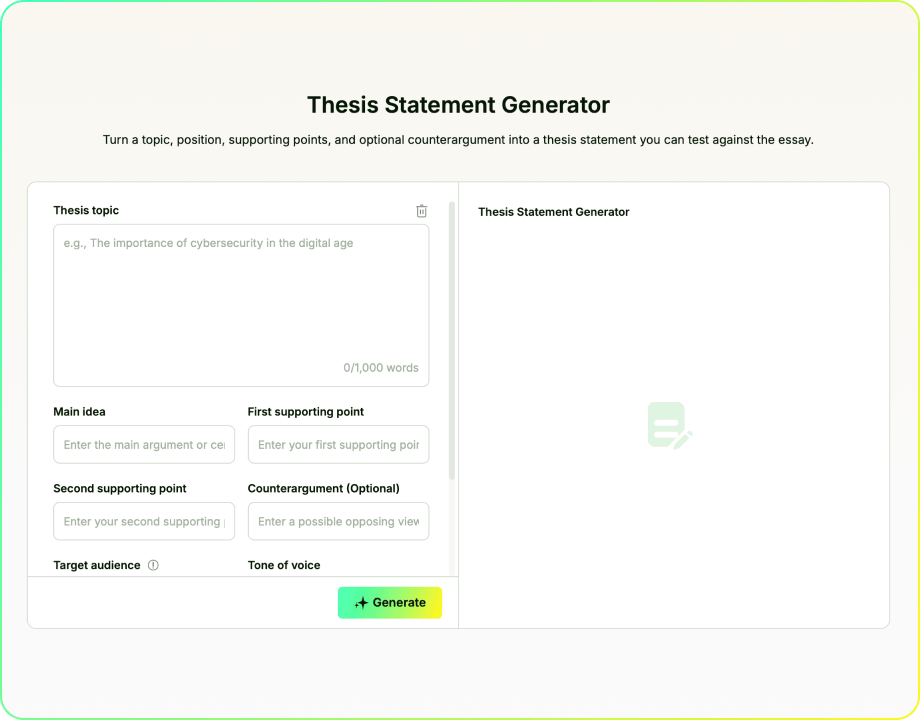
Turn a topic, position, supporting points, and optional counterargument into a thesis statement you can test against the essay.
Build Your Claim With EssayDone Thesis Statement Generator
To produce a usable claim, a thesis statement generator needs a focused question, a clear position, and reasoning the paper can support.
Step 1: State the disagreement. Define the topic, the question at stake, and the position the thesis statement generator should help you express.
Step 2: Expose the supporting logic. Add the strongest reasons and any meaningful counterargument so the thesis statement generator can reveal the claim's structure and limits.
Step 3: Stress test the claim. Keep the thesis that is arguable, specific, and supportable, then revise it when the body develops a different or narrower conclusion.
More Than a Topic: Build the Claim, Logic, and Boundaries
A Claim With Edges
EssayDone Thesis Statement Generator helps separate the topic from the position the essay will defend. “AI in education” names a subject; a thesis must state what the writer believes, how the topic should be interpreted, or what the paper will argue.

Build the Logic Before You Draft
Add the first supporting point to identify one reason or line of analysis behind the claim.
Use the second supporting point when the argument needs another distinct reason; not every essay requires exactly two.
Add the optional counterargument to test a plausible objection, limitation, or alternative interpretation.
Keep only the points you can develop with relevant evidence and analysis in the body.

Match the Claim to Its Reader
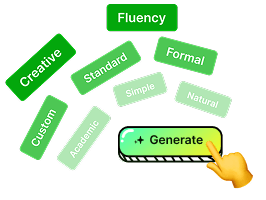
Target audience and tone settings help adjust how the thesis is expressed around your intended argument. Review the result afterward to confirm that its claim, scope, and level of certainty still match the position you plan to defend.
Define the Position
Make the claim specific enough to guide the body while leaving room for evidence, qualification, and revision.

Move From Topic to Claim
Turn a broad subject into a claim the essay can argue and support.

Test the Scope
Revise the thesis when the evidence reveals a narrower or more accurate argument.

For Argument-Based Papers
A broad topic becomes more workable when it is shaped into a claim the body can test, qualify, and support.

Develop a Working Thesis
Put a provisional thesis on the page so the body can reveal where the claim is too broad, weak, or incomplete.

Plan What the Body Must Prove
Identify the reasons, evidence, and qualifications the paper still needs.
From Topic to Thesis: Use the Question-Answer Test
A topic names the subject; a thesis answers a focused question about that subject. Turn the topic into a how, why, or should question, then answer it with a specific, arguable claim whose scope fits the assignment and available evidence.
What Changes a Topic Into a Thesis
- Ask an analytical question. How and why questions usually require interpretation, while should questions lead toward an evaluative or policy claim.
- Answer instead of announcing. “This essay will discuss...” names a task; a thesis states the conclusion the essay will defend.
- Narrow the scope. Specify the text, population, context, relationship, period, or condition the paper can realistically examine.
- Show the logic. Indicate the reason, mechanism, comparison, or tension behind the claim without cramming every body point into one sentence.
- Match the assignment. Analytical, argumentative, persuasive, compare-and-contrast, and expository papers may require different kinds of claims.
- Example—Topic: AI feedback in college writing. Weak: “AI feedback has advantages and disadvantages.” Stronger: “When used after a complete first draft, AI feedback can improve revision efficiency, but students still need explicit evaluation criteria to avoid accepting inaccurate or unnecessary changes.”

Can the Body Actually Prove Your Thesis?
A thesis statement is a promise about the argument the paper will deliver. It needs a claim, a workable scope, and a visible line of support. The two supporting-point fields in the tool are planning aids, not a rule that every essay must have exactly two reasons; the optional counterargument is useful only when it represents a reasonable challenge.
The Anatomy of a Defensible Thesis

Position or Interpretation
State clearly the answer, judgment, or interpretation the essay will defend.

Scope and Conditions
Define the population, text, context, period, or limits covered by the claim.

Supporting Logic
Name the reason, relationship, or mechanism that makes the position defensible.

Evidence Path
Confirm that every part of the thesis can be supported and analyzed in the body.

Qualification or Counterargument
Add a meaningful limit or alternative view when it makes the claim more accurate.
From Broad Position to Defensible Thesis
A thesis becomes defensible when its scope, reasoning, and qualifications tell the body exactly what it must establish.
- Broad position: “Universities should ban laptops in class.”
- Scope problem: Universities, classes, laptop use, and the reason for a ban are all left undefined.
- Narrowed setting: Focus on non-course laptop use in discussion-based first-year seminars.
- Necessary qualification: Preserve access for course activities and students who require devices for accessibility.
- Defensible revision: “In discussion-based first-year seminars, instructors should restrict non-course laptop use while allowing devices needed for accessibility and course activities.”
The revised thesis gives the essay a clear setting, position, and boundary. The body can now test the reasoning instead of trying to defend an unlimited claim.
One focused line of reasoning may be enough if it is fully developed and directly answers the prompt.
Use as many subclaims and pieces of evidence as the argument requires; do not force a two- or three-point formula.
Include one when a reasonable reader could challenge a central assumption, interpretation, or consequence.
Need Help With the Next Part?
Move to the next step with tools for drafting, rewriting, checking, summarizing, and research.
 Outline GeneratorOrganize a topic into a practical structure before drafting.
 Introduction GeneratorDraft an opening around the topic, purpose, audience, and direction.
 Essay CheckerReview grammar, spelling, clarity, and sentence issues.
 Thesis Statement GeneratorTurn a topic and position into a focused central claim.
 Hook CrafterCreate opening lines suited to different topics, audiences, and formats.
 Conclusion GeneratorCreate a closing section from the claims and points already developed.
 ParaphraserRewrite text with controlled wording changes while preserving meaning.
 Essay EnhancerImprove clarity, flow, tone, and organization in an existing draft while keeping its core meaning.

Explore by Category
Writing
Thesis Statement Generator FAQ
Provide the thesis topic and your main position, then add supporting points and an optional counterargument when they clarify the logic. Choose the intended audience and tone before generating, and test the result against the evidence you expect to use.
Look for a tool that accepts more than a broad topic. EssayDone Thesis Statement Generator uses a position, supporting logic, an optional counterargument, audience, and tone, giving you a claim that can be evaluated for scope, qualification, and evidence fit.
The free thesis statement generator lets you shape the claim with a position, supporting logic, audience, and tone. Keep only a thesis the body can support.
There is no fixed academic rule. A short response may develop one focused reason, while a longer essay may need several subclaims. Include only the logic readers need to understand the direction; detailed evidence belongs in the body.
Address a counterargument only when it sharpens, qualifies, or strengthens the claim. Do not force an opposing view into the thesis when it adds no useful precision.
Use it to compare wording for a position you already understand, not to outsource the position itself. The final thesis and the evidence behind it must remain your own work.
In many academic essays, the thesis appears near the end of the introduction after readers receive enough context to understand the issue. Placement varies by discipline and assignment, but the claim should appear early enough to guide the paper.
Yes. Use the language menu to generate the claim in the language required by the assignment or audience. Check that the translated thesis remains specific, arguable, and supported rather than becoming broader or more absolute.
The topic, position, and supporting points remain yours. EssayDone excludes this material from model training by default and gives you control over deleting any saved thesis generation history.
🔗 References
Thesis-writing resources define the qualities an AI thesis statement generator must help surface—an arguable position, workable scope, supporting logic, and appropriate qualification.

- Harvard College Writing Center|Thesis in Academic Writing
- University of Toronto Writing Advice|Using Thesis Statements
- UMGC Effective Writing Center|Designing an Effective Thesis
- UW-Madison Writing Center|Thesis and Purpose Statements
- Purdue Online Writing Lab|Tips and Examples for Writing Thesis Statements