
 ZeroGPT
 GPTZero
 QuillBot
 Grammarly
 Copyleaks
 Scribbr
 Originality.ai
 Isgen.ai
 SciSpace
 Sapling
 Winston AI
 Undetectable AI
 Smodin
 Writer
 JustDone
 Phrasly
 Brandwell
 Crossplag
 DeCopy AI
 NoteGPT
 Surfer
 SurgeGraph
 AI Detector
 Walter Writes AI
 Grubby AI
 Merlin
 Monica
 Stealthwriter
 Humbot
 Rewritify
 YouScan
 AI-Detector
 RyRob
RyRob Turnitin
 Pangram
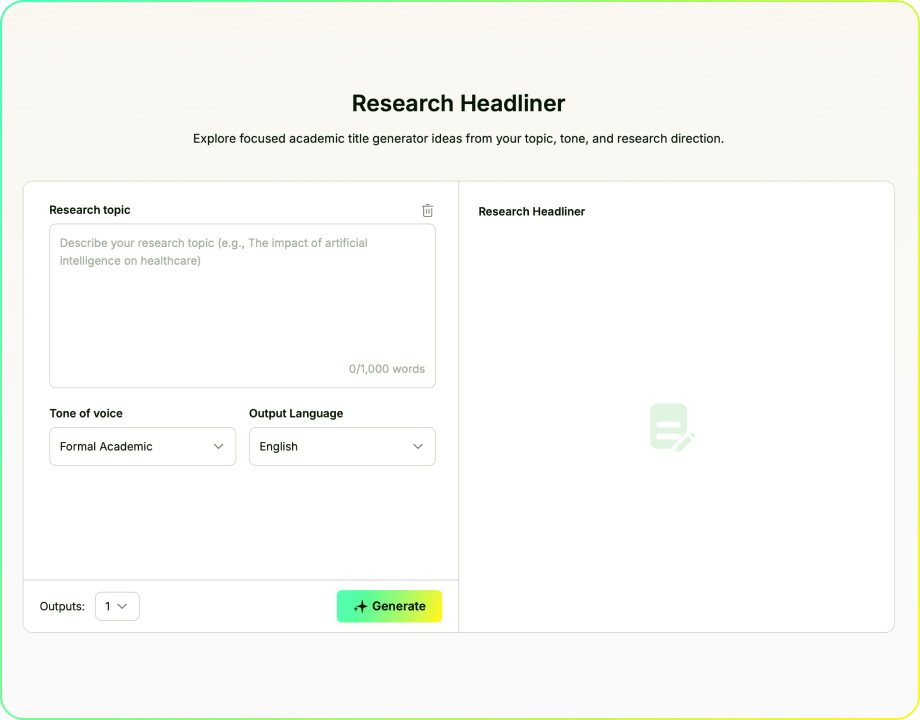
Research Headliner
Explore focused academic title generator ideas from your topic, tone, and research direction.
Find Research Title Angles With EssayDone Research Headliner
Used carefully, an academic title generator can frame the study for the right reader without claiming findings the project has not established.
Step 1: Surface the research angle. Describe the problem or question and include known scope details such as population, setting, text, relationship, method, or outcome.
Step 2: Decide what the title should foreground. Set tone, language, and output count, then compare titles centered on the topic, method, question, or contribution.
Step 3: Match the title to the study stage. Use provisional wording for unfinished work and revise the final title once the method, evidence, and contribution are stable.
Research Titles That Reflect the Study You Can Support
A Title That Signals the Research
A research title is a framing decision, not decoration. EssayDone Research Headliner, an academic title generator, helps compare which subject, relationship, method, scope, population, or contribution the finished title should foreground.
Turn One Topic Into Several Research Angles
Enter a focused topic rather than a few disconnected academic keywords.
Use the research title generator to compare topic-led, relationship-led, method-led, and contribution-led directions.
Treat each option as a possible framing decision, not only a different wording of the same title.
Unlike a random academic title generator, the result becomes useful only when you check it against the study you can actually complete and support.

Supports Different Academic Formats
Use it as an academic article title generator for manuscripts, an academic paper title generator for coursework, a research paper title generator for studies, or a thesis title generator for longer projects. In every case, revise the final wording to match the work's actual method, scope, evidence, and disciplinary conventions.
Explore More Than One Research Angle
Compare several research framings to see whether the title should foreground the problem, method, population, relationship, or contribution.

Research Angles From One Topic
Use the academic title generator to surface possible subjects, relationships, methods, populations, and research angles hidden inside a broad topic.

Titles That Evolve With the Research
Compare generated options, combine useful elements, remove vague wording, and update the title as the research direction develops.

Papers, Theses, and Proposals
Known research directions can be translated into titles that reveal method, scope, population, or contribution.

Focused Title Exploration
Compare distinct title directions before one framing becomes difficult to change later in the project.

Research Framing
Use the title options to see whether the project is primarily about a problem, relationship, comparison, method, population, or contribution.
How to Find Research Title Ideas When You Are Stuck
Getting stuck on a title often starts when you try to perfect the wording before deciding what the title should foreground. Build several candidates from the paper's actual components, then compare the research promise made by each one.
Use One Topic to Test Six Title Angles
- Topic and scope—name the central concepts and the population or context: “Nighttime Social Media Use and Sleep Quality Among First-Year College Students.”
- Research question—use a question when the unresolved relationship is the paper's central focus: “Is Nighttime Social Media Use Associated With Poorer Sleep Among First-Year College Students?”
- Method-led—add the design when it helps readers judge relevance: “Nighttime Social Media Use and Sleep Quality Among First-Year College Students: A Cross-Sectional Survey.”
- Comparison-led—foreground the groups or conditions being compared: “Nighttime Social Media Use and Sleep Quality in Residential and Commuter College Students.”
- Result-led—state the finding only after the evidence supports it: “Nighttime Social Media Use Is Associated With Poorer Sleep Among First-Year College Students.”
- Creative compound—pair a memorable phrase with an informative subtitle: “Scrolling Past Midnight: Nighttime Social Media Use and Sleep Quality Among First-Year College Students.”

Should the Title Describe the Topic, Method, or Finding?
There is no single best academic title form. Descriptive, method-led, question, result-led, and compound titles make different promises to readers. An academic title generator can provide options, but the assignment type, research stage, evidence, and disciplinary conventions determine which promise is appropriate.
The Title-Paper Fit Map

Core Subject
Name the central concept, text, problem, case, or relationship the title must signal.

Scope Signal
Add the population, setting, period, dataset, or condition that defines the paper's limits.

Research Action
Show whether the paper analyzes, compares, evaluates, reviews, tests, or argues.

Evidence Status
Use a result-led title only when completed evidence supports its level of certainty.

Assignment and Field Fit
Compare titles with recent work in the field, then follow the assignment or journal rules.
Choose the Title Form That Matches the Paper
The strongest title form depends on what readers need to know before reading the paper. Do not choose a structure only because it sounds more impressive or academic.
- Use a descriptive title when the subject and scope matter more than announcing a result. This is often the safest choice for proposals, early research plans, literature reviews, and student papers.
- Include the method when terms such as case study, systematic review, survey, textual analysis, or comparative analysis help readers understand what kind of work the paper presents.
- Use a result-led title only for a completed paper whose evidence supports the stated finding. A proposal or unfinished study should not announce a conclusion it has not yet established.
- Use a question or creative compound title when it suits the assignment, but keep the research subject clear—often by adding an informative subtitle after the memorable phrase.
- Do not follow a universal title-length rule. Keep words that improve accuracy, scope, or discoverability, and remove wording that merely makes the title sound formal.
A strong title does not need to contain every detail. It should identify the paper's most important direction, set accurate expectations, and avoid promising anything the finished work does not support.
Treat a thesis title generator result as a working title until the research question, scope, and evidence become stable.
Match the title to the paper; remove any method, population, or finding it does not cover.
Compare your title with recent work in your department, then follow program requirements.
Need Help With the Next Part?
Move to the next step with tools for drafting, rewriting, checking, summarizing, and research.
 Outline GeneratorOrganize a topic into a practical structure before drafting.
 Introduction GeneratorDraft an opening around the topic, purpose, audience, and direction.
 Essay CheckerReview grammar, spelling, clarity, and sentence issues.
 Thesis Statement GeneratorTurn a topic and position into a focused central claim.
 Hook CrafterCreate opening lines suited to different topics, audiences, and formats.
 Conclusion GeneratorCreate a closing section from the claims and points already developed.
 ParaphraserRewrite text with controlled wording changes while preserving meaning.
 Essay EnhancerImprove clarity, flow, tone, and organization in an existing draft while keeping its core meaning.

Explore by Category
Writing
Research Headliner FAQ
It generates several research title directions that can foreground the subject, relationship, population, method, setting, or contribution. Compare those angles to narrow the project; do not let the first fluent title define a question the research has not settled.
Choose the number of outputs before generating. Each option uses the same research focus, but the wording may foreground a different subject, relationship, method, population, scope, or contribution. Compare the directions rather than choosing only by phrasing.
There is no charge to generate research title options. Compare how each title frames the topic, scope, method, or contribution before choosing one.
Yes. Use a descriptive, question-led, or method-led working title that reflects the study you plan to conduct. Do not use a result-led title until the analysis is complete and the evidence supports the finding.
Yes. Choose the target language and compare several title directions. Discipline-specific terminology, capitalization, punctuation, and the expected level of detail can differ by language and publication venue.
Include the method when it helps readers judge the evidence or distinguish the study—for example, systematic review, case study, survey, experiment, or textual analysis. Leave it out when it adds clutter or the discipline does not expect it. EssayDone can surface both method-led and topic-led options.
There is no universal word count. Use the shortest title that still identifies the topic and necessary scope. Remove filler such as 'A Study of,' but keep the population, comparison, setting, or method when readers need it; then follow the target journal or course rules.
Follow the required style: some journals use sentence case, while others use title case. Preserve proper nouns, acronyms, species names, and technical symbols. EssayDone can propose the wording, but the final capitalization must match the publication or assignment.
Use it to brainstorm accurate title directions for research you actually conducted. Do not imply a method, population, or result that the finished work does not contain.
🔗 References
Research-title guidance from journals and writing resources shows what an academic title generator should balance: clarity, specificity, keywords, scope, and disciplinary expectations.

- Nature Index|How to Write a Good Research Paper Title
- PubMed Central (PMC)|Writing the Title and Abstract for a Research Paper: Being Concise, Precise, and Meticulous Is the Key
- Wordvice Blog|How to Choose a Research Paper Title with Examples
- Taylor & Francis Author Services|Using Keywords to Write Your Title and Abstract
- Impactio Blog|Understanding the Good, Bad, and Ugly of Research Titles