
 ZeroGPT
 GPTZero
 QuillBot
 Grammarly
 Copyleaks
 Scribbr
 Originality.ai
 Isgen.ai
 SciSpace
 Sapling
 Winston AI
 Undetectable AI
 Smodin
 Writer
 JustDone
 Phrasly
 Brandwell
 Crossplag
 DeCopy AI
 NoteGPT
 Surfer
 SurgeGraph
 AI Detector
 Walter Writes AI
 Merlin
 Monica
 Stealthwriter
 Humbot
 Rewritify
 YouScan
 AI-Detector
 RyRob
RyRob Turnitin
 Pangram
Sentence Expander
Turn a short sentence into a fuller, clearer version with goal, tone, and meaning controls.
Develop Ideas With EssayDone Sentence Expander
A sentence expander should resolve a specific reader question without burying the original claim under filler.
Step 1: Name the missing relationship. Give the sentence expander the sentence and context, then identify whether it needs a reason, example, condition, contrast, consequence, or qualification.
Step 2: Control the kind of expansion. Set the sentence expander goal, level, tone, language, meaning control, and number of versions according to what the sentence must accomplish.
Step 3: Keep only necessary detail. Choose the version that resolves the reader's question while preserving the original subject, scope, certainty, and tone.
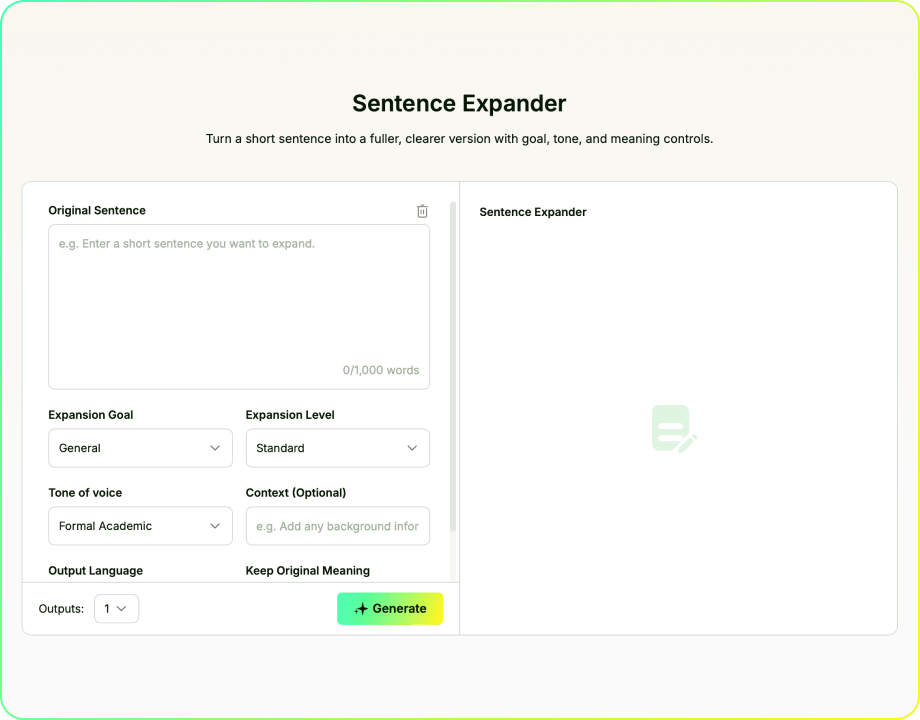
Expand a Sentence With Control Over Purpose, Detail, and Meaning
More Detail Around the Same Claim
EssayDone Sentence Expander helps develop a sentence that already contains a useful idea but still leaves the reader with a question. It can add explanation, context, an example, a qualification, or a clearer logical connection while keeping the original point visible.
Controls Why and How the Sentence Grows
Enter the original sentence and add optional context from the surrounding paragraph or writing situation.
Choose an expansion goal such as explanation, reason, example, detail, qualification, or connection.
Set the expansion level, tone, output language, and meaning control according to the writing task.
Generate multiple outputs so you can compare how each version develops the same idea.

Keeps Expanded Options Reviewable
Compare several outputs from the sentence expander generator before choosing one. Check whether each version preserves the original subject, claim direction, scope, certainty, and tone, then remove any wording that adds length without adding information.
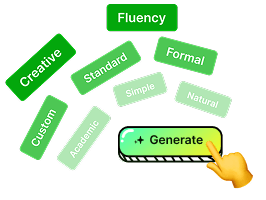
Choose Why the Sentence Grows
Name the missing question—why, how, under what condition, or with what example—so the sentence grows for a reason.

Give the Tool the Missing Context
Optional background helps the added information fit the paragraph, audience, and situation.

Control the Size of the Change
Light, standard, and detailed levels match the expansion to the actual gap.

Compare Versions Without Losing the Point
A useful sentence that still leaves a reader question can be developed without changing its claim, certainty, or tone.

Develop Ideas Across Writing Tasks
Develop a sentence for the actual writing task—essay, report, application, email, instruction, or discussion—without adding a second claim.

Stop When the Reader Has Enough
Keep only detail that improves understanding without adding a second claim or unsupported content.
How to Expand a Sentence Without Adding Filler
A sentence expander should add useful development, not just more words. When you need to expand a sentence, first identify what the reader is missing: a reason, example, definition, qualification, consequence, or connection.
What a Good Sentence Extender Should Add
- Reason or explanation: Add why the claim is true or why it matters when that information is already supported by your context.
- Concrete detail: Add a specific example, condition, action, or observation instead of repeating the same idea in longer wording.
- Qualification: A sentence lengthener can improve accuracy by adding limits such as time, group, condition, or degree.
- Logical connection: Show whether the added information explains cause, contrast, sequence, consequence, or significance.
- Keep the core meaning stable: Do not change the original subject, claim direction, certainty, scope, or causal relationship just to make the sentence longer.
- Example—“The policy affected attendance” can become “The policy affected attendance by adding an extra check-in before class,” but only when that detail is supported by the supplied context. If the task is simply “expand this sentence,” stop once the missing reader question is answered.
Expand This Sentence: Add One Missing Piece at a Time
An AI sentence expander is most useful when the core idea is already clear but the reader still needs one more piece of information. Expand the sentence by answering one specific question, then stop before the added detail turns into filler or a second independent claim.
The Add-One-Thing Method

Step 1: Lock the Core Claim
Keep the original subject, action, scope, time, certainty, and causal relationship unchanged.

Step 2: Choose the Missing Reader Question
Ask what the reader still needs: Why? How? Under what condition? For example? With what result? Why does it matter?

Step 3: Add Supported Detail
Use information you already have. A sentence extender should not invent facts, statistics, citations, or examples just to make the sentence longer.

Step 4: Check for Semantic Drift
Compare the expanded version with the original for stronger claims, broader scope, changed causality, or altered tone.

Step 5: Stop or Split
If the expansion introduces a second claim that needs its own evidence or explanation, start a new sentence instead of forcing everything into one long line.
Worked Example: Expand Sentence
Original: “Remote work can reduce commuting time.”
- Useful expansion: “Remote work can reduce commuting time for employees who would otherwise travel to a central workplace several days a week.”
- The added detail clarifies who the claim applies to without inventing a statistic or changing the original meaning.
- If the sentence already contains enough information but sounds awkward, use a rephraser instead. If you need several supporting ideas or a full body paragraph, move to paragraph-level drafting.
- Yes—if the idea genuinely needs separate explanation or evidence. Do not force two additional sentences when one precise expansion answers the reader’s question.
- Logical connection: Show whether the information expresses cause, contrast, sequence, consequence, example, or significance in relation to the claim.
Stop expanding when the reader can follow the claim and its support without an additional reader question.
identify the missing information before generating anything.
keep only details that clarify, support, qualify, or connect the original idea.
longer is useful only when the reader understands more.
Need Help With the Next Part?
Move to the next step with tools for drafting, rewriting, checking, summarizing, and research.
 Outline GeneratorOrganize a topic into a practical structure before drafting.
 Introduction GeneratorDraft an opening around the topic, purpose, audience, and direction.
 Essay CheckerReview grammar, spelling, clarity, and sentence issues.
 Thesis Statement GeneratorTurn a topic and position into a focused central claim.
 Hook CrafterCreate opening lines suited to different topics, audiences, and formats.
 Conclusion GeneratorCreate a closing section from the claims and points already developed.
 ParaphraserRewrite text with controlled wording changes while preserving meaning.
 Essay EnhancerImprove clarity, flow, tone, and organization in an existing draft while keeping its core meaning.

Explore by Category
Writing
Sentence Expander FAQ
It combines the original sentence with any optional context, then applies the selected goal, expansion level, tone, language, meaning control, and output count.
EssayDone Sentence Expander is free to use. Choose the reader question the sentence should answer, and stop expanding once the added detail resolves that question.
Expand only the relationship the reader is missing—a reason, example, condition, contrast, consequence, or qualification. Keep the original claim at the center, then remove repetition, filler, and any detail that does not answer a real reader question.
Add context when the sentence depends on a previous claim, technical definition, audience, situation, or evidence that is not visible in the sentence itself. Leave it blank when the sentence already stands on its own.
Split the result when the added explanation creates two independent ideas, too many clauses, or an unclear main point. Keep one sentence only when the relationships remain easy to follow.
Yes. Choose the language that matches the sentence or the required output. When the language changes, compare names, technical terms, tone, conditions, and meaning before keeping the expanded version.
No. The setting guides the expansion, but every output still needs comparison with the original for subject, scope, causality, negation, conditions, and certainty.
Use it to develop a sentence you wrote when AI-assisted revision is allowed. Remove invented facts or experiences and keep the final wording under your control.
Use Sentence Expander when one sentence needs focused development. Use Length Booster when a paragraph, section, or longer draft needs several connected additions rather than one expanded sentence.
🔗 References
Sentence-development, concision, action-verb, and transition guidance shows how an AI sentence expander can add explanation or context without burying the main claim in filler.

- UNC Writing Center|Writing Concisely
- UNC Writing Center|Transitions Between Ideas and Paragraphs
- George Mason University Writing Center|Cohesion and Coherence
- UW-Madison Writing Center|Put the Action in the Verb
- UW-Madison Writing Center|Connecting Ideas Through Transitions