
 ZeroGPT
 GPTZero
 QuillBot
 Grammarly
 Copyleaks
 Scribbr
 Originality.ai
 Isgen.ai
 SciSpace
 Sapling
 Winston AI
 Undetectable AI
 Smodin
 Writer
 JustDone
 Phrasly
 Brandwell
 Crossplag
 DeCopy AI
 NoteGPT
 Surfer
 SurgeGraph
 AI Detector
 Walter Writes AI
 Merlin
 Monica
 Stealthwriter
 Humbot
 Rewritify
 YouScan
 AI-Detector
 RyRob
RyRob Turnitin
 Pangram
Article Summarizer
Summarize an article into a clear, adjustable overview of its main argument, evidence, and key developments before deeper reading.
Summarize an Article With EssayDone Article Summarizer
Used well, an article summarizer provides a map of purpose, argument, evidence, and conclusion rather than replacing the original article.
Step 1: Preserve the article's structure. Give the article summarizer the full text or a supported file with the title, headings, conclusion, and key sections intact whenever possible.
Step 2: Generate for comparison. Set the output language and number of article summaries. Use multiple versions to notice changes in emphasis, not to vote on factual accuracy.
Step 3: Reconstruct the article map. Check purpose, central claim, major evidence, attribution, and conclusion against the source, and watch for extraction problems in uploaded files.
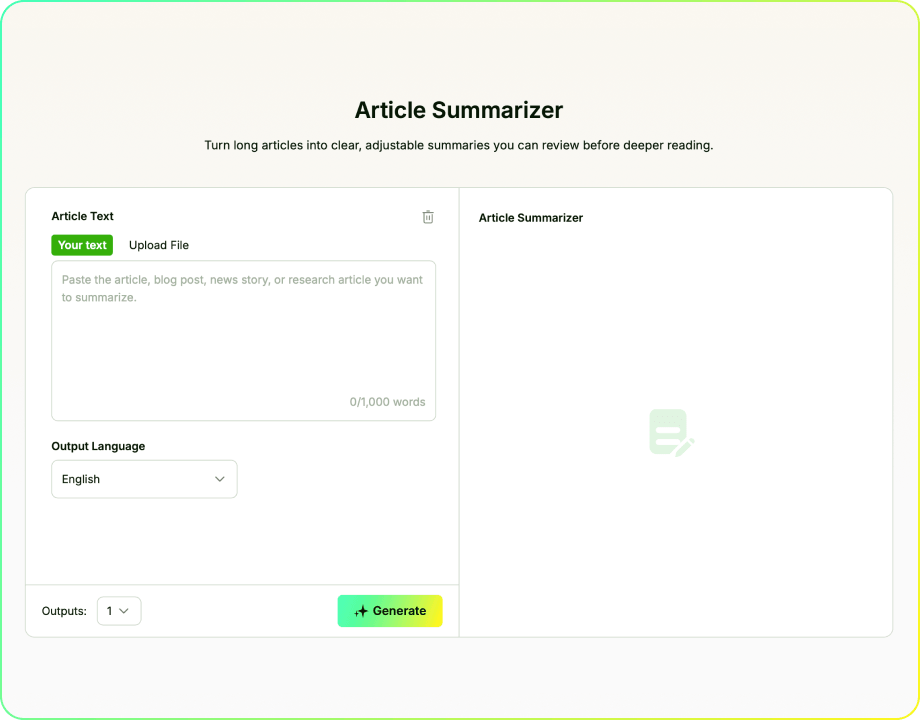
Article Summaries That Keep the Source in the Workflow
The Article's Main Line, Not Every Line
Articles organize information differently from one another. EssayDone Article Summarizer works with pasted text and supported files to identify the source's purpose, central point, major support, and conclusion rather than shortening every paragraph equally.
Read the Article Through More Than One Lens
The selected language determines how the article summary is presented.
Several versions can reveal which parts of the article receive the strongest emphasis.
Differences between versions are reasons to reopen the source, not proof that one is correct.
The title, body, and conclusion give every generated summary a stronger basis.

Keeps the Original Article in the Workflow
Use the generated summary as a map of the article, not as invisible evidence. It can help you locate the argument and decide which sections deserve closer attention, while quotations, statistics, research methods, and important qualifications should still be checked in the original source.
The Whole Article Sets the Context
Use the article's title, structure, evidence, and conclusion to separate the main argument from supporting background.

Article Purpose Changes What Matters
An AI article summarizer should treat news, opinion, research, and reviews according to their different aims.

Differences Become Verification Clues
When versions emphasize different points, return to the source and inspect the disputed sections.

Built for Varied Article Formats
News, opinion, reviews, reports, and research articles need summaries that reflect what each source is actually doing.

A Quicker Relevance Check
Map the article's main line before committing time to a full close read or detailed note-taking.

The Original Remains the Authority
Reopen it for quotations, statistics, attribution, methods, limitations, and consequential claims.
How to Summarize Different Types of Articles
A useful article summary should reflect what the source is trying to do. A news report, opinion piece, research paper, and review organize importance differently, so the same summary checklist will not work equally well for every article.
Match the Summary to the Article's Purpose
- For a news report, preserve what happened, who was involved, when it happened, which information is confirmed, who supplied each important claim, and what remains uncertain.
- For an opinion or argumentative article, identify the author's position, main reasons, supporting evidence, assumptions, and response to competing views. Do not present the author's judgment as an uncontested fact.
- For a research paper, retain the research question, method or sample, main findings, and stated limitations. A conclusion without method and scope can make the result sound broader than the study supports.
- For a review or critical analysis, include what is being evaluated, the criteria used, the writer's judgment, the evidence behind that judgment, and any important weaknesses or alternative interpretations.
- For an explainer or professional report, preserve its scope, key definitions, reasoning or causal chain, major evidence, and practical implications, including the conditions under which its conclusions apply.
- Weak summary: “The program improved attendance.” Better summary: “In a six-month pilot at two schools, attendance rose, but the article warns that the result may not apply to other districts.”

Verify an AI-Generated Article Summary Before You Trust It
An AI article summarizer can speed up first-pass reading, but a fluent summary may still omit evidence, blur attribution, or remove an important limitation. Use this practical review process to test whether the output represents the article rather than merely sounding plausible.
The Claim-Evidence-Context Check

Classify the Article
Identify whether the source is news, opinion, research, review, or explanation.

State the Core Claim
State what the author reports, argues, tests, or evaluates, then compare it with the summary.

Trace the Support
Find the source passage supporting each major summary claim.

Restore Context and Limits
Restore attribution, scope, time, population, uncertainty, exceptions, and limitations.

Set the Reading Depth
Use summaries for screening; reopen the article for evidence, methods, and consequential claims.
Why PDF Quality Can Change the Summary
A PDF can preserve how an article looks while storing its reading order imperfectly. An article summarizer can only represent content that was successfully extracted from the uploaded file, so formatting problems may become summary problems.
- Multi-column pages may be extracted in the wrong order, joining sentences from separate columns or separating ideas that originally belonged together.
- Headers, footers, page numbers, footnotes, references, and figure captions may be mixed into the article's main text and receive too much emphasis.
- Scanned or image-based PDFs may provide incomplete or inaccurate text, especially when pages are faint, skewed, handwritten, or use unusual fonts.
- Tables, charts, equations, and diagrams may lose the relationships between labels, values, rows, columns, and visual evidence when converted into plain text.
- Line breaks, hyphenated words, symbols, and special characters may be extracted incorrectly, changing technical terms, names, numerical statements, or sentence meaning.
Before relying on an article summary, compare it with the title or abstract, section headings, conclusion, and at least one evidence-heavy passage. If the uploaded PDF appears incomplete or scrambled, paste clean article text when available or return to the original document.
Verify who made each important claim and keep reported facts separate from the writer's interpretation.
With an AI paper summarizer, reopen the methods, results, tables, and limitations before relying on findings or statistics.
When versions emphasize different points, use the disagreement to locate sections that require closer reading.
Need Help With the Next Part?
Move to the next step with tools for drafting, rewriting, checking, summarizing, and research.
 Outline GeneratorOrganize a topic into a practical structure before drafting.
 Introduction GeneratorDraft an opening around the topic, purpose, audience, and direction.
 Essay CheckerReview grammar, spelling, clarity, and sentence issues.
 Thesis Statement GeneratorTurn a topic and position into a focused central claim.
 Hook CrafterCreate opening lines suited to different topics, audiences, and formats.
 Conclusion GeneratorCreate a closing section from the claims and points already developed.
 ParaphraserRewrite text with controlled wording changes while preserving meaning.
 Essay EnhancerImprove clarity, flow, tone, and organization in an existing draft while keeping its core meaning.

Explore by Category
Writing
Article Summarizer FAQ
Use the full article whenever possible, including its title, body, and conclusion. Complete input makes it easier to distinguish the central point from background and supporting detail.
Yes. The free article summarizer works without an account. Paste the article or upload a supported file, choose the output settings, and use the result to decide which sections deserve closer reading. Signing in helps you continue related research in the wider EssayDone workspace.
It can summarize news reports, essays, opinion pieces, blog posts, professional reports, explainers, reviews, and academic articles. The important information differs by type, so review attribution in news, reasoning in arguments, and methods and limitations in research papers.
A supported PDF can be uploaded instead of pasted manually. Review the summary closely when the file contains scans, columns, tables, charts, equations, footnotes, or complex formatting because the extracted reading order may be incomplete.
Grammarly's AI summarizing tool is a general-purpose AI summarizer that accepts pasted text or file uploads, offers tone and format controls, and connects with Grammarly's broader writing workflow. EssayDone's AI article summarizer is organized around article review: choose the output language and number of summaries, compare emphasis across versions, and verify the central claim, evidence, attribution, and conclusion against the source. Grammarly may suit users who want summarizing within a wider writing assistant, while EssayDone may suit users who want a dedicated article-reading and verification process.
Uploaded article text and files are not used to train AI models by default. EssayDone respects the privacy of your reading material, and any saved article summary record can be deleted from account history.
Yes, as a reading aid. A research article summarizer can map a paper's question, method, findings, and limitations, but the original paper remains necessary for citation, interpretation, and evaluation.
Cite the original article, not the generated summary, when its ideas or findings enter your work. Reopen the source to verify the relevant passage, quotation, statistic, method, or limitation, then record the author, publication details, and required page or section information.
Yes. Choose a supported output language even when it differs from the article. For example, an English source can be summarized in Spanish or Portuguese. Verify names, attribution, technical terms, conditions, and certainty against the original article.
🔗 References
Article-reading and factual-consistency research frames how an AI article summarizer should capture purpose, argument, evidence, structure, and conclusion while keeping the original article available for verification.

- Microsoft 365|What Is an AI Summarizer?
- ACL Anthology|Evaluating the Factual Consistency of Abstractive Text Summarization
- Adobe Acrobat|Reading Order Tool for PDFs
- The Associated Press|News Values and Principles: Telling the Story
- University of Toronto Writing Advice|How to Get the Most Out of Reading