
 ZeroGPT
 GPTZero
 QuillBot
 Grammarly
 Copyleaks
 Scribbr
 Originality.ai
 Isgen.ai
 SciSpace
 Sapling
 Winston AI
 Undetectable AI
 Smodin
 Writer
 JustDone
 Phrasly
 Brandwell
 Crossplag
 DeCopy AI
 NoteGPT
 Surfer
 SurgeGraph
 AI Detector
 Walter Writes AI
 Grubby AI
 Merlin
 Monica
 Stealthwriter
 Humbot
 Rewritify
 YouScan
 AI-Detector
 RyRob
RyRob Turnitin
 Pangram
Synonym Search
Find sharper wording with synonym search by comparing context, tone, and language fit.
Explore Better Word Choices With EssayDone Synonym Search
Good results from synonym search depend on sentence meaning, grammar, register, and collocation, not on dictionary similarity alone.
Step 1: Pin down the intended meaning. Enter the word or phrase inside a complete sentence when context, tone, or usage could change the best synonym.
Step 2: Compare usage, not just definitions. Run the synonym search engine in the relevant language and evaluate formality, connotation, grammar, and natural word combinations.
Step 3: Read the sentence aloud. Replace the word temporarily and keep only a synonym that preserves meaning while sounding natural in the full sentence.
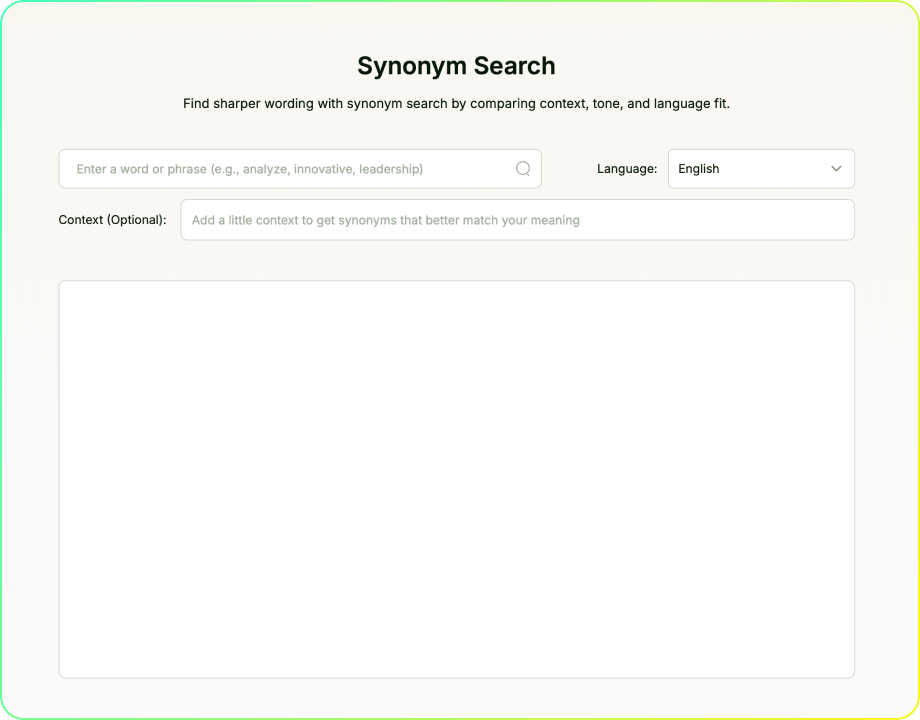
Synonyms Ranked by Sentence Fit, Not Definition Alone
Word Choice With Evidence
EssayDone Synonym Search helps writers look beyond the first word that appears in a thesaurus. By letting you enter a word or phrase with optional context, the synonym search engine can support choices that fit the sentence, audience, and intended meaning. This matters because synonyms can share a definition while carrying different tone, formality, or usage patterns.
Prioritizes Relevant Alternatives
Review vertically displayed results so relevant alternatives are easier to scan.
Users can compare options without sorting through a crowded thesaurus list.
Relevance prioritization supports clearer revision without mechanical word replacement.
The sentence context still decides which synonym belongs.

Works Across Languages and Contexts
Language selection gives EssayDone Synonym Search a practical role for students, multilingual writers, and professionals who need word choices in a specific language. A synonym generator can suggest options quickly, but context still matters: the right choice should keep the original meaning, match the sentence structure, and sound natural for the reader.
Context Before Replacement
Compare alternatives inside the sentence so tone, grammar, collocation, and meaning remain aligned.

Sentence Fit
Use context to compare meaning, grammar, tone, and natural usage.

Meaning Preserved
Reject replacements that alter certainty, emphasis, or the writer's point.

Writing Contexts
When a word is nearly right, sentence context helps expose problems with tone, collocation, or formality.

Beyond the Thesaurus
Move beyond a long thesaurus list by checking definitions, examples, collocations, register, and sentence fit together.

Language Choice
Search in English, Chinese, or Spanish and verify the result in context.
Synonym, Rephrase, or Keep the Original?
A repeated or imperfect word does not always need a synonym. First decide whether the real problem is imprecise vocabulary, repetitive sentence structure, redundant meaning, or a key term that should remain consistent.
Choose the Right Kind of Revision
- Diagnose the problem first. Ask whether the word is inaccurate, too informal, distractingly repetitive, or simply repeated because the idea itself appears more than once.
- Keep the original when it names the same concept, variable, method, group, or technical category throughout the paper. Consistent terminology helps readers track the argument.
- Use a synonym when the current word is vague or unsuitable and another word preserves the intended meaning, grammatical role, and level of certainty.
- Rephrase the sentence when repetition comes from its structure. Replacing each repeated noun with a different label can create artificial variation or imply distinctions that do not exist.
- Cut or combine content when the repeated word reflects a repeated idea. Vocabulary changes cannot fix a sentence that says the same thing twice.
- Example—Original: “The study examines feedback, and the study evaluates how the feedback affects revision.” Weak synonym swap: “The research examines feedback, and the investigation evaluates...” Better revision: “The study examines feedback and evaluates its effect on revision.”

Why Does a Correct Synonym Still Sound Wrong?
Dictionary similarity is only the first test. Near-synonyms can differ in grammatical pattern, collocation, register, strength, and the attitudes they commonly express. A reliable choice needs evidence from how the word is actually used, not only a shared definition.
The Usage Profile of a Reliable Synonym

Exact Sense
Confirm that the candidate expresses the precise action, quality, relationship, or concept needed.

Grammatical Pattern
Check whether the word takes the same object, preposition, form, or sentence structure.

Natural Collocation
Review whether the candidate commonly appears with the surrounding words and phrases.

Register and Stance
Match the word to the genre, formality, emotional tone, and level of certainty.

Discourse Consistency
Keep established terminology when a new label could suggest a different concept.
How to Check a Synonym Beyond the Thesaurus
A corpus is a searchable collection of real language. Combined with learner dictionaries, it shows how a word behaves across sentences, genres, and recurring combinations.
- Start with the intended sense. Read the full definition and usage examples rather than selecting a word because it appears beside the original in a synonym list.
- Search the word together with its surrounding phrase. A candidate may carry the right definition but require a different preposition, object, or grammatical construction.
- Compare register and genre. A word common in conversation, journalism, or creative writing may be unusual or overly dramatic in an academic paper.
- Check semantic prosody—the positive, negative, or neutral associations a word develops through its usual company. Near-synonyms may share a definition while expressing different attitudes.
- Test the strength of the claim. Prove, demonstrate, indicate, and suggest are not stylistic substitutes; they signal different levels of certainty and must match the evidence.
A trustworthy synonym is supported by meaning, grammar, collocation, register, and paragraph context. If the available evidence does not support the replacement, keeping the original word is the more precise choice.
Keep one term for the same variable, group, method, or defined concept unless the meaning genuinely changes.
Check examples in the selected language because direct translations may differ in register, grammar, and collocation.
If a synonym changes the structure, revise the whole phrase—not just one word.
Need Help With the Next Part?
Move to the next step with tools for drafting, rewriting, checking, summarizing, and research.
 Outline GeneratorOrganize a topic into a practical structure before drafting.
 Introduction GeneratorDraft an opening around the topic, purpose, audience, and direction.
 Essay CheckerReview grammar, spelling, clarity, and sentence issues.
 Thesis Statement GeneratorTurn a topic and position into a focused central claim.
 Hook CrafterCreate opening lines suited to different topics, audiences, and formats.
 Conclusion GeneratorCreate a closing section from the claims and points already developed.
 ParaphraserRewrite text with controlled wording changes while preserving meaning.
 Essay EnhancerImprove clarity, flow, tone, and organization in an existing draft while keeping its core meaning.

Explore by Category
Writing
Synonym Search FAQ
A single word or phrase is enough to begin, but adding the full sentence helps when meaning depends on context. Choose the language, then compare the results by definition, grammar, tone, collocation, and natural sentence fit.
A thesaurus often presents broad groups of related words. EssayDone Synonym Search lets you add sentence context and review relevant alternatives in the selected language. The synonym search engine provides candidates, but the sentence still determines which word belongs.
Search synonyms in context at no cost. When one-word replacement cannot solve the sentence problem, switch to a broader rewriting tool.
Use a replacement when the original word is vague, inaccurate, too informal, or distractingly repetitive. Do not change a clear technical term merely to sound more advanced, especially when another word would alter the meaning.
Keep repeated terms when they name the thesis, a variable, a group, a method, or another defined concept. Replace repetition only when it distracts the reader and the alternative preserves the same meaning.
Test each synonym generator result inside the full sentence. Compare connotation, certainty, formality, grammatical pattern, collocation, and the prepositions the word normally takes before choosing a replacement.
Yes. It can help refine wording in emails, reports, presentations, proposals, and other workplace documents. Choose the clearest word for the reader rather than the longest or most formal-looking option.
Yes. Select the language of the sentence and compare the suggested words in context. EssayDone provides multilingual synonym options, but the surrounding sentence should determine whether a word matches the intended meaning, register, grammar, and natural usage.
EssayDone respects the privacy of the word, phrase, and sentence context you submit. It is not used for AI model training by default. Where search history is saved, you can clear the record yourself.
🔗 References
Dictionary, corpus, diction, and collocation resources show why a synonym search engine must compare usage, grammar, register, and connotation instead of offering mechanical replacements.

- Cambridge Dictionary|Cambridge Thesaurus
- Merriam-Webster|Thesaurus Definition and Meaning
- Purdue Online Writing Lab|Diction: Choosing Words for Your Audience
- English-Corpora.org|Using Corpora for Language Learning and Teaching
- Sketch Engine|Word Sketch Difference: Compare Words via Collocations