
 ZeroGPT
 GPTZero
 QuillBot
 Grammarly
 Copyleaks
 Scribbr
 Originality.ai
 Isgen.ai
 SciSpace
 Sapling
 Winston AI
 Undetectable AI
 Smodin
 Writer
 JustDone
 Phrasly
 Brandwell
 Crossplag
 DeCopy AI
 NoteGPT
 Surfer
 SurgeGraph
 AI Detector
 Walter Writes AI
 Merlin
 Monica
 Stealthwriter
 Humbot
 Rewritify
 YouScan
 AI-Detector
 RyRob
RyRob Turnitin
 Pangram
Essay Enhancer
Use an AI essay enhancer to strengthen clarity, flow, tone, and organization in an existing draft without losing its core meaning.
Improve a Draft With EssayDone Essay Enhancer
An essay improver is most useful when you want to enhance an essay or draft by strengthening argument flow, clarity, development, and reader fit while keeping the writer's evidence and voice intact.
Step 1: Give the tool the whole argument. Use the complete draft so EssayDone Essay Enhancer can account for relationships between claims, paragraphs, evidence, and the conclusion.
Step 2: Define the intended reader. Set audience, tone, and language according to the actual writing situation, not simply the most formal option.
Step 3: Keep changes that solve a problem. Compare the enhanced draft with the original and retain only changes that improve clarity, organization, development, or reader guidance.
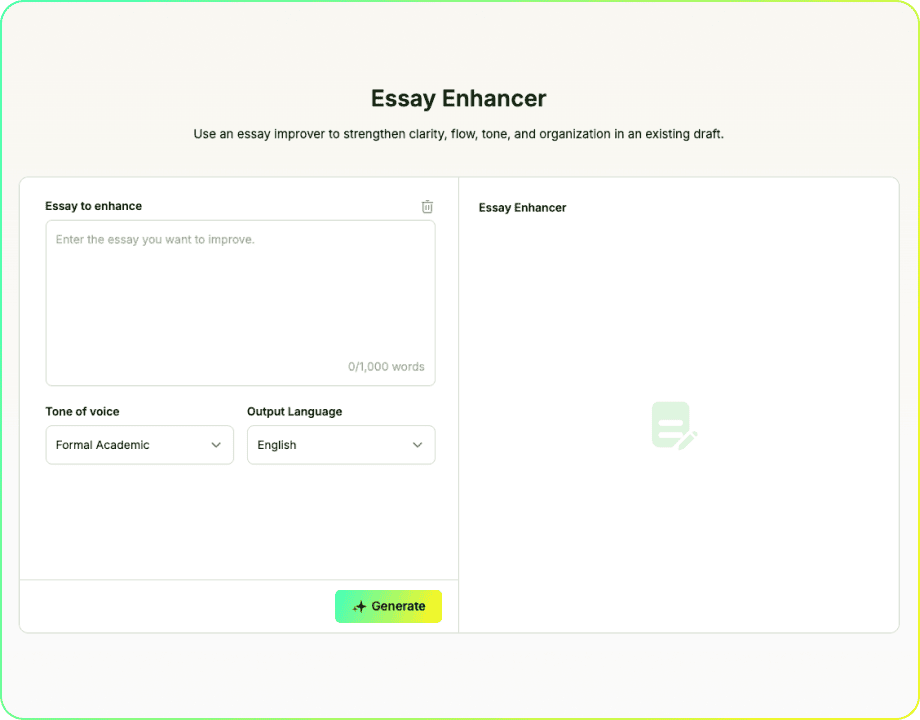
Improve Clarity, Flow, and Development Across the Whole Draft

Revision Across the Whole Essay
EssayDone Essay Enhancer works from an existing essay rather than generating a new argument from a topic. As an essay improver, it can help strengthen clarity, paragraph flow, organization, development, and tone while keeping the draft's original purpose visible.

Improves the Draft You Already Have
Compare the enhanced version with the original instead of assuming that every change is an improvement.
Check whether revised paragraphs make the central claim and supporting logic easier to follow.
Keep additions that develop evidence or explanation, and remove changes that introduce repetition or unsupported ideas.
Restore specific wording, qualifications, or personal details when the enhanced draft becomes too general.

Adapts Revision to the Reader
The AI essay editor workflow uses target audience, tone of voice, and output language to shape how the revised essay communicates. These controls can make a draft more formal, direct, accessible, or reader-aware without requiring the tool to invent a new thesis or research direction.
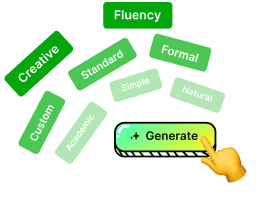
Set the Revision Direction
Choose the revision priority—clarity, organization, development, flow, or audience fit—before comparing the new draft.
Whole-Draft Revision Signals
An AI essay improver can reveal unclear wording, weak transitions, uneven paragraph development, and organizational problems across the draft.

A Stronger Base for Proofreading
Use the enhanced version to refine paragraph order, restore important details, and prepare the essay for final fact-checking and proofreading.

Student and Professional Revision
Uneven, underdeveloped, repetitive, or difficult-to-follow drafts benefit most from whole-draft revision.

A Stronger Revision Starting Point
Begin revision from a stronger draft, then spend attention on argument, evidence, accuracy, organization, and voice.

Revision Priorities
See whether the draft most needs stronger development, better organization, clearer explanations, smoother transitions, or closer audience alignment.
Why Good Essays Need More Than Grammar Corrections
A grammatically clean sentence does not automatically create a strong essay. Deeper revision checks whether the paper fulfills its purpose, develops its claims, uses evidence effectively, and leads readers through the argument in a logical order.
Four Moves That Improve Essay Writing
- Add when readers are missing something necessary: a precise claim, essential context, relevant evidence, explanation, qualification, counterargument, or connection to the thesis.
- Cut when material repeats an existing point, summarizes more background than readers need, introduces evidence the essay never analyzes, or uses polished language without advancing the argument.
- Move when useful material appears in the wrong place. Put definitions before readers need them, evidence beside the claim it supports, and implications after the paper has established the reasoning behind them.
- Clarify when a sentence contains an ambiguous reference, an abstract claim, an overloaded structure, or a relationship between ideas that the reader has to infer.
- Do not use word count as the improvement score. A stronger draft may become longer after adding missing analysis or shorter after removing repetition; the test is whether each change performs necessary writing work.
- Example—Original: “The narrator changes throughout the story.” Polished but not developed: “The narrator undergoes a considerable transformation across the narrative.” Developed: “The narrator's shift from certainty to hesitation makes his account less reliable as the conflict intensifies.”

What AI Feedback Reveals About a Draft
Writers know the ideas and connections they intended, so they can miss what never reached the page. An essay improver can offer another version, but different wording is not automatically better. Compare drafts to identify specific reader problems and useful revision techniques rather than accepting a full rewrite.
The Model-Draft Comparison Map

Choose a Comparable Model
Choose a strong model that answers a similar assignment in the same field.

Reverse-Outline Its Structure
Label each paragraph's function: context, claim, evidence, analysis, qualification, or significance.

Isolate the Technique
Identify how the model narrows claims, introduces evidence, connects analysis, and guides readers.

Adapt the Function
Apply the same function to your evidence without copying wording or ideas.

Test the Transfer
Check that the technique fits the assignment and still sounds like your essay.
How to Know When the Essay Is Improved Enough
An essay is finished when another revision pass is unlikely to improve assignment fit, argument, evidence, organization, clarity, or reader understanding.
- Check the assignment and rubric first. Stop adding material when the essay has answered every required part at an appropriate depth.
- Confirm that the thesis, body paragraphs, and conclusion make the same central argument and that every major paragraph performs a necessary role.
- Make sure essential evidence is introduced, interpreted, and connected to the claim rather than merely inserted into the draft.
- Test the reader path. A new reader should be able to identify the main claim, follow the order of ideas, and recognize why each example or source appears.
- Compare the latest version with the previous one. When new changes only exchange one acceptable phrase for another, undo earlier improvements, or cannot be linked to a clear revision goal, save the stronger version and move to proofreading.
Revision has reached diminishing returns when you can no longer explain what problem the next change will solve. Keep the version that best fulfills the assignment and communicates the argument, rather than chasing a theoretically perfect sentence.
Focus on one or two revision goals, such as organization or evidence, at a time.
Imitate the way a strong paper performs a writing task, not its sentences, examples, argument, or distinctive voice.
Save separate versions and stop revising when the latest changes no longer create a clear improvement.
Need Help With the Next Part?
Move to the next step with tools for drafting, rewriting, checking, summarizing, and research.
 Outline GeneratorOrganize a topic into a practical structure before drafting.
 Introduction GeneratorDraft an opening around the topic, purpose, audience, and direction.
 Essay CheckerReview grammar, spelling, clarity, and sentence issues.
 Thesis Statement GeneratorTurn a topic and position into a focused central claim.
 Hook CrafterCreate opening lines suited to different topics, audiences, and formats.
 Conclusion GeneratorCreate a closing section from the claims and points already developed.
 ParaphraserRewrite text with controlled wording changes while preserving meaning.
 Essay EnhancerImprove clarity, flow, tone, and organization in an existing draft while keeping its core meaning.

Explore by Category
Writing
Essay Enhancer FAQ
It can enhance a draft by revising clarity, development, organization, flow, tone, and audience fit across an existing essay. Compare the new version with the original and reject any unsupported claim or evidence.
A grammar checker mainly targets sentence-level correctness, while an essay rewriter may replace wording across a passage. An AI essay improver supports broader revision by helping you compare clarity, organization, development, flow, tone, and audience fit.
No. You can improve a draft for free without an account. The tool is designed for serious academic revision, not a cosmetic rewrite: compare argument flow, paragraph purpose, clarity, and reader guidance before keeping a change. Signing in gives you access to the wider EssayDone workspace.
Yes. You can paste a paragraph or section when that is the part you want to revise. A complete essay gives the tool more context for organization and consistency, so include surrounding material when those relationships matter.
It may revise wording or introduce possible additions, so treat the output as a proposal rather than verified content. Reject any claim, example, or evidence that is unsupported, inaccurate, or inconsistent with the essay's argument.
Choose the intended audience and tone of voice before generating. Then check whether the new wording is consistently formal, direct, accessible, or persuasive without becoming vague, inflated, or unlike the rest of the essay.
Use it for revision when the assignment permits AI assistance. Compare substantive changes with your draft and remove any new claim, example, or evidence you cannot verify.
Yes. Select the draft language before revising. EssayDone provides revision options in supported languages, but you should still check academic tone, structure, specialist terms, quotations, and culturally specific phrasing.
EssayDone respects the privacy of the source draft and does not use it for model training by default. Any saved enhancement session remains under your control and can be cleared from history.
🔗 References
Revision, reverse-outline, and drafting resources identify the areas an AI essay improver can support—clarity, organization, paragraph development, transitions, and audience awareness—without replacing the writer's argument.

- George Mason University Writing Center|23 Ways to Improve Your Draft
- UW-Madison Writing Across the Curriculum|Using a Reverse Outline to Revise
- UC Berkeley Writing Across the Humanities|Drafting, Revising, and Editing
- Taylor & Francis Author Services|What Makes a Good Research Paper?
- University of Waterloo Writing and Communication Centre|Writing Process: Revision