
 ZeroGPT
 GPTZero
 QuillBot
 Grammarly
 Copyleaks
 Scribbr
 Originality.ai
 Isgen.ai
 SciSpace
 Sapling
 Winston AI
 Undetectable AI
 Smodin
 Writer
 JustDone
 Phrasly
 Brandwell
 Crossplag
 DeCopy AI
 NoteGPT
 Surfer
 SurgeGraph
 AI Detector
 Walter Writes AI
 Grubby AI
 Merlin
 Monica
 Stealthwriter
 Humbot
 Rewritify
 YouScan
 AI-Detector
 RyRob
RyRob Turnitin
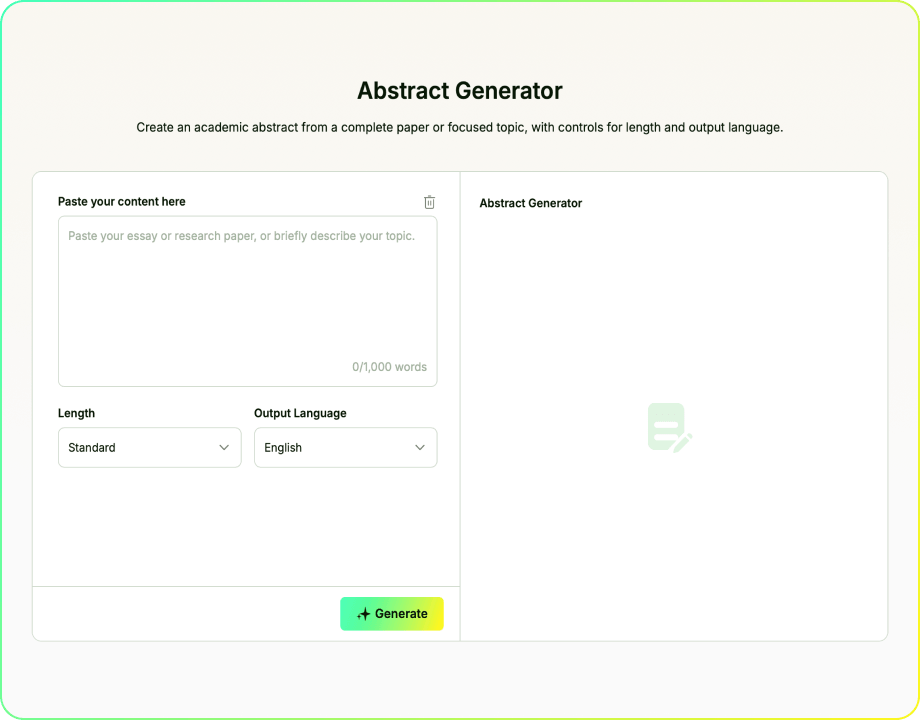
Abstract Generator
Create an academic abstract from a complete paper or focused topic, with controls for length and output language.
Draft an Academic Abstract With EssayDone Abstract Generator
An abstract generator should capture the paper's purpose, approach, main result, and conclusion within a strict word limit.
Step 1: Start from the full paper. Use the completed paper whenever possible so the abstract reflects evidence actually present. For an early draft, provide a focused topic description and label the result as provisional.
Step 2: Match the submission rules. Set the abstract length and language from the journal, course, or conference requirements rather than choosing a generic size.
Step 3: Audit every claim. Compare the abstract with the paper's purpose, approach, findings, and conclusion. Remove unsupported claims, restore omitted results, and preserve the original certainty.
From Full Paper to Abstract: More Context, More Control
A Compact Map of the Study
An academic abstract has to compress the study without misrepresenting it. EssayDone Abstract Generator turns a complete paper or focused topic into a compact draft that can be reviewed for purpose, approach, findings, conclusion, scope, and terminology.
Works From a Paper or Topic
Start with a completed paper when the abstract needs to reflect the full text.
Enter a focused topic when you need an early working draft before the paper is finished.
Use the full-paper route for stronger source alignment and the topic route for early planning.
Return with the finished paper later to refine the abstract against the final argument and evidence.
Control Length and Language
Set the abstract length and output language before generation. These controls guide the amount of detail and intended readership, but the result still needs to be checked against the source paper for meaning, scope, and terminology.
Set the Abstract's Scope
Choose whether the draft should represent a finished paper or serve as an early working abstract, then keep its scope proportional to the source.
Paper-to-Abstract Draft
Turn a paper or focused topic into an academic abstract draft.

Source-Aligned Review
Check scope, terminology, and evidence against the source paper.
Academic Abstracts
For papers, proposals, capstones, and reviews, it provides a compact account of purpose, method, findings, and conclusion.

Start With a Draft
Get a workable abstract early enough to compare against the finished paper, not after the deadline.

Clearer Paper Overview
Keep purpose, approach, findings, and conclusion in balance.
Abstract Generator vs. Summarizer: Which One Do You Need?
An abstract generator and a summarizer both condense information, but they serve different writing goals. A summarizer shortens existing content for faster understanding, while an abstract generator creates a formal academic overview of a paper's purpose, approach, findings, and conclusion.
Academic Abstract vs. Quick Summary
- A summary condenses existing content for faster understanding, while an abstract previews the paper as a whole.
- A summary may follow the source's order, while an abstract is organized around the paper's academic purpose and contribution.
- An abstract must stay close to the paper's evidence and avoid claims, results, or implications the paper does not support.
- An abstract generator is better suited to research papers, proposals, and formal academic submissions than a general summarizer.
- An AI abstract generator can provide a useful first draft, but the final abstract must match the paper's scope and evidence.
- Choose an abstract for a formal paper overview and a summary for notes, study support, or condensed reading.
Does Your Abstract Represent the Whole Paper?
A useful abstract works like a map of the paper: it identifies the purpose, shows the approach, reports the central finding, and ends with the main takeaway. Whether you write it manually or start with an AI abstract generator, the strongest review method is to trace every claim back to the paper itself.
Does Your Abstract Match the Paper?

Identify the Research Purpose
State the exact question, thesis, or problem the abstract needs to represent.

Check the Method or Approach
Identify the method, source base, or analytical approach used to develop the paper.

Confirm the Main Findings
Make sure the central finding matches the evidence and level of certainty in the paper.

Match the Conclusion
Align the abstract's final takeaway with the conclusion the full paper actually supports.

Remove Unsupported Details
Delete claims, implications, or background details the paper does not clearly establish.
When a Complete-Sounding Abstract Is Still Wrong
A polished paragraph can still misrepresent the paper. These mismatches reveal where an abstract needs correction rather than more elegant wording.
- Purpose drift: The abstract promises to evaluate effectiveness, while the paper only explores experiences or patterns.
- Method omission: Findings appear without the sample, source base, text, case, or analytical approach that gives them context.
- Result inflation: The paper says stress and sleep are associated, but the abstract claims that poor sleep causes stress.
- Conclusion mismatch: The final takeaway introduces an implication or recommendation the paper never develops.
- Background crowding: Context consumes most of the abstract, leaving too little room for the approach, findings, and contribution.
A reliable abstract does not merely sound academic. It gives each major part of the paper accurate weight and keeps every claim inside the evidence.
Use the abstract generator after the paper's main argument, approach, and findings are stable.
Use an AI abstract generator to explore scope, but treat the output as a working draft until the paper is complete.
Match every generated sentence to the paper's evidence before submitting.
Need Help With the Next Part?
Move to the next step with tools for drafting, rewriting, checking, summarizing, and research.
 Outline GeneratorOrganize a topic into a practical structure before drafting.
 Introduction GeneratorDraft an opening around the topic, purpose, audience, and direction.
 Essay CheckerReview grammar, spelling, clarity, and sentence issues.
 Thesis Statement GeneratorTurn a topic and position into a focused central claim.
 Hook CrafterCreate opening lines suited to different topics, audiences, and formats.
 Conclusion GeneratorCreate a closing section from the claims and points already developed.
 ParaphraserRewrite text with controlled wording changes while preserving meaning.
 Essay EnhancerImprove clarity, flow, tone, and organization in an existing draft while keeping its core meaning.

Explore by Category
Writing
Abstract Generator FAQ
Upload a complete paper when you want the abstract to reflect the finished study, or provide a focused topic description for an early working draft. Then select the abstract length and output language. Whatever you start with, compare the result with the source before using it.
Yes. EssayDone Abstract Generator is free to use without an account. It gives you length and language controls suited to academic abstracts, but the paper remains the authority for methods, findings, and conclusions.
The abstract generator tool creates a draft from your source material, selected length, and output language. When a journal or course requires labeled sections such as Background, Methods, Results, and Conclusion, reorganize and verify the draft against that exact format rather than assuming the default output already satisfies it.
It can produce a planning abstract from a focused topic, but the result is provisional. Regenerate it after the argument, approach, findings, and conclusion are settled.
Yes, when the assignment permits AI support. Use the AI abstract generator only to condense research and writing you completed, verify every method and result against the paper, and disclose the assistance when your course or publisher requires it.
Follow the required word limit whenever one is provided. Otherwise, use enough space to identify the purpose, approach, central finding or argument, and main conclusion without turning the abstract into a miniature literature review.
EssayDone respects the confidentiality of unpublished work. The paper is not used to train AI models by default. When you use account history, you remain able to remove the saved abstract and related record.
Most abstracts summarize the paper's own work and do not include citations, but disciplinary and publication rules vary. Follow the requirements for the assignment, journal, conference, or institution rather than treating this as a universal rule.
Yes. Choose the language required by the journal, course, conference, or intended reader. EssayDone provides multilingual output options for academic abstracts. Verify technical terms, names, methods, and findings against the original paper before submission.
🔗 References
Abstract-writing guidance on structure, proportion, scope, and evidence sets the standard for judging whether an AI abstract generator represents the full paper accurately.

- UW-Madison Writing Center|Writing an Abstract for Your Research Paper
- UNC Writing Center|Academic Writing: Abstracts
- George Mason University Writing Center|Writing an Abstract
- Nature Human Behaviour|Writing More Informative Titles and Abstracts
- UMGC Effective Writing Center|Academic Abstract