
 ZeroGPT
 GPTZero
 QuillBot
 Grammarly
 Copyleaks
 Scribbr
 Originality.ai
 Isgen.ai
 SciSpace
 Sapling
 Winston AI
 Undetectable AI
 Smodin
 Writer
 JustDone
 Phrasly
 Brandwell
 Crossplag
 DeCopy AI
 NoteGPT
 Surfer
 SurgeGraph
 AI Detector
 Walter Writes AI
 Merlin
 Monica
 Stealthwriter
 Humbot
 Rewritify
 YouScan
 AI-Detector
 RyRob
RyRob Turnitin
 Pangram
Conclusion Generator
Use a conclusion writer to generate ending drafts from your topic and essay content, then compare them by tone, length, synthesis, and emphasis.
Finish Your Essay With EssayDone Conclusion Generator
A conclusion generator or conclusion writer is most useful when the ending synthesizes what the essay established instead of repeating the opening or adding a new argument.
Step 1: Anchor the ending in the essay. Provide the topic and complete draft so the conclusion generator follows the actual claim, evidence, and scope.
Step 2: Decide the final emphasis. Set length, audience, tone, language, and output count according to whether the conclusion should stress synthesis, implication, limitation, or next steps.
Step 3: Check the evidence. Keep a conclusion that reconnects the argument and significance without adding unsupported claims.
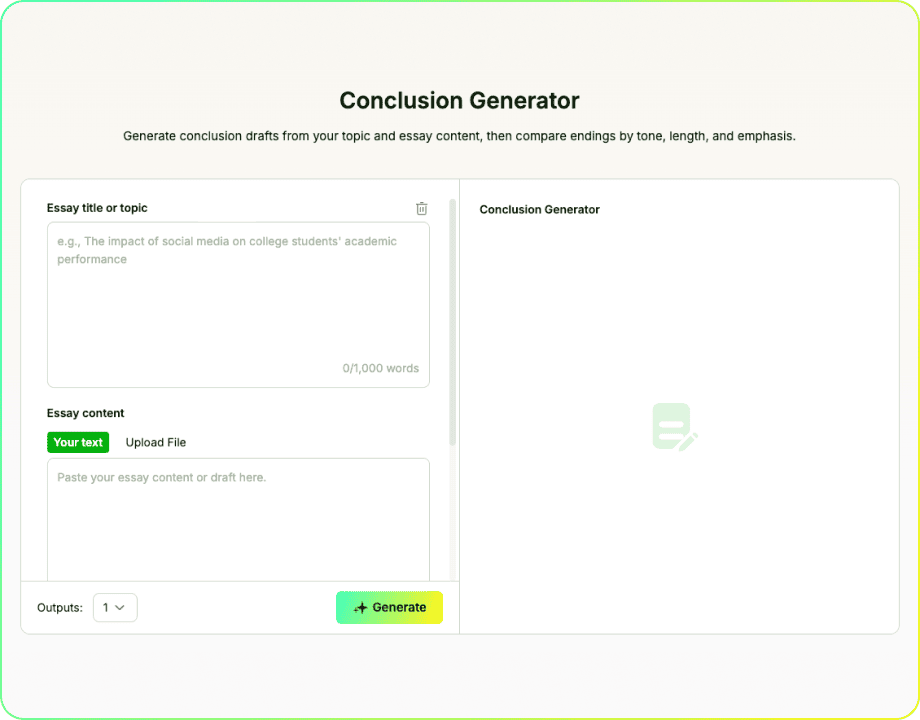
An Essay-Aware Conclusion Generator, Not a Generic Closing
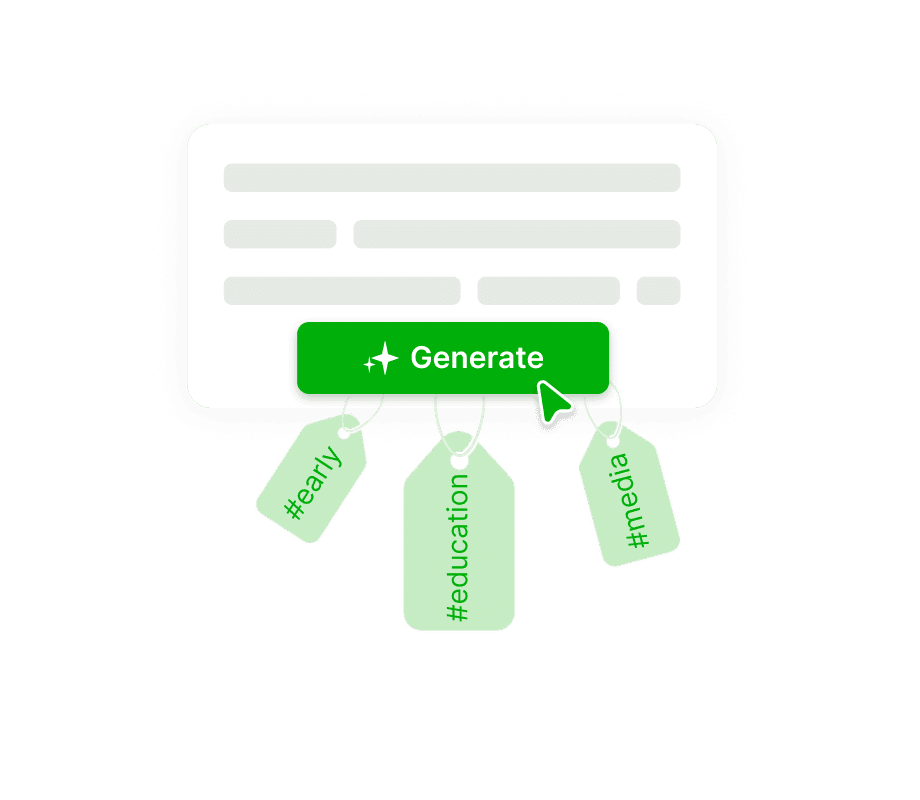
The Ending Begins in the Body
The strongest conclusion grows out of the body rather than being attached at the end. EssayDone Conclusion Generator uses the topic and essay content to reconnect the central claim with the evidence, synthesis, and final significance.

Shape the Ending for Its Reader
Use Length to control how much space the ending has.
Choose the target audience to decide what context or significance needs explanation.
Adjust tone of voice and output language to match the assignment and intended reader.
Set the number of outputs when you want several versions to compare.

Compare Different Closing Strategies
Multiple outputs let you examine different emphases for the same essay. One draft may foreground synthesis, while another may emphasize an implication, limitation, recommendation, or final insight. Compare these approaches against the paper rather than choosing the version that merely sounds most dramatic.
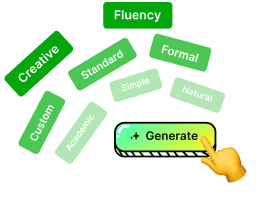
Decide How the Paper Should Close
Set the ending's job—synthesis, implication, limitation, recommendation, or final insight—before polishing the paragraph.

Evidence-Based Ending
Reconnect the thesis, evidence, and final significance.

Evidence-Limited Revision
Remove repetition and narrow claims that exceed the evidence.

Essays and Reports
Once the body is complete, it helps turn the established evidence into synthesis and significance.

Resolve the Ending
Use several possible endings to decide whether the paper should close on synthesis, implication, limitation, or recommendation.

Stronger Final Insight
Compare synthesis, implication, limitation, or recommendation.
Summary vs. Synthesis in a Conclusion
A strong conclusion does not simply repeat the essay in shorter form. It brings the thesis and supporting ideas together so readers understand what the argument adds, why it matters, and what final insight they should carry forward.
How Synthesis Beats Conclusion Repetition
- A conclusion should return to the thesis in fresh wording, not copy the introduction claim.
- A useful conclusion gathers key ideas so readers see how evidence works together.
- Synthesis explains significance: why the argument matters for the topic, reader, field, or problem.
- Avoid unrelated new evidence in the conclusion because new proof needs explanation.
- Close with direction: the final sentence should feel earned by the essay's reasoning.
- A conclusion paragraph writer is strongest when it turns evidence into final meaning rather than simply restating earlier sentences.

Has the Essay Earned Its Final Claim?
A strong conclusion is the paper's final inference, not a decorative ending. Whether you write it manually or use an AI conclusion generator, test the draft for support, scope, and significance: what does the evidence justify, how far can the claim reach, and why should the reader care?
Trace the Argument From Claim to Significance

Reopen the Central Question
Return to the thesis or research question without copying the introduction's wording.

Synthesize the Evidence
Group the main points by what they establish together, not by paragraph order.

State the Warranted Conclusion
Match words such as suggests, shows, or proves to the strength of the evidence.

Define the Significance
Explain what the conclusion changes, clarifies, or makes possible for the reader.

Choose the Final Move
Add an implication, limitation, recommendation, or question only when the essay supports it.
Where a Conclusion Crosses the Evidence Line
A conclusion can extend the paper's meaning, but it cannot create support that the body never supplied. Check these common forms of overreach.
- New evidence appears: A source, statistic, example, or case is introduced too late for readers to evaluate it.
- Certainty increases: The body says “survey data suggests a relationship between remote work and employee satisfaction,” but the conclusion claims “remote work proves that employees are more satisfied.”
- Scope expands: Findings from one text, group, period, or context become a universal statement.
- A recommendation appears without a path: The ending proposes action that the paper has not analyzed or justified.
- Significance becomes generic: The conclusion says the issue matters without showing what the argument specifically changes or clarifies.
The best final move is ambitious enough to matter and limited enough to remain credible. Let the evidence determine how far the ending can go.
One focused paragraph may be enough when it closes the claim and explains its significance.
Include implications, limitations, or future directions only when the evidence and assignment support them.
If the conclusion contains the paper's strongest idea, develop that idea in the body or narrow it before submitting.
Need Help With the Next Part?
Move to the next step with tools for drafting, rewriting, checking, summarizing, and research.
 Outline GeneratorOrganize a topic into a practical structure before drafting.
 Introduction GeneratorDraft an opening around the topic, purpose, audience, and direction.
 Essay CheckerReview grammar, spelling, clarity, and sentence issues.
 Thesis Statement GeneratorTurn a topic and position into a focused central claim.
 Hook CrafterCreate opening lines suited to different topics, audiences, and formats.
 Conclusion GeneratorCreate a closing section from the claims and points already developed.
 ParaphraserRewrite text with controlled wording changes while preserving meaning.
 Essay EnhancerImprove clarity, flow, tone, and organization in an existing draft while keeping its core meaning.

Explore by Category
Writing
Conclusion Generator FAQ
Provide the topic and full essay so the conclusion maker can reconnect the ending to the thesis, supporting points, and evidence. A complete draft helps the conclusion reflect what the body actually established instead of producing a broad closing from the topic alone.
It does. Compare several endings from the same essay to see whether synthesis, implications, limitations, or another supported closing move works best.
It can still draft an ending from the topic and body, but the result will usually be broad. Clarify the paper's central claim first, then regenerate so the conclusion can synthesize a defined argument rather than guess at one.
Yes. Choose another supported output language when you need a translated or localized conclusion. Recheck terminology, names, argument structure, and certainty because a fluent result can still shift the meaning of the body.
Yes, when the course allows it. The conclusion must still follow from claims and evidence already developed in your essay. Remove any new fact, source, or implication you cannot justify, and follow the required disclosure rule.
One focused paragraph may close a short essay, while a longer or more complex paper may need a fuller final section. Remove sentences that repeat earlier wording without adding synthesis, significance, or a supported final implication.
A conclusion may present an inference, implication, or connection drawn from evidence already discussed. It should not introduce unrelated evidence, sources, or arguments that the body has not explained.
Provide the full essay, then revise the generated ending to synthesize what the evidence establishes rather than restating the opening. Return to the central question in fresh language, refine the claim, and explain the significance without copying the thesis.
EssayDone does not use the uploaded essay to train its AI models by default. Your conclusion work remains private, and a saved generation record can be removed from account history.
🔗 References
Sources on synthesis and final significance clarify what an AI conclusion generator should reconnect: the central claim, supporting evidence, implications, and the limits of what the essay can support.

- UW-Madison Writing Center|Conclusions: Make Your Last Words Count
- Harvard College Writing Center|Academic Writing: Conclusions
- George Mason University Writing Center|Introductions and Conclusions for Humanities Papers
- UMGC Effective Writing Center|Strategies for Conclusions
- Purdue Online Writing Lab|Argument Papers: Conclusions