
 ZeroGPT
 GPTZero
 QuillBot
 Grammarly
 Copyleaks
 Scribbr
 Originality.ai
 Isgen.ai
 SciSpace
 Sapling
 Winston AI
 Undetectable AI
 Smodin
 Writer
 JustDone
 Phrasly
 Brandwell
 Crossplag
 DeCopy AI
 NoteGPT
 Surfer
 SurgeGraph
 AI Detector
 Walter Writes AI
 Grubby AI
 Merlin
 Monica
 Stealthwriter
 Humbot
 Rewritify
 YouScan
 AI-Detector
 RyRob
RyRob Turnitin
 Pangram
Essay Shortener
Reduce word count while protecting your thesis, key evidence, tone, and required terms.
Tighten Your Draft With EssayDone Essay Shortener
Essay shortener results succeed when repetition and detours disappear but the argument, evidence, terminology, and logical relationships remain intact.
Step 1: Mark what cannot disappear. Give the AI essay shortener the full draft and identify names, technical terms, quotations, required phrases, or evidence that must survive the cut.
Step 2: Choose the reduction priority. Set target length, tone, language, and output count according to whether the essay mainly needs tighter sentences, fewer examples, or less repeated explanation.
Step 3: Compare what was lost. Check each shortened version against the thesis, evidence, qualifications, transitions, and protected terms before keeping the shortest result.
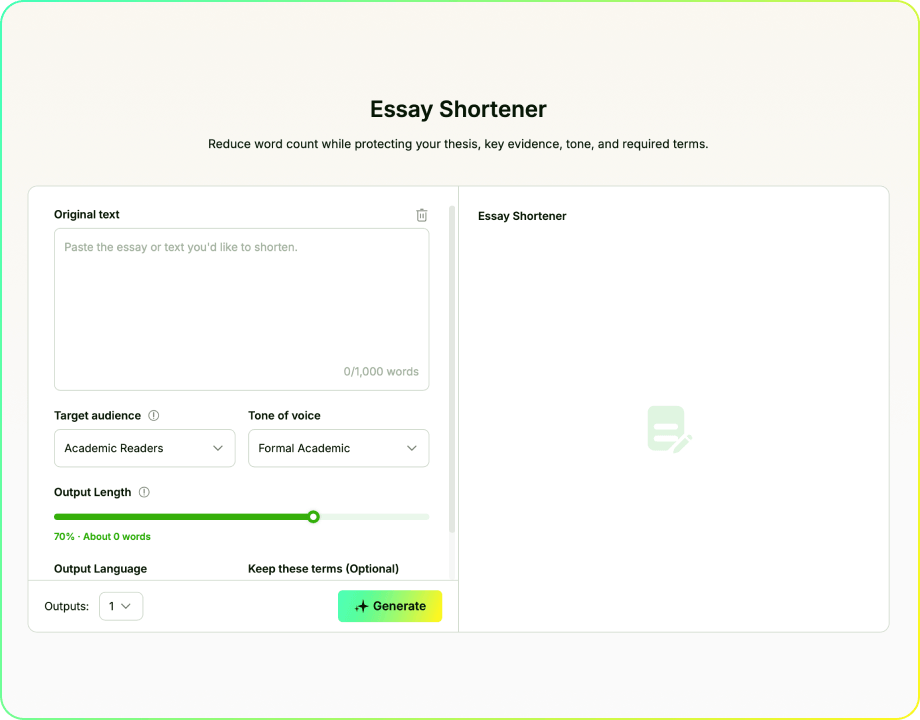
Cut the Word Count Without Cutting the Argument
A Shorter Draft That Still Thinks
EssayDone Essay Shortener helps reduce word count while keeping the paper's central argument visible. The essay shortener tool is useful when a draft is too long but still needs its thesis, essential evidence, qualifications, and necessary context. Instead of turning the paper into a loose summary, it supports a tighter version that should still read like the same essay.
Protects Required Terms
Paste the complete text and mark names, concepts, quoted wording, technical terms, or assignment language that must remain unchanged.
Protected terms help prevent important wording from disappearing during reduction.
Treat shortening as a decision about what the argument must keep, not simply how many words to remove.
A reliable shortening pass should cut repetition before removing language that carries the paper's meaning.

Controls Length, Tone, and Language
The AI essay shortener uses output length, tone of voice, output language, and number of outputs to shape the shortened draft around the writing task. Generate several versions when you need to compare different levels of compression instead of accepting one fixed cut.
Protect What Must Stay
Mark terminology, evidence, and qualifications that cannot disappear, then cut repetition around them.

Meaning-Safe Reduction
Cut repetition and wordiness before removing essential meaning.

Restore What Matters
Compare versions and restore anything important that was lost.

Strict Word Limits
Firm limits on essays, application answers, abstracts, or reports call for compression that protects the central argument.

Skip Line-by-Line Cutting
Start from a condensed version so attention can go to what was lost, not to deleting every sentence by hand.

Clearer Cutting Decisions
See which words are expendable and which carry the argument.
How to Shorten an Essay Without Making It Weaker
Shortening an essay is not the same as writing a summary. A strong edit reduces word count while protecting the thesis, key evidence, conditions, and transitions that make the argument work.
Shorten an Essay Without Weakening the Argument
- Remove repetition before cutting evidence; duplicate claims and examples weaken the draft without adding meaning.
- Cut empty openers such as “it is important to note that” when they add no meaning.
- Reduce qualifiers like very, really, basically, or somewhat unless they change the claim.
- Replace weak verb phrases with stronger verbs, such as “make a decision” becoming “decide.”
- Cut excessive detail only when it does not support thesis, evidence, or logic.
- A careful shortening pass protects meaning; the goal is clearer writing with fewer words.

Did Shortening Change the Meaning of Your Essay?
A shorter draft may sound cleaner while quietly becoming broader, more certain, or less supported. Check the parts that control the argument—not only how many words disappeared.
Where Meaning Usually Slips

Claim Strength
Check whether cautious wording became a stronger, less supportable claim during shortening.

Essential Evidence
Confirm that readers still have the proof needed to understand and trust the claim.

Scope and Conditions
Keep the population, period, conditions, exceptions, and limits that define the claim.

Logical Relationships
Protect words and transitions that express cause, contrast, sequence, qualification, or comparison.

Final Meaning
Ask whether a careful reader would reach the same conclusion from both versions.
A Shorter Sentence Can Make a Bigger Claim
A sentence may lose only a few words and still change its scope, evidence, and level of certainty.
- Original: “In a small survey, flexible scheduling was associated with lower reported stress among first-year nurses.”
- Over-compressed: “Flexible scheduling reduced stress.”
- Scope was lost: The shorter version removes the small sample and the first-year nurse population.
- Certainty changed: “Was associated with” became the causal claim “reduced,” while “reported” disappeared.
- Faithful reduction: “A small survey linked flexible scheduling to lower reported stress among first-year nurses.”
The strongest shorter version is not simply the one with the fewest words. It removes expendable wording while keeping the boundaries that make the argument accurate.
Protect variables, methods, population details, and limitation language before shortening.
Cut repeated background before removing the personal details that make the response specific.
Recheck technical terms, tone, and certainty when shortening into another language.
Need Help With the Next Part?
Move to the next step with tools for drafting, rewriting, checking, summarizing, and research.
 Outline GeneratorOrganize a topic into a practical structure before drafting.
 Introduction GeneratorDraft an opening around the topic, purpose, audience, and direction.
 Essay CheckerReview grammar, spelling, clarity, and sentence issues.
 Thesis Statement GeneratorTurn a topic and position into a focused central claim.
 Hook CrafterCreate opening lines suited to different topics, audiences, and formats.
 Conclusion GeneratorCreate a closing section from the claims and points already developed.
 ParaphraserRewrite text with controlled wording changes while preserving meaning.
 Essay EnhancerImprove clarity, flow, tone, and organization in an existing draft while keeping its core meaning.

Explore by Category
Writing
Essay Shortener FAQ
The free essay shortener works directly on the page. Paste the draft, protect any required terms, and compare the shorter result with the original before keeping it.
An essay shortener keeps the original draft's argument and structure while reducing length. An AI summarizer creates an overview and may remove much more of the original detail and organization.
Start with the actual assignment, application, or submission limit rather than choosing the shortest option. Protect space for the thesis, essential evidence, analysis, and conclusion. When reaching the target would require deleting core reasoning, revise the structure instead of compressing every paragraph equally.
Keep quotations exact, preserve attribution, and make sure every citation still supports the sentence beside it. Do not let shortening turn a limited source claim into a broader statement or separate evidence from the explanation it was meant to support.
Restore the evidence, analysis, and paragraph-level reasoning that make the text function as an essay. A shorter essay should still develop an argument; a summary mainly reports the central points. Compare the result with the assignment prompt before keeping it.
It can help condense longer drafts, but research writing requires extra care around methods, variables, source names, technical terms, findings, and limitations. Mark required terminology before generating, then review the result section by section rather than relying only on the final word count.
Yes. Select the appropriate language and compare the shorter version with the source. This is especially important for translated or multilingual writing, where small cuts can remove a qualification, change formality, or disturb required terminology.
Yes, as an editing aid when permitted. Preserve quotations, attribution, citations, and the original argument; shortening must not disguise copied material or change what a source claims.
EssayDone does not use your original draft for model training by default. Your shortening work remains private, and any saved record can be removed from your account history.
🔗 References
Concision and revision sources establish how an essay shortener tool should remove repetition and wordiness while protecting terminology, evidence, logical relationships, and the original argument.

- Purdue Online Writing Lab|Conciseness: Eliminating Unnecessary Words
- George Mason University Writing Center|Revising Prose for Concision: 10 Tips
- UW-Madison Writing Center|Tidy Up Wordy Phrases
- GOV.UK Content and Publishing Guidance|GOV.UK Writing Guidelines: Use Clear Language
- Microsoft Writing Style Guide|Microsoft Learn Style and Voice Quick Start