
 ZeroGPT
 GPTZero
 QuillBot
 Grammarly
 Copyleaks
 Scribbr
 Originality.ai
 Isgen.ai
 SciSpace
 Sapling
 Winston AI
 Undetectable AI
 Smodin
 Writer
 JustDone
 Phrasly
 Brandwell
 Crossplag
 DeCopy AI
 NoteGPT
 Surfer
 SurgeGraph
 AI Detector
 Walter Writes AI
 Merlin
 Monica
 Stealthwriter
 Humbot
 Rewritify
 YouScan
 AI-Detector
 RyRob
RyRob Turnitin
 Pangram
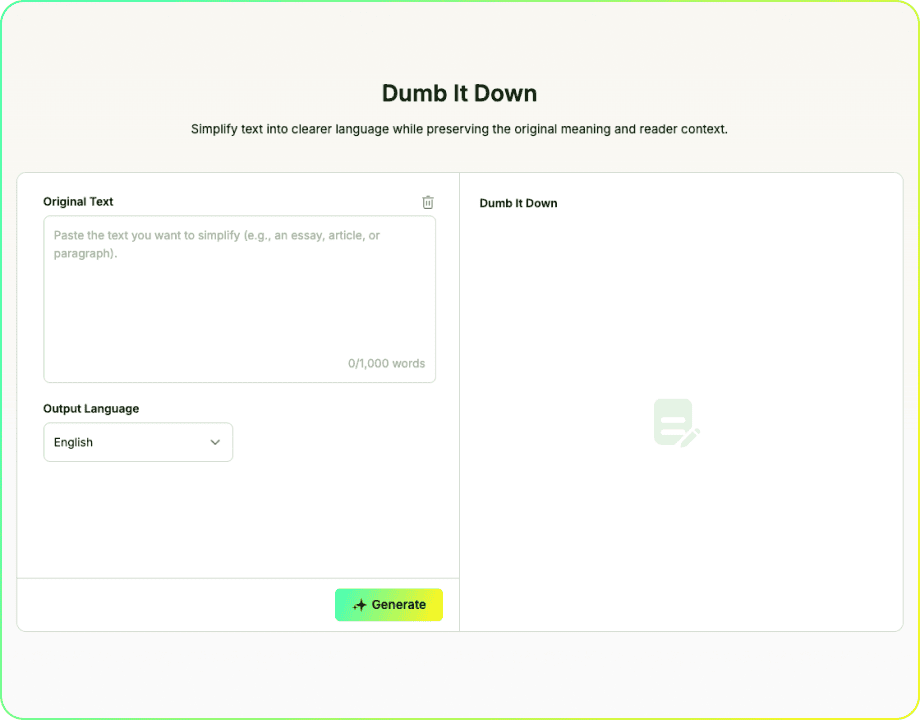
Dumb It Down
Simplify text into clearer language while preserving the original meaning and reader context.
Make Complex Text Clearer With EssayDone Dumb It Down
Dumb it down should make difficult material easier to follow without erasing facts, conditions, uncertainty, or technical distinctions.
Step 1: Identify what makes the passage hard. Give the AI text simplifier the dense text and note whether the difficulty comes from jargon, sentence structure, hidden logic, or assumed knowledge.
Step 2: Decide what the reader needs explained. Select the output language, then identify which technical terms must remain and which can be explained in plain language.
Step 3: Check for lost nuance. Compare the simpler version with the original and restore any fact, exception, condition, or qualification that disappeared.
Make Complex Text Easier Without Flattening the Meaning
Plain Language Without Lost Nuance
Plain language is not the same as removing difficult ideas. EssayDone Dumb It Down creates a simpler version of the pasted text in the selected language, helping reduce avoidable difficulty while keeping the original message available for comparison.
Simplifies Presentation, Not Evidence
Paste complex text and choose the language for the simplified version.
Use the text simplifier to clarify difficult ideas rather than delete them automatically.
Preserve essential facts, numbers, conditions, exceptions, and cause-and-effect relationships.
Define necessary technical terms when removing them would make the explanation less accurate.

Works Across Dense Text Types
An AI text simplifier can help with academic passages, technical explanations, workplace policies, instructions, study materials, and jargon-heavy writing. Because simplification can accidentally remove a limitation or change a relationship between ideas, review every generated version against the original before relying on it.
Start With the Reader
Clarify for a specific reader, preserving necessary terms and explaining them when replacement would reduce accuracy.
Clarity Without Lost Detail
Dumb It Down uses AI to replace avoidable jargon and unpack difficult steps without deleting necessary facts or distinctions.
A Draft to Verify
Compare both versions and restore any condition, exception, or nuance that disappeared.

Complex Text, Wider Access
Policies, technical explanations, academic passages, and instructions become more accessible when difficult language is unpacked.

Reach the Main Idea Faster
Reach the central idea sooner, then use the original to restore any detail, condition, or nuance that disappeared.

Clarify for a Real Audience
Identify which terms need defining, which steps need unpacking, and what context readers lack.
What Does Dumb It Down Mean?
To dumb it down means to make difficult information easier to understand. The phrase can sound dismissive when it is used about people, but useful simplification should do the opposite: assume the reader is capable and remove avoidable barriers between the reader and the idea. Lower the barrier, not the reader.
Simplify, Shorten, Summarize, or Rephrase?
- Dumb it down or simplify text—reduce linguistic or conceptual difficulty while keeping the information readers still need. The result may stay close to the original length or become slightly longer when a definition or explanation is necessary.
- Shorten—reduce the word count. A shorter version may still contain the same jargon, assumed knowledge, and complicated sentence structures.
- Summarize—retain the main points while intentionally removing supporting details. Use this when readers need an overview rather than the full explanation.
- Rephrase—express the same idea using different wording or structure. A rephrased sentence may sound different without becoming shorter or easier to understand.
- Use Dumb It Down when the real obstacle is jargon, abstract wording, hidden assumptions, long chains of reasoning, or relationships that the writer has not explained clearly—not merely because the passage is long.
- Example—Original: “The system authenticates users through multifactor verification before granting access to restricted resources.” Shortened: “The system uses multifactor authentication for restricted access.” Simplified: “Before users can open restricted files, the system checks their identity in more than one way.”
How to Dumb It Down Without Oversimplifying
A simpler version succeeds only when the intended reader can understand it more easily and still reach the same conclusion. Shorter sentences and familiar words are useful techniques, but they are not the final test of accuracy or comprehension.
The Meaning-Safe Simplification Pass

Define the Reader
Define what readers already know and what they need from the explanation.

Protect the Meaning
Mark the claim, facts, conditions, exceptions, uncertainty, and relationships that must remain.

Find the Friction
Locate jargon, hidden assumptions, abstract wording, and missing logical steps.

Rebuild the Explanation
Lead with the message, split difficult steps, and define necessary technical terms.

Test Understanding
Check whether the intended reader can explain the central idea accurately.
A Lower Reading Level Is Not the Finish Line
Readability measures can help reveal difficult wording, but they do not prove that readers understand the idea correctly. Judge the simplified version by meaning, usability, and audience comprehension—not only sentence length or vocabulary difficulty.
- Allow the simplified version to become longer when readers need a definition, example, transition, or missing logical step. Simpler does not always mean shorter.
- Keep essential technical terms when readers need to recognize or use them later. Introduce the term beside a plain-language explanation rather than deleting the concept.
- Preserve uncertainty. May, could, is associated with, and suggests should not silently become will, causes, or proves.
- Check every number, unit, condition, exception, comparison, and causal relationship. These small details often determine whether a simplified explanation remains accurate.
- Treat the AI-generated version as a draft. A fluent text simplifier result can still remove context, merge separate claims, or add an explanation that the original does not support.
Dumb It Down should reduce the effort required to understand the text—not the accuracy of the information or the dignity of the reader.
Use the simplified version for initial understanding, then return to the original for terminology, evidence, and detail.
Ask someone in the target audience to explain the key point in their own words.
Verify high-stakes simplified text against the original or a qualified professional.
Need Help With the Next Part?
Move to the next step with tools for drafting, rewriting, checking, summarizing, and research.
 Outline GeneratorOrganize a topic into a practical structure before drafting.
 Introduction GeneratorDraft an opening around the topic, purpose, audience, and direction.
 Essay CheckerReview grammar, spelling, clarity, and sentence issues.
 Thesis Statement GeneratorTurn a topic and position into a focused central claim.
 Hook CrafterCreate opening lines suited to different topics, audiences, and formats.
 Conclusion GeneratorCreate a closing section from the claims and points already developed.
 ParaphraserRewrite text with controlled wording changes while preserving meaning.
 Essay EnhancerImprove clarity, flow, tone, and organization in an existing draft while keeping its core meaning.

Explore by Category
Writing
Dumb It Down FAQ
The tool creates a clearer version in the selected output language. Compare it with the original for facts, conditions, exceptions, uncertainty, and logical relationships.
Create a simpler version at no cost. The result is useful only when it reduces difficulty without dropping facts, conditions, or necessary distinctions.
Yes. Keep a necessary term when readers will encounter it again, then add a short definition, example, or plain-language explanation. Replace the term only when the simpler wording remains equally accurate.
Yes. Select the same language when you only want clearer wording, or choose another supported language when translation is part of the task. In either case, verify technical terms, names, numbers, and important qualifications.
Dumb It Down reduces difficulty while preserving needed information. Shortening reduces word count, even if the remaining language stays technical. Summarizing keeps the main points and intentionally removes supporting detail.
EssayDone rewrites the whole passage rather than replacing isolated difficult words. It can simplify sentence structure, make hidden relationships more explicit, keep necessary technical terms beside plain-language explanations, and work across the supported language menu. The advantage is clearer text without automatically discarding conditions, uncertainty, numbers, or technical distinctions.
Hemingway's Simplify feature works inside its editor, uses readability feedback, and can rewrite selected sentences or larger passages. EssayDone Dumb It Down is a focused text simplifier: paste a difficult passage, choose an output language, and create a clearer version while checking facts, conditions, and technical distinctions. Choose Hemingway when you want readability scoring and in-editor revision; choose EssayDone when you want a direct simplification workflow or multilingual output.
Yes. A clearer explanation may need a definition, example, transition, or explicit logical step. Use an essay shortener or summarizer when reducing length is the primary goal.
You can simplify sensitive working text without it being used for model training by default. EssayDone respects your privacy, and any saved Dumb It Down history can be removed from your account.
🔗 References
Plain-language standards and research on simplification show how an AI text simplifier can reduce jargon and sentence difficulty without erasing necessary facts, distinctions, or audience context.

- National Institutes of Health|Plain Language at NIH
- CDC Clear Communication Index|CDC Clear Communication Index: About Everyday Words
- ACL Anthology|Evaluating Factuality in Text Simplification
- Center for Plain Language|Getting Started with Plain Language
- arXiv|Know Your Audience: The Benefits and Pitfalls of Generating Plain Language Summaries Beyond the "General" Audience