
 ZeroGPT
 GPTZero
 QuillBot
 Grammarly
 Copyleaks
 Scribbr
 Originality.ai
 Isgen.ai
 SciSpace
 Sapling
 Winston AI
 Undetectable AI
 Smodin
 Writer
 JustDone
 Phrasly
 Brandwell
 Crossplag
 DeCopy AI
 NoteGPT
 Surfer
 SurgeGraph
 AI Detector
 Walter Writes AI
 Grubby AI
 Merlin
 Monica
 Stealthwriter
 Humbot
 Rewritify
 YouScan
 AI-Detector
 RyRob
RyRob Turnitin
Paraphraser
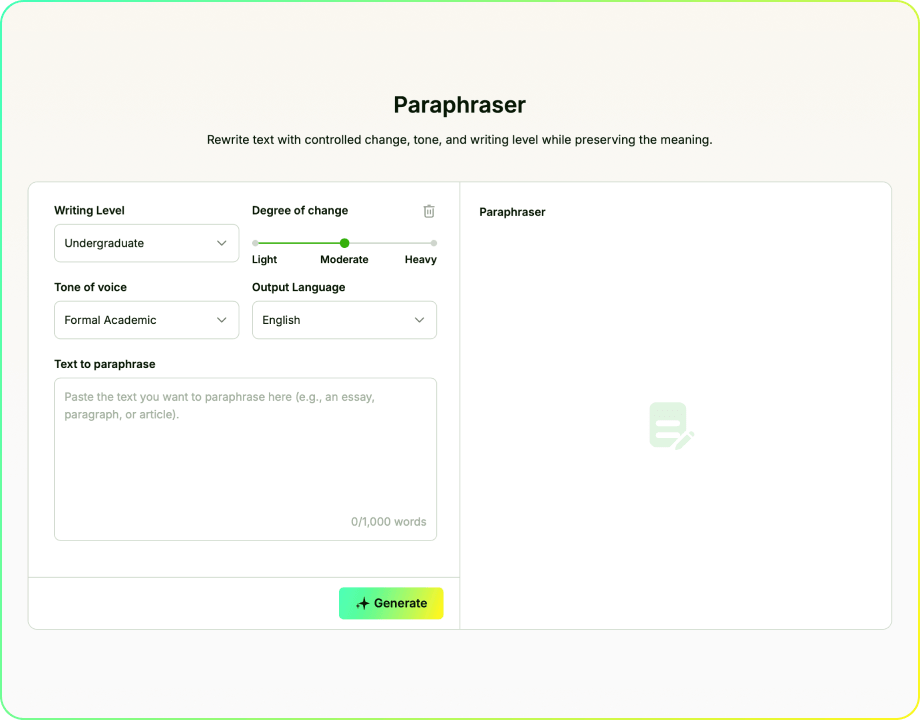
Rewrite text with controlled change, tone, and writing level while preserving the meaning.
Rewrite With EssayDone Paraphraser
A paraphraser works only when the wording changes but the source's claim, scope, conditions, and certainty stay the same.
Step 1: Preserve the full thought. Give the paraphraser enough surrounding text to distinguish the main claim from examples, qualifications, causes, and supporting details.
Step 2: Decide how much may change. Set writing level, degree of change, tone, and language according to whether the paraphraser needs to solve wording, structure, or readability.
Step 3: Compare meaning line by line. Restore anything that changes the actor, claim, condition, causality, or certainty, and cite the source when its ideas enter your work.
Choose How Much the Paraphrase Changes—and What It Must Preserve
Rewrite Depth You Can Control
EssayDone Paraphraser helps writers rephrase text while controlling how much the wording changes. By choosing writing level, degree of change, tone of voice, and output language, users can guide the Paraphraser toward a light polish or a more substantial rewrite. This is useful when the goal is clearer expression—not a random synonym swap.
Adapts to Level and Tone
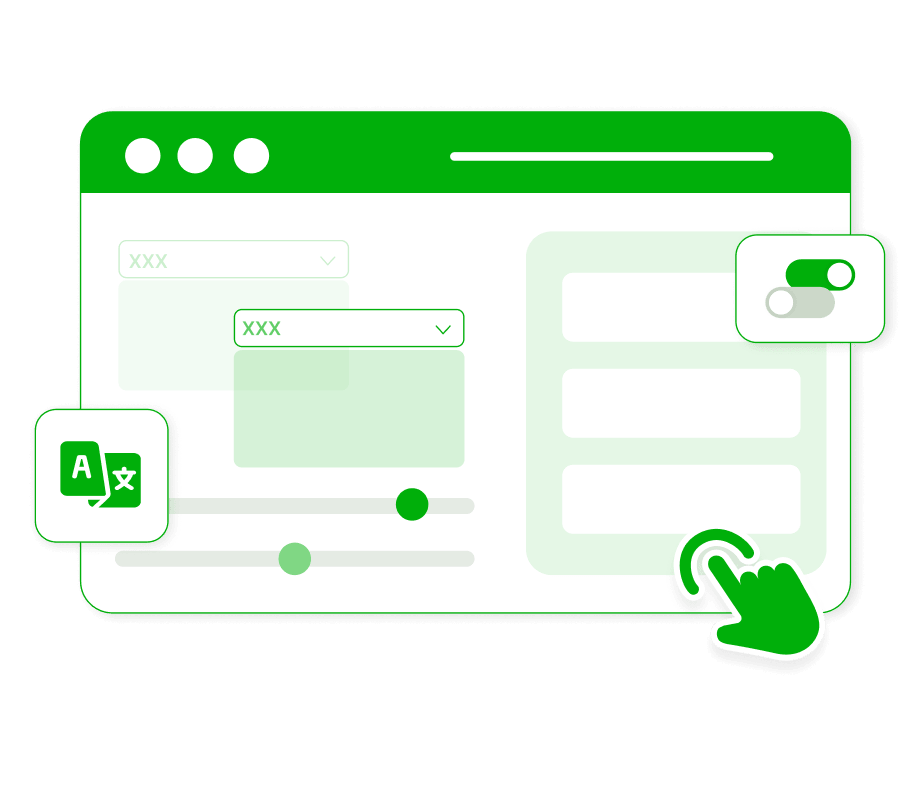
Set the writing level, degree of change, tone of voice, and output language before generating.
Keep a class assignment appropriately academic or make a professional message more concise and direct.
Use the paraphraser tool to adapt the rewrite to a particular reader, purpose, and writing context.
Compare different settings instead of expecting one paraphrase style to fit every audience and task.
Preserves Meaning While Changing Form
A useful paraphrasing tool should reshape sentence structure and word choice without changing the central message. EssayDone Paraphraser gives users a structured way to rephrase text and compare the result with the original, helping them catch forced synonyms, awkward phrasing, removed qualifications, or polished wording that communicates a different claim.
Choose How Far to Rewrite
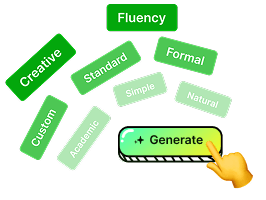
Match the degree of change to the problem: light polish for awkward wording, deeper restructuring for weak flow.
Structure, Not Synonym Swaps
The AI paraphraser reshapes clauses, emphasis, and wording while keeping the original message available for comparison.
Compare Before You Keep
Check claims, conditions, certainty, and terminology before choosing the smoother version.
From Essays to Workplace Text
Source-based writing, emails, and explanations can be reworded without changing the underlying message.

Rebuild Less, Review More
Test alternative wording quickly while keeping the original beside it as the standard for meaning and naturalness.

Match the Rewrite to the Need
Decide whether the passage needs light polish, structural change, tone adjustment, or simpler wording.
How to Paraphrase Without Making the Writing Sound Awkward
A good paraphrase keeps the original meaning while changing the wording enough to fit the new sentence, audience, or purpose. Natural paraphrasing depends on structure, context, and tone, not only synonyms.
Paraphrasing Checks for Natural, Accurate Rewrites
- Understand the original claim, condition, and certainty before using a paraphraser or changing structure.
- Change structure before chasing advanced synonyms; word swaps alone make paraphrases awkward.
- Choose words by context; the most advanced synonym is often weaker than the natural word.
- Preserve tone so paraphrased text stays formal, conversational, cautious, or direct.
- Read the paraphrase aloud and remove wording that feels stiff or overloaded.
- The best paraphrasing tool improves clarity and variety while keeping the message accurate.
Can a Paraphraser Help You Become a Better Writer?
Potentially—but only when you study the differences between versions instead of accepting the output automatically. An AI paraphraser can expose you to alternative structures and expressions, while learning happens when you understand, test, and later reuse those techniques independently.
A 5-Step Paraphrase Learning Loop

Draft Before Generating
Draft your own version first so the generated alternative has a meaningful comparison point.

Compare the Versions
Compare focus, clause order, verbs, transitions, detail, tone, and reading level.

Name the Technique
Name the structural or language decision that made the new version work.

Test It on New Writing
Apply the same technique to new writing without copying the generated phrase.

Track Independent Use
Track techniques you can recognize and use later without assistance.
When Paraphrasing Supports Learning—and When It Replaces It
The same tool use can function as revision assistance, source integration, language practice, or academic misconduct depending on what text you enter, why you rewrite it, and what your assignment permits.
- Use a paraphraser on your own writing to explore clearer structures, reduce repetition, adjust tone, or compare ways of expressing an idea you already developed.
- For source-based writing, understand the original first, decide why the information matters to your argument, draft from that understanding, compare for accuracy, and cite the source.
- Use generated alternatives as examples to analyze. Ask why one version is clearer, more concise, more cautious, or more appropriate for the audience instead of memorizing isolated phrases.
- Do not treat a smoother paraphrase as new knowledge. The tool does not replace reading the source, evaluating its evidence, checking facts, or understanding the concept being discussed.
- Do not use a paraphraser to disguise copied material, hide unapproved AI-generated writing, evade similarity checks, or complete work whose rules prohibit rewriting assistance.
A paraphraser supports learning when you can explain the change and apply the underlying technique elsewhere. If you can only copy the output, the tool may have improved one passage without improving the skill behind it.
Save your original attempt and label one useful structural or language change in the generated version.
Read, close the source, draft the idea in your own words, then reopen it to verify meaning and add the citation.
Review the instructor's AI policy before using a paraphraser tool on assessed work, and disclose its use when required.
Need Help With the Next Part?
Move to the next step with tools for drafting, rewriting, checking, summarizing, and research.
 Outline GeneratorOrganize a topic into a practical structure before drafting.
 Introduction GeneratorDraft an opening around the topic, purpose, audience, and direction.
 Essay CheckerReview grammar, spelling, clarity, and sentence issues.
 Thesis Statement GeneratorTurn a topic and position into a focused central claim.
 Hook CrafterCreate opening lines suited to different topics, audiences, and formats.
 Conclusion GeneratorCreate a closing section from the claims and points already developed.
 ParaphraserRewrite text with controlled wording changes while preserving meaning.
 Essay EnhancerImprove clarity, flow, tone, and organization in an existing draft while keeping its core meaning.

Explore by Category
Writing
Paraphraser FAQ
The tool works from a sentence, paragraph, or longer passage. Writing level, degree of change, tone, and output language guide alternatives that should still be checked for meaning and paragraph fit.
Yes, and it can handle a sentence, paragraph, or longer passage. Control the degree of change and check that the paraphrase still says the same thing.
Yes. It can rewrite a word choice in context, one sentence, a paragraph, or a longer passage. Give it enough surrounding text to preserve qualifications and logical relationships.
Yes. EssayDone Paraphraser supports more than 50 languages. It is built for multilingual rewriting with controls for writing level, degree of change, tone, and output language, so non English work is not treated as a basic translation task. Compare meaning and citation needs with the source.
Do not use EssayDone or any paraphrasing tool to disguise copied material, avoid citation, rewrite text you do not understand, or bypass an assignment's AI policy.
Paraphrasing restates the same idea and usually keeps a similar level of detail. Rephrasing broadly means expressing wording differently. Summarizing reduces longer material to its main points.
Yes. Changing the wording does not make another author's idea your own. Cite the original source in the required style and make sure the paraphrase does not remain too close to its distinctive wording and structure.
Compare the actor, main claim, scope, negation, conditions, causal relationship, and level of certainty. If 'may be associated with' becomes 'causes,' or a limited finding becomes a general claim, the paraphrase is inaccurate even when it sounds smoother. EssayDone gives you an alternative to verify, not a substitute for the source.
EssayDone does not use the passage you submit for AI model training by default. Your paraphrasing work remains private, and saved history can be cleared whenever you no longer need it.
🔗 References
Academic-integrity and paraphrasing sources explain how a paraphraser tool should restructure language, preserve meaning and qualification, and keep citation responsibilities visible.

- Purdue Online Writing Lab|Quoting, Paraphrasing, and Summarizing: Paraphrasing
- Scribbr|How to Paraphrase
- Monash Student Academic Success|Paraphrasing, Summarising, and Quoting: Paraphrase
- University of Melbourne Academic Skills|Incorporating Sources
- Adelaide University English for Uni|Exercise 4: Paraphrasing