
 ZeroGPT
 GPTZero
 QuillBot
 Grammarly
 Copyleaks
 Scribbr
 Originality.ai
 Isgen.ai
 SciSpace
 Sapling
 Winston AI
 Undetectable AI
 Smodin
 Writer
 JustDone
 Phrasly
 Brandwell
 Crossplag
 DeCopy AI
 NoteGPT
 Surfer
 SurgeGraph
 AI Detector
 Walter Writes AI
 Grubby AI
 Merlin
 Monica
 Stealthwriter
 Humbot
 Rewritify
 YouScan
 AI-Detector
 RyRob
RyRob Turnitin
 Pangram
Length Booster
Use an AI text expander to develop thin passages with context, examples, and style controls.
Expand Your Draft With EssayDone Length Booster
An AI text expander adds value when new explanation, evidence, context, or analysis answers a reader's question; extra length alone is not the goal.
Step 1: Find the thin spot. Give the AI text expander the passage and identify where the reader still needs a reason, example, explanation, qualification, or transition.
Step 2: Set a direction, not a quota. Choose expansion mode, target length, audience, tone, and style controls. Treat the word count as guidance rather than a guarantee.
Step 3: Keep substance, cut padding. Retain additions that clarify or support the original ideas, remove repetition, and verify every new factual claim.
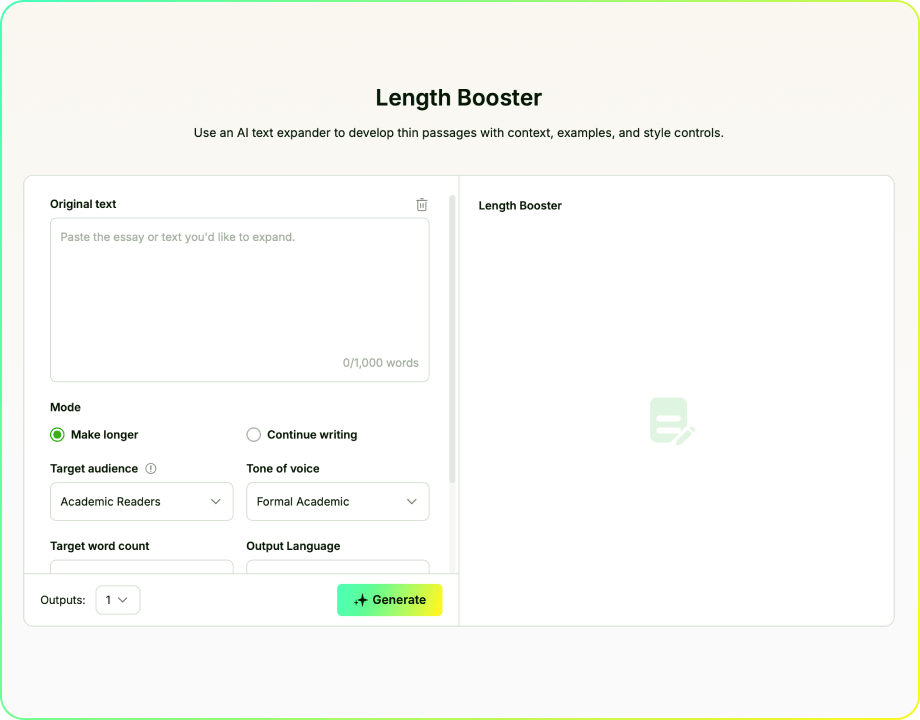
Expand Writing Where the Draft Is Actually Thin
Development That Earns Its Space
Expansion is useful only when the added material develops the idea. EssayDone Length Booster, an AI text expander, adds relevant context, explanation, examples, and support instead of repeating the same point to make text longer.
Add the Kind of Detail Your Draft Needs
Choose an expansion mode based on whether the text needs fuller explanation, additional context, examples, or broader development.
Set a target word count to guide the amount of expansion without treating volume as the only measure of quality.
Use the expanded version to identify where the original draft was underdeveloped.
Keep only additions that clarify, support, illustrate, qualify, analyze, or connect the existing ideas.

Preserve Audience, Tone, and Style
Use the target audience, tone, and keep-original-style controls to guide the expansion, then compare the result with the original draft's vocabulary, rhythm, and formality.
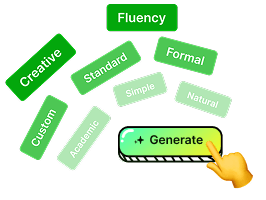
Choose Where the Draft Should Grow
Direct expansion toward the idea that needs context, evidence, explanation, or significance instead of spreading extra words everywhere.

AI Development Support
The AI text expander helps reveal where a draft can grow through context, explanation, examples, evidence, or analysis rather than filler.

Revision-Ready Expansion
Review the expanded draft, keep useful additions, remove repeated ideas, and refine wording that no longer matches the original meaning.

Academic and Professional Fit
Drafts with a sound idea but thin development can gain the missing context, example, reason, or connection.

Faster Draft Development
See where development is missing, add only the material that answers that gap, and return to revision with a fuller draft.

Clearer Development Decisions
See whether the draft needs more context, evidence, examples, analysis, or significance instead of distributing extra words evenly across the text.
Does a Longer Draft Actually Make a Better Paper?
Not by itself. An AI text expander can create room for fuller development, but additional words do not guarantee better writing. In a study of 2,820 timed SAT essays, word count explained 39% of the variation in scores, yet the result showed a relationship—not that adding words caused higher-quality writing. Separate experimental research found that low-quality texts could receive more negative evaluations as they became longer. Treat length as a signal to inspect development, not as a quality score.
Find the Missing Writing Work
- A short draft is not automatically underdeveloped. If it answers the prompt with a clear claim, sufficient support, and enough analysis for readers to follow the reasoning, keeping it concise may be the stronger choice.
- Expand a claim gap when the paragraph introduces a subject but never states the point readers should understand, question, or accept.
- Expand a support gap with relevant evidence, an example, a source, or a concrete observation—not another version of the same assertion.
- Expand an analysis gap by explaining how the evidence supports, qualifies, or complicates the claim. Evidence adds depth only when its connection to the argument is clear.
- Expand a context or scope gap by defining a key term, explaining necessary background, or adding a condition or limitation to an overly broad statement.
- Example—Original: “Remote work affects collaboration.” Padded: “Remote work has many important effects on collaboration in several different ways.” Developed: “Remote work can weaken informal knowledge sharing because employees lose spontaneous exchanges that often clarify tasks before problems escalate.”

Where Should the Extra Words Go?
Do not distribute new sentences evenly across the draft. Expand the point where the reader's understanding breaks—whether the missing element is the claim, context, support, analysis, or significance. Target word count is a constraint; development is the objective.
The Development Gap Map

Claim
Make the paragraph's main point explicit, specific, and limited to the assignment.

Reader Context
Define a term or add only the background readers need to evaluate the point.

Evidence or Example
Add a source, data point, quotation, case, or example that supports the claim.

Analysis
Explain how the support proves, qualifies, or complicates the point.

Significance and Connection
Show why the point matters and how it advances the thesis or answers the prompt.
How to Expand Writing by Function, Not Volume
Read each new sentence according to the job it performs. When two sentences perform the same job without adding new information, the expansion is probably padding.
- If the paragraph only announces a topic, develop the claim before adding examples or extra background.
- If it already contains evidence but little reasoning, spend the added words on analysis rather than inserting another quotation or statistic.
- If an idea remains abstract, add one concrete example and explain exactly what the example demonstrates about the claim.
- If the claim sounds universal, develop it with a condition, boundary, counterexample, or limitation instead of repeating it more strongly.
- Classify every AI-added sentence as context, evidence, example, analysis, connection, or implication. Verify factual additions and remove sentences that perform no identifiable role.
Stop expanding when readers can follow the claim-support-reasoning connection without supplying a missing step themselves. A target word count should guide the amount of development, not force unnecessary content.
Check for missing analysis before searching for another source or example.
Expand one development gap at a time so the added material remains focused.
Verify new facts, citations, and claims, and keep only additions permitted by the assignment's AI policy.
Need Help With the Next Part?
Move to the next step with tools for drafting, rewriting, checking, summarizing, and research.
 Outline GeneratorOrganize a topic into a practical structure before drafting.
 Introduction GeneratorDraft an opening around the topic, purpose, audience, and direction.
 Essay CheckerReview grammar, spelling, clarity, and sentence issues.
 Thesis Statement GeneratorTurn a topic and position into a focused central claim.
 Hook CrafterCreate opening lines suited to different topics, audiences, and formats.
 Conclusion GeneratorCreate a closing section from the claims and points already developed.
 ParaphraserRewrite text with controlled wording changes while preserving meaning.
 Essay EnhancerImprove clarity, flow, tone, and organization in an existing draft while keeping its core meaning.

Explore by Category
Writing
Length Booster FAQ
It develops material already present by adding explanation, examples, context, transitions, or continued writing. Choose the mode, target length, audience, tone, language, and output options, then remove anything that does not serve the main point.
Length Booster can develop essays, reports, application drafts, explanations, workplace documents, and individual paragraphs. It works best when the source already has a clear point; an empty or directionless passage gives it little substance to build on.
Yes. Use it when a clear idea needs more explanation, context, examples, or connected development. Set a longer target, then remove any added material that repeats the point or drifts from it.
No. You can set the number you want, but EssayDone Length Booster treats it as a target rather than a guaranteed total. The result is generated around that count while prioritizing coherent additions, so it may finish slightly above or below it. Check the final word count, then trim or regenerate if the assignment requires a tighter range.
Yes. Choose the required output language before expanding. When the input and expansion use different languages, recheck names, technical terms, qualifications, and whether the added explanation still develops the original point.
Use it only when the rules permit AI revision. Expand ideas you already understand, add evidence from sources you actually read, and remove generated details you cannot support. Extra length is not a substitute for analysis.
Meet the minimum, maximum, or range stated in the assignment; there is no universal margin accepted by every instructor. If the draft is still short, check whether each part of the prompt and each major claim is fully developed before adding more material.
It may produce factual details or source-like references, but those additions are not verified evidence. Locate the original source, confirm that it supports the claim, and cite that source directly before keeping the material.
The keep-original-style setting is intended to guide the expansion toward the draft's existing voice, but it cannot guarantee an exact match. Compare vocabulary, sentence rhythm, formality, and certainty with the original before using the result.
🔗 References
Writing-center guidance on paragraph development, evidence, transitions, and concision explains when an AI text expander adds substance—and when it merely makes text longer.

- University of Toronto Writing Advice|Planning Academic Writing: Paragraphs
- George Mason University Writing Center|General Writing Practices: Paragraphing
- UNSW Current Students|Writing Your Essay: Structure and Development
- University of Reading Study Advice|Study Advice: Academic Writing
- Yale Poorvu Center for Teaching and Learning|Yale College Writing Center Resources: Writing Center Handouts