
 ZeroGPT
 GPTZero
 QuillBot
 Grammarly
 Copyleaks
 Scribbr
 Originality.ai
 Isgen.ai
 SciSpace
 Sapling
 Winston AI
 Undetectable AI
 Smodin
 Writer
 JustDone
 Phrasly
 Brandwell
 Crossplag
 DeCopy AI
 NoteGPT
 Surfer
 SurgeGraph
 AI Detector
 Walter Writes AI
 Merlin
 Monica
 Stealthwriter
 Humbot
 Rewritify
 YouScan
 AI-Detector
 RyRob
RyRob Turnitin
 Pangram
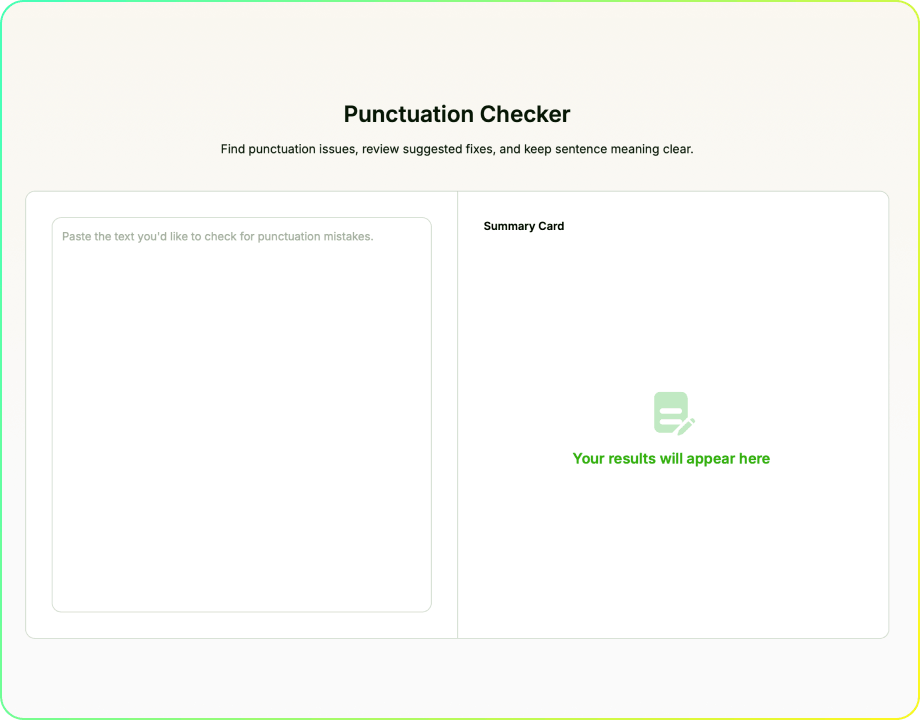
Punctuation Checker
Find punctuation issues, review suggested fixes, and keep sentence meaning clear.
Summary Card
Review Punctuation With EssayDone Punctuation Checker
Because punctuation carries structure, meaning, and attribution, a punctuation checker needs complete sentences rather than isolated marks.
Step 1: Review finished sentences. Use a stable draft so the punctuation checker can evaluate commas, boundaries, apostrophes, quotation marks, and other marks in context.
Step 2: Ask what the mark is doing. Run the punctuation checker, then inspect whether each suggestion affects structure, emphasis, attribution, or a required convention.
Step 3: Accept rules, preserve intent. Apply punctuation changes that clarify structure or meet the required convention, and dismiss suggestions that conflict with quotations, citations, names, or intentional style.
Punctuation Review That Keeps Meaning and Style Under Control
Marks That Change the Reading
EssayDone Punctuation Checker reviews pasted text for marks that may disrupt sentence boundaries, clause relationships, possession, quotations, lists, or readability. Highlighted issues make it easier to locate punctuation decisions that deserve another look.
Keeps Every Suggestion in Context
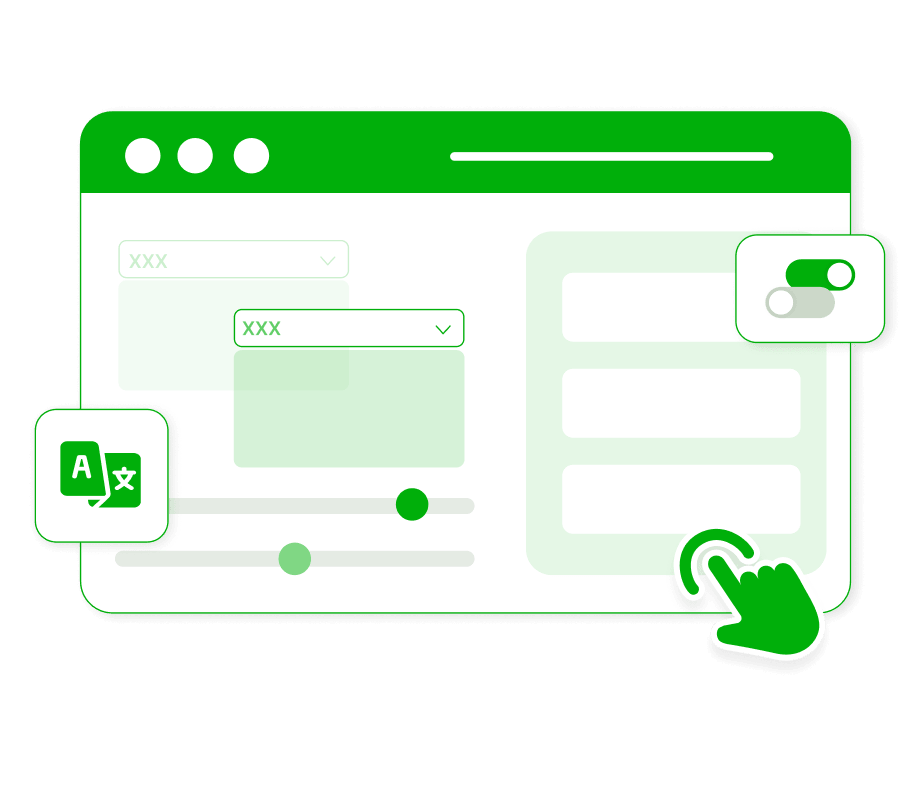
Choose the output language and number of outputs before starting the review.
Inspect each highlighted mark inside its complete sentence rather than judging punctuation in isolation.
Compare the suggestion with the sentence's clauses, intended meaning, and required writing convention.
Accept useful corrections and dismiss suggestions that would introduce a new error or change the intended structure.
Leaves the Final Punctuation Decision to You
Some marks are required by sentence structure, while others depend on meaning, emphasis, style guides, or regional convention. EssayDone shows possible issues without treating every punctuation choice as mechanically interchangeable.
See the Mark Inside the Sentence
Judge each mark inside the sentence it shapes, where clause boundaries, meaning, and style can be seen together.

Rule, Meaning, and Style Stay Separate
The review helps distinguish a structural error from a convention or an optional stylistic choice.
Accept Only the Change the Sentence Needs
Keep a suggestion when it clarifies the structure; dismiss it when the original mark is correct or required.

Punctuation for Formal and Everyday Drafts
Documents with inconsistent commas, quotations, dashes, lists, or boundaries need a dedicated punctuation pass.

Screen the Draft Before Close Proofreading
Locate likely punctuation trouble spots first, then spend close-reading time on ambiguous and style-dependent cases.

Consistency Becomes a Deliberate Choice
Track decisions for commas, quotations, dashes, lists, and English conventions across the document.
How to Check Punctuation in an Essay or Paragraph
A punctuation checker should help you find marks that make a sentence hard to read or change its meaning. Use an AI punctuation checker for a first punctuation check, then review the sentence in context before you accept every fix.
What a Useful Punctuation Check Should Catch
- Sentence boundaries: Check periods, question marks, and run-on sentences first. A punctuation corrector should help you see where one complete thought ends and another begins.
- Commas: Use a comma checker to review introductory phrases, lists, joined clauses, and places where a missing comma makes the sentence harder to follow.
- Oxford comma: If your style guide requires it, keep the final comma in a list. If it is optional, use it when it prevents ambiguity.
- Quotations and citations: Check punctuation around quotation marks and citations without changing the words or source information.
- Apostrophes and possessives: Confirm whether the mark shows possession, a contraction, or a plural form before you fix punctuation.
- Final context check: Read the sentence once without looking at the suggested mark. If the punctuation changes the meaning, pause and verify the rule instead of accepting the fix automatically.
Run a Fast Punctuation Check Before You Submit
A free punctuation checker can find suspicious marks quickly, but a good final pass separates real punctuation errors from optional style choices. Use this workflow to check punctuation in an essay, paragraph, or sentence without accepting every suggestion automatically.
The 5-Pass Punctuation Fix

Pass 1: Sentence Endings
Check periods, question marks, fragments, and run-on sentences first. Fixing sentence boundaries usually improves readability more than changing individual commas.

Pass 2: Commas
Use a comma checker to review introductory phrases, lists, joined clauses, and nonessential information. Ask whether removing the comma changes the structure or meaning.

Pass 3: Quotations and Citations
Check where quotation marks end, where the citation belongs, and where the sentence-ending punctuation should go. Keep the source's words separate from your own analysis.

Pass 4: Apostrophes and Possessives
Confirm whether the apostrophe marks possession or a contraction. Do not add one simply because a word ends in s.

Pass 5: Lists, Colons, and Semicolons
Use colons to introduce material after a complete clause and semicolons to connect closely related independent clauses or separate complex list items.
Worked Example: Does This Need a Comma?
Draft: “After reviewing the evidence the committee delayed the decision.”
- Corrected: “After reviewing the evidence, the committee delayed the decision.” The introductory phrase is separated from the main clause.
- Without Oxford comma: “The report thanked the mentors, Dr. Lee and Dr. Patel.” This can imply that the mentors are Dr. Lee and Dr. Patel.
- With Oxford comma: “The report thanked the mentors, Dr. Lee, and Dr. Patel.” This clearly identifies three separate groups.
- Use the required style guide when punctuation choices are optional.
- Some choices depend on the required style guide, house style, or instructor preference. If both versions are grammatically acceptable, choose one convention and use it consistently.
If a punctuation change affects meaning, source boundaries, or sentence structure, verify the rule before accepting it.
Run the tool after the content is stable so you do not spend time fixing punctuation in sentences you will later delete.
Review every flagged comma in context instead of assuming that more commas mean better punctuation.
Check one paragraph at a time when a long document contains many suggestions.
Need Help With the Next Part?
Move to the next step with tools for drafting, rewriting, checking, summarizing, and research.
 Outline GeneratorOrganize a topic into a practical structure before drafting.
 Introduction GeneratorDraft an opening around the topic, purpose, audience, and direction.
 Essay CheckerReview grammar, spelling, clarity, and sentence issues.
 Thesis Statement GeneratorTurn a topic and position into a focused central claim.
 Hook CrafterCreate opening lines suited to different topics, audiences, and formats.
 Conclusion GeneratorCreate a closing section from the claims and points already developed.
 ParaphraserRewrite text with controlled wording changes while preserving meaning.
 Essay EnhancerImprove clarity, flow, tone, and organization in an existing draft while keeping its core meaning.

Explore by Category
Writing
Punctuation Checker FAQ
Possible issues appear inside their complete sentences so you can inspect the mark, clause relationship, meaning, and required convention before accepting or dismissing a change.
The punctuation checker is free. Review each highlighted mark in its sentence because grammar, meaning, and style can support different choices.
Yes. Punctuation conventions vary by language, region, and publication style. Select the text language first. EssayDone can review the relevant punctuation patterns, while your required style guide remains the final authority.
It can flag possible issues involving commas, periods, apostrophes, quotation marks, colons, semicolons, dashes, parentheses, list punctuation, and sentence boundaries.
A punctuation checker concentrates on marks and sentence boundaries. A punctuation and grammar checker also reviews agreement, tense, articles, word forms, and broader sentence structure.
It may flag the boundary, but the repair can require more than adding a comma. Depending on the relationship, use a period, semicolon, coordinating conjunction, subordination, or a rewritten sentence.
Some decisions depend on style guides, regional English, emphasis, or the relationship the writer intends. When grammar and meaning allow either form, follow the required convention and apply it consistently.
Usually, when language-level editing tools are permitted. Review each suggestion yourself and follow any rule the course sets for AI-assisted editing.
Dismiss it when the original mark is required by a quotation, citation, name, format, or style guide, or when the proposed change alters the intended grammar or meaning.
🔗 References
Style guides and punctuation resources establish what a punctuation checker must distinguish: structural errors, meaning dependent choices, house style, and optional conventions.

- George Mason University Writing Center|Commas, Semicolons, and Colons
- Office for National Statistics Content Style Guide|Content Style Guide: Punctuation
- MLA Style Center|The Placement of a Comma or Period after a Quotation
- MLA Style Center|How Do You Punctuate a Question That Quotes a Question?
- The Chicago Manual of Style Q&A|Chicago Style Q&A: Semicolons