
 ZeroGPT
 GPTZero
 QuillBot
 Grammarly
 Copyleaks
 Scribbr
 Originality.ai
 Isgen.ai
 SciSpace
 Sapling
 Winston AI
 Undetectable AI
 Smodin
 Writer
 JustDone
 Phrasly
 Brandwell
 Crossplag
 DeCopy AI
 NoteGPT
 Surfer
 SurgeGraph
 AI Detector
 Walter Writes AI
 Merlin
 Monica
 Stealthwriter
 Humbot
 Rewritify
 YouScan
 AI-Detector
 RyRob
RyRob Turnitin
 Pangram
Sentence Rephraser
Rephrase a sentence into clearer wording while keeping the original meaning, tone, and paragraph fit intact.
Rephrase One Sentence With EssayDone Sentence Rephraser
A sentence rephraser must do more than change wording. When you rephrase this sentence or another sentence, the actor, action, conditions, certainty, and paragraph fit must remain correct.
Step 1: Isolate the real sentence problem. Provide the complete sentence and keep names, numbers, qualifications, and technical terms visible to the sentence rephraser.
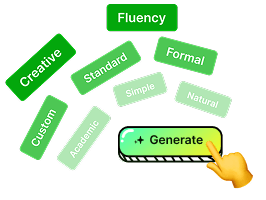
Step 2: Explore different forms. Set tone, language, and output count so the sentence rephraser can vary directness, emphasis, rhythm, and structure.
Step 3: Put it back in the paragraph. Check meaning first, then read the chosen sentence between the surrounding sentences to confirm tone and logical fit.
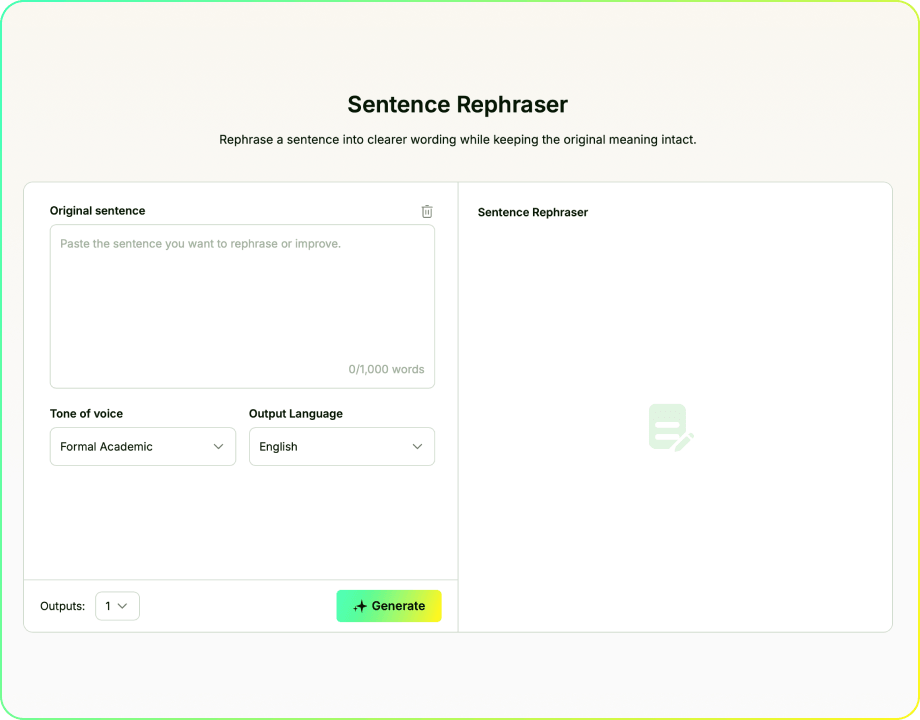
Focused Sentence Rephrasing Without Rebuilding the Paragraph
Focused Sentence Alternatives
EssayDone Sentence Rephraser creates alternatives for one complete sentence without automatically changing the surrounding paragraph. Use it when the idea is already useful but its wording, clause order, emphasis, or tone needs focused revision.
Controls Tone, Language, and Output Count
Choose a tone of voice that fits the reader and purpose of the sentence.
Select the output language before generating the rephrased versions.
Generate more than one output to explore different sentence structures and expressions.
Compare the alternatives instead of assuming that the version with the most noticeable changes is the strongest.

Makes Local Changes Easier to Evaluate
Because each output rewrites one sentence, you can compare the result directly with the original for meaning, tone, emphasis, and sentence structure. The final choice remains yours, including whether the new sentence still belongs naturally in its paragraph.
One Sentence, Several Useful Paths
Compare several local rewrites without disturbing the rest of a paragraph that already works.

Meaning Stays in View
Compare the actor, action, condition, attribution, and certainty before keeping a smoother version.

Drop It Back Into Context
Return the rephrased sentence to its paragraph and check terminology, transitions, tense, and voice.

Useful Across Everyday and Academic Writing
One awkward sentence can be revised locally while the surrounding paragraph stays intact.

Local Revision Without a Full Rewrite
Repair one troublesome sentence without reopening every sentence in an otherwise functional paragraph.

Choose by Function, Not Polish
Keep the version that fixes the named problem without shifting meaning or breaking the paragraph.
What Makes a Rephrased Sentence Actually Better?
When you rephrase a sentence, the goal is not simply to produce different wording. Strong sentence rephrasing helps readers find the main actor and action, follow the relationship between ideas, and recognize where the sentence places its emphasis.
Use the Actor-Action-Link-Landing Test
- Actor: Identify who or what performs the main action. Replace vague openings such as “it is believed” or “there are” when the responsible person, source, object, or process can be named clearly.
- Action: Keep the main actor reasonably close to the core verb. Compare “the researchers conducted an evaluation of the program” with the more direct “the researchers evaluated the program.”
- Link: Check how the clauses relate. Because introduces a reason, although signals a concession, if establishes a condition, and while may express time or contrast; changing the connector can change the sentence's logic.
- Landing: Examine the final phrase, where readers often expect important new information. Move routine background or minor details away from the end when they accidentally receive more emphasis than the main result.
- Context: Place every AI sentence rephraser output after the preceding sentence and before the following one. Its opening should connect through a repeated key term, a clear pronoun, or information the reader already knows; otherwise, a polished rephrase may still feel abrupt.
- Real paper example—Claude Shannon, “A Mathematical Theory of Communication” (1948): “The fundamental problem of communication is that of reproducing at one point either exactly or approximately a message selected at another point.” The sentence names one central problem, uses a precise core action, distinguishes two degrees of accuracy, and compresses the relationship through the parallel structure “at one point / at another point.”
Choose the Best Output From a Sentence Rephraser
An AI sentence rephraser can generate several grammatically correct alternatives, but only some will solve the original wording problem without damaging meaning or paragraph fit. Use this practical test to compare outputs instead of selecting the first sentence that sounds polished.
The Three-Output Rephrase Test

Save the Three-Sentence Window
Keep the previous and next sentence visible while reviewing the target sentence.

Create a Meaning Lock
Mark facts, conditions, names, numbers, attribution, and certainty that must not change.

Name One Rephrasing Target
Name the one problem the rewrite should solve: clarity, reference, structure, emphasis, or tone.

Generate Three Sentence Alternatives
Compare several versions by subject, verb, opening, ending, and clause structure.

Apply Five Pass-or-Fail Checks
Reject meaning changes; choose the version that fixes the target and fits the paragraph.
A Worked Three-Sentence Comparison
This example shows how to compare sentence rephraser outputs by accuracy and context rather than choosing the shortest or most fluent version.
- Context window—Previous: “The first survey measured commute time.” Target: “A reduction in reported stress was also observed by the researchers after flexible scheduling was introduced.” Next: “However, the six-week trial was too short to show whether the effect would last.”
- Output A: “Researchers also observed lower reported stress after introducing flexible schedules.” It keeps “reported,” makes the actor and action visible, and connects naturally to the limitation in the next sentence.
- Output B: “Flexible scheduling reduced employee stress.” Reject it: the sentence changes an observation into a causal claim, removes the qualification “reported,” and expresses more certainty than the original.
- Output C: “Following the implementation of flexible scheduling, a reduction in reported stress was observed.” It largely preserves meaning, but it retains the buried action and indirect structure that the rephrase was intended to improve.
- Selection: Choose Output A. It passes the Meaning, Target Fix, Entry Fit, Exit Fit, and Voice Fit checks. Output B is fluent but inaccurate; Output C is accurate but fails to solve the identified sentence problem.
The value of a free sentence rephraser comes from comparing outputs against a fixed goal, not accepting an automatic replacement. Keep a version only when you can explain what improved, what stayed intact, and why it fits between the surrounding sentences.
Reject output that changes the actor, negation, condition, attribution, number, logic, or certainty.
Generate three alternatives to reveal meaningful structural choices without endless browsing.
Read the previous, rephrased, and next sentence aloud to detect broken references, tone shifts, or weak connections.
Need Help With the Next Part?
Move to the next step with tools for drafting, rewriting, checking, summarizing, and research.
 Outline GeneratorOrganize a topic into a practical structure before drafting.
 Introduction GeneratorDraft an opening around the topic, purpose, audience, and direction.
 Essay CheckerReview grammar, spelling, clarity, and sentence issues.
 Thesis Statement GeneratorTurn a topic and position into a focused central claim.
 Hook CrafterCreate opening lines suited to different topics, audiences, and formats.
 Conclusion GeneratorCreate a closing section from the claims and points already developed.
 ParaphraserRewrite text with controlled wording changes while preserving meaning.
 Essay EnhancerImprove clarity, flow, tone, and organization in an existing draft while keeping its core meaning.

Explore by Category
Writing
Sentence Rephraser FAQ
Yes. Paste one complete sentence and generate alternatives using the selected tone, output language, and output count. Compare meaning, emphasis, and paragraph fit before keeping a version.
Multiple sentence options are available for free. Put each version back into its paragraph before deciding which one fits.
Yes. EssayDone Sentence Rephraser works across multiple languages. Choose the target language, then place the result back into its paragraph because translation can change tone, emphasis, or a necessary qualification.
QuillBot offers multiple paraphrasing modes, synonym controls, file upload, history, and mode comparison for sentence or passage rewriting. EssayDone Sentence Rephraser keeps the task at one sentence and lets you compare several outputs by tone, local structure, emphasis, and paragraph fit. Choose QuillBot for broad paraphrasing and mode experimentation; choose EssayDone when one sentence needs focused alternatives without rebuilding the whole passage.
Yes, but first identify the relationship the sentence must preserve. A clearer result may reorder clauses or divide the sentence, so check cause, contrast, condition, chronology, attribution, and certainty afterward.
Choose the tone of voice and number of outputs before generating. Compare how the alternatives change directness, formality, politeness, emphasis, and distance without assuming that the most noticeable rewrite is best.
Yes, but cite the source and preserve its meaning. A new sentence structure does not turn another author's idea into original work.
Use it for individual sentences in essays, reports, applications, emails, explanations, and other drafts where the surrounding paragraph already works.
Keep it when the alternatives change meaning, remove a necessary qualification, break the connection with nearby sentences, or offer only cosmetic differences with no clear improvement.
🔗 References
Sentence-level resources on word choice, voice, parallel structure, and cohesion provide the checks an AI sentence rephraser needs to preserve meaning while changing form.

- UNC Writing Center|Word Choice for Clear and Precise Writing
- Purdue Online Writing Lab|Academic Writing: Conciseness
- George Mason University Writing Center|Active and Passive Voice
- George Mason University Writing Center|Parallel Structure
- American Scientist|The Science of Scientific Writing