
 ZeroGPT
 GPTZero
 QuillBot
 Grammarly
 Copyleaks
 Scribbr
 Originality.ai
 Isgen.ai
 SciSpace
 Sapling
 Winston AI
 Undetectable AI
 Smodin
 Writer
 JustDone
 Phrasly
 Brandwell
 Crossplag
 DeCopy AI
 NoteGPT
 Surfer
 SurgeGraph
 AI Detector
 Walter Writes AI
 Merlin
 Monica
 Stealthwriter
 Humbot
 Rewritify
 YouScan
 AI-Detector
 RyRob
RyRob Turnitin
 Pangram
Summarizer
Condense text into a focused summary with the length, format, tone, and language you need.
Turn Text Into a Summary With EssayDone Summarizer
The right output from a summarizer depends on the next task, because screening, note taking, review, and drafting require different levels of detail.
Step 1: Give the main idea enough context. Use a complete, coherent passage so the AI summarizer can distinguish central claims from examples, qualifications, and conclusions.
Step 2: Match the format to the task. Set summary length, bullet or paragraph format, tone, language, and output count according to how closely you need to read.
Step 3: Return to the source. Verify claims, numbers, quotations, technical terms, and scope before using the summary for academic or professional work.
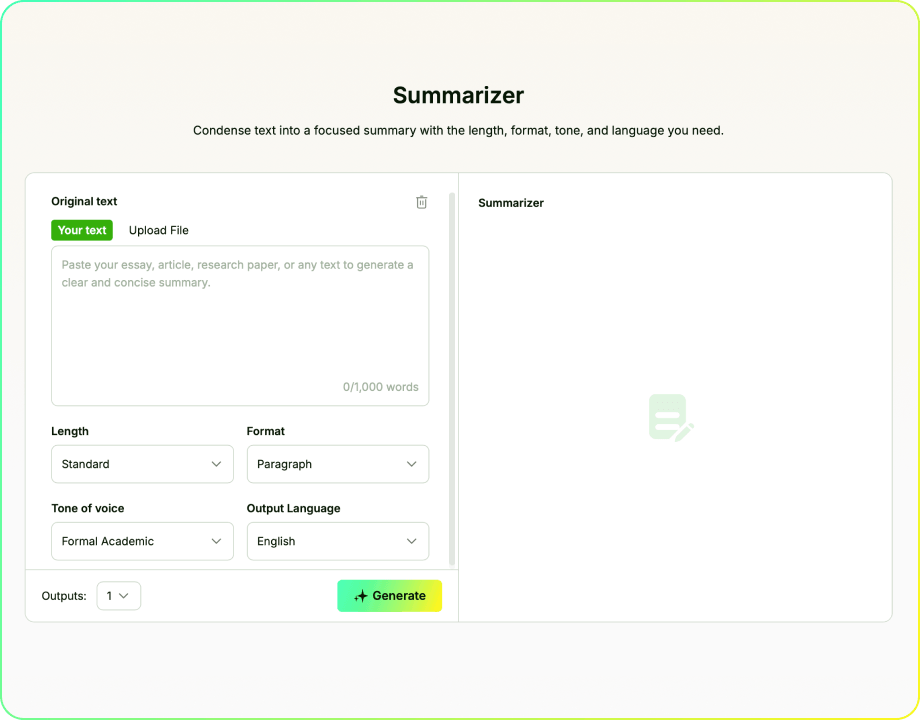
A Summary You Can Shape for Reading, Notes, or Review
Summary Settings With a Purpose
EssayDone Summarizer turns longer text into a focused overview without forcing every task into one output style. By choosing summary length, format, tone of voice, output language, and number of outputs, users can create a quick scan, structured notes, or a more detailed summary for review.
Shape the Summary for the Next Task
A brief overview works for screening; a fuller summary protects more context.
Bullets expose key points quickly, while paragraphs preserve relationships between ideas.
Tone and language settings help the output fit notes, review, or professional reading.
Multiple outputs let you compare emphasis before choosing the most useful version.

Useful for Reading and Writing Workflows
A useful summarizer tool should support what happens after generation. Use the summary to preview a text, locate important sections, prepare structured notes, identify questions for closer reading, or organize ideas before drafting—while returning to the original for evidence, quotations, methods, and full context.
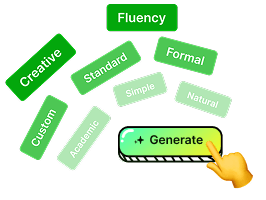
A Summary Built for the Task
Choose whether the next task needs a quick scan, structured notes, or a fuller overview, then set the summary depth accordingly.

See the Structure Before Close Reading
The AI summarizer surfaces the central idea, major relationships, and supporting points in long text.

From Overview to Working Notes
Turn the result into questions, source cards, outline cues, and items to verify.

Handles More Than Academic Articles
Long reports, study materials, meeting notes, and professional documents can be screened before closer reading.

Faster Triage, Not Faster Assumptions
Use a quick overview to decide what deserves full reading, what can be skimmed, and what needs verification.

Let the Reading Question Lead
Choose summary depth according to whether you need relevance, evidence, methods, or context.
How to Summarize Text Without Losing the Main Idea
Use an AI text summarizer when you need to turn long text into a focused summary without losing the main claim, strongest support, or important limits. Whether you need to summarize an essay, article, paragraph, or conclusion, start by deciding what the reader still needs after the details are removed.
What a Good AI Summary Should Keep
- Main idea: Identify the single point the text is trying to explain, argue, report, or prove before you summarize text.
- Key support: Keep the strongest evidence, reason, example, or result needed to understand why the main idea matters.
- Scope and limits: Preserve conditions, uncertainty, time period, sample, exceptions, or other details that keep the summary accurate.
- Structure: Keep the relationship between ideas—cause, contrast, sequence, or qualification—so the shortened version does not change the logic.
- Length: Match the summary to the task. A sentence summarizer may compress one passage into a line, while an essay summarizer may need several sentences.
- Quick check: After the AI summarizer creates a draft, ask whether someone could recover the source's main idea and strongest support from the summary alone.
Turn an AI Summary Into Useful Study Notes
An AI summarizer can give you a fast first draft, but the most useful summary is one you can verify, remember, and reuse. This workflow helps you summarize text, check the main idea, and turn the result into notes you can actually study from.
The 5-Step Summary Check

Start With the Main Idea
Before you summarize this text, write one sentence that states what the source is mainly trying to say. Compare that sentence with the AI summary.

Check the Strongest Support
Keep the evidence, reason, example, or result that makes the main idea understandable. Remove details that are interesting but not necessary.

Restore Missing Limits
Look for words such as may, only, in this sample, under these conditions, or according to the author. Put back any limit the summary writer removed.

Match the Length to the Task
A sentence summarizer is useful for one compact passage; an essay summarizer may need several sentences to preserve the argument. Shorter is not automatically better.

Verify Against the Source
Reopen the original and check names, numbers, quotations, technical terms, and the conclusion before you rely on the summary.
Use the Summary for the Right Job
Study notes, reading previews, essay planning, and source screening need different levels of detail. Choose the shortest version that still supports the task.
- Example: Main Idea vs. Detail
- Source: “The pilot improved attendance in two schools over six months, but the authors caution that the result may not generalize to other districts.”
- Weak summary: “The program improved attendance.” Better summary: “A six-month pilot at two schools improved attendance, but the authors warn that the result may not generalize.”
- Why the Better Version Works
- It keeps the main finding, time frame, setting, and limitation instead of keeping only the positive result.
Before using a summary for study or writing, verify the main idea, strongest evidence, conclusion, and any limits against the original source.
Close the source and explain its main point in one sentence. If your summary says something different, revise it.
Keep the strongest support for the main claim, not every example.
If you use a free AI summarizer, treat the output as a draft and verify facts before using it in assessed work.
Need Help With the Next Part?
Move to the next step with tools for drafting, rewriting, checking, summarizing, and research.
 Outline GeneratorOrganize a topic into a practical structure before drafting.
 Introduction GeneratorDraft an opening around the topic, purpose, audience, and direction.
 Essay CheckerReview grammar, spelling, clarity, and sentence issues.
 Thesis Statement GeneratorTurn a topic and position into a focused central claim.
 Hook CrafterCreate opening lines suited to different topics, audiences, and formats.
 Conclusion GeneratorCreate a closing section from the claims and points already developed.
 ParaphraserRewrite text with controlled wording changes while preserving meaning.
 Essay EnhancerImprove clarity, flow, tone, and organization in an existing draft while keeping its core meaning.

Explore by Category
Writing
Summarizer FAQ
A complete, coherent passage gives the tool enough context to identify the central idea, key relationships, and essential support. Length, format, tone, language, and output count shape the result.
Yes. Paste the text and generate a summary without paying or creating an account. Use the controls to match a quick scan, study notes, or a fuller overview, then return to the source for evidence and exact wording.
It can condense essays, articles, reports, study material, research passages, meeting notes, explanations, and other coherent text. Complete input gives the text summarizer more context than isolated sentences or disconnected fragments.
Choose a shorter or more detailed result, bullet or paragraph format, tone of voice, any supported output language, and the number of versions. Use the language menu rather than assuming the tool is limited to English; the best combination depends on what you need to do next.
A shorter setting creates less room for context and support, so omissions become more likely. It may still be right for screening, while a detailed summary is safer when reasoning, qualifications, or evidence matter.
Use it to preview a reading, organize notes, or locate sections for closer study. Read and cite the original source whenever its ideas, evidence, or wording enter your work.
Return to the original source. Verify every quotation, statistic, name, unit, technical term, and claim before using it. Quote and cite the source itself rather than treating the generated summary as evidence.
Use a summary for orientation or relevance screening, not as a replacement when you need evidence, methods, limitations, exact wording, or a decision with academic or professional consequences.
Yes. Choose the number of outputs before generating. Differences between versions can reveal changes in emphasis, but they should prompt source checking rather than a vote for whichever point appears most often.
🔗 References
Reading, note-taking, and summarization guidance defines what an AI summarizer should retain: central ideas, supporting relationships, essential context, and a clear reason to return to the source.

- University of Toronto Writing Advice|Researching: Summarizing Sources
- Princeton McGraw Center for Teaching and Learning|Active Reading Strategies: Remember and Analyze What You Read
- University of Toronto Writing Advice|Taking Notes from Research Reading
- Yale Poorvu Center for Teaching and Learning|AI Guidance for Students
- Microsoft Learn|AI Summary Transparency Note