






GPTHuman.ai Review: We Tested Its Free Humanizer

If you're considering trying GPTHuman.ai, you probably want to know two things:
- Will its rewrites sound natural enough to actually use?
- Will GPTZero and other AI detectors still flag your text?
We tried GPTHuman's free Humanizer on two very different pieces of writing: an academic paragraph and an everyday email.
One rewrite became longer and introduced a detail that wasn't in the original. The email was easier to read, but the detectors disagreed about it. That contrast raises an important question: does a lower AI score actually mean better writing?
Here's what happened in our tests, what the free trial includes, and whether the tool is worth paying for.
How the free trial worked
We tested gpthuman.ai, not the similarly named gpthuman.org. The public homepage lets you paste custom text, but selecting “Humanize My Text” sent our first attempt to account registration. After sign-in, the dashboard showed a Free plan with 300 available credits and an active Humanizer. No credit card was needed. The editor showed a credit estimate before submission, accepted the academic passage (59 words in its editor, 60 by a whitespace count) and a 61-word email, then returned full editable results. The site saved both in history.
The official pricing page calls this a 300-word trial, with a 300-word maximum per output and limited AI Detector use. The editor labels its balance as credits, so watch the live estimate rather than assuming “300 words” and “300 credits” are always identical. We used the built-in detector once on the academic source: it gave a 0.78% Human Score. Later, with 67 credits left, a scan of the longer academic rewrite asked for 102 credits and showed “Insufficient Credits.” The rewrite page itself had already shown Human Score, Readability, and Similarity for both outputs.
For both rewrites, we used the logged-in editor's Professional / Balanced setting on November 16, 2026. Both source passages were AI-written test inputs. The academic scenario is hypothetical and designed to expose meaning changes; it is not a real study finding.
Academic test: the score improved, but the prose did not
Original input, 60 words by whitespace count (59 in GPTHuman’s editor)
In a hypothetical 12-week pilot involving 84 students, optional study sessions were associated with higher attendance, but the data did not establish that the sessions caused the increase. Two students withdrew before the final survey. The comparison did not adjust for students' prior attendance, and participants chose whether to attend the sessions. These limitations make a causal interpretation especially uncertain.
Complete GPTHuman output, 105 words
In this hypothetical example, a 12 week pilot project conducted with 84 students, made it so students could attend optional study sessions. In this case, it seems that the students who attended these study sessions had higher attendance rates, although this does not necessarily mean that the study sessions are causing the improvement in attendance. Also, 2 students dropped out of the study before the final survey could be conducted. There was no adjustment made for previous attendance rates of students, and students had the option to attend the study sessions or not. For this reason, it is particularly hard to draw conclusions about causality.
The rewrite keeps 84 students, 12 weeks, optional sessions, and the warning against a causal conclusion. But “made it so students could attend” adds an unsupported claim that the pilot created the sessions. “Dropped out of the study” is more specific than “withdrew before the final survey”; the original does not say they left the study itself. The first sentence has an unnecessary comma between subject and verb, and several phrases repeat “students” or “study sessions.” The output is 45 words longer and less fluent than the input.
The Humanizer displayed Human Score 98.99%, Readability 46.1, Similarity 95.7%. In external checks, GPTZero moved from 100% AI on the original to 36% AI / 64% human on the rewrite. ZeroGPT rated the rewrite 0% AI, and Copyleaks marked 0 of 105 words as AI text, compared with 60 of 60 words as AI text in the source. The score gains are real observations. They do not fix the added claim or the clumsy first sentence.
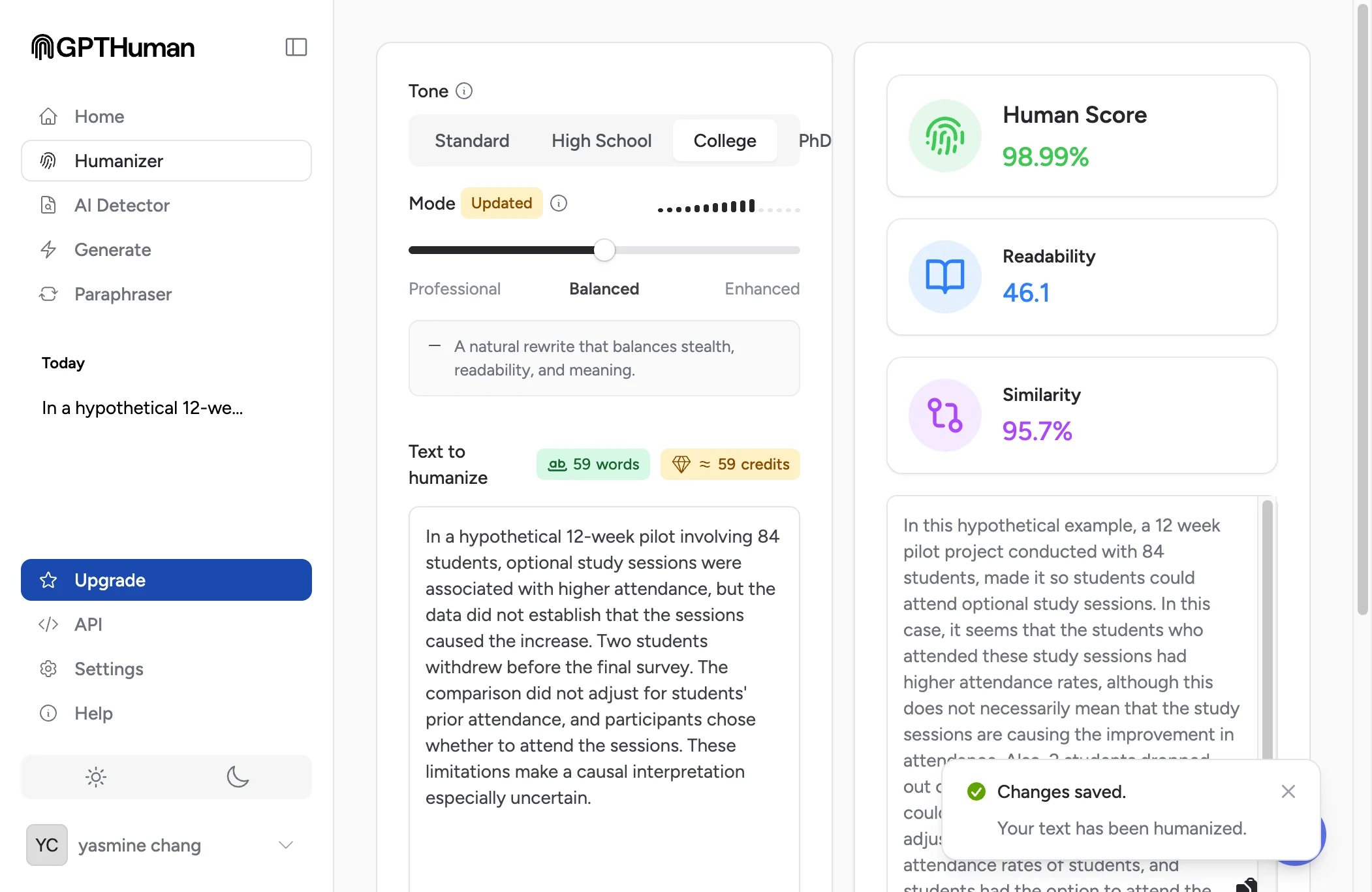
The editor shows the full academic rewrite and its 98.99% Human Score. Read the first sentence: the high score does not flag the added claim about what the pilot made possible.
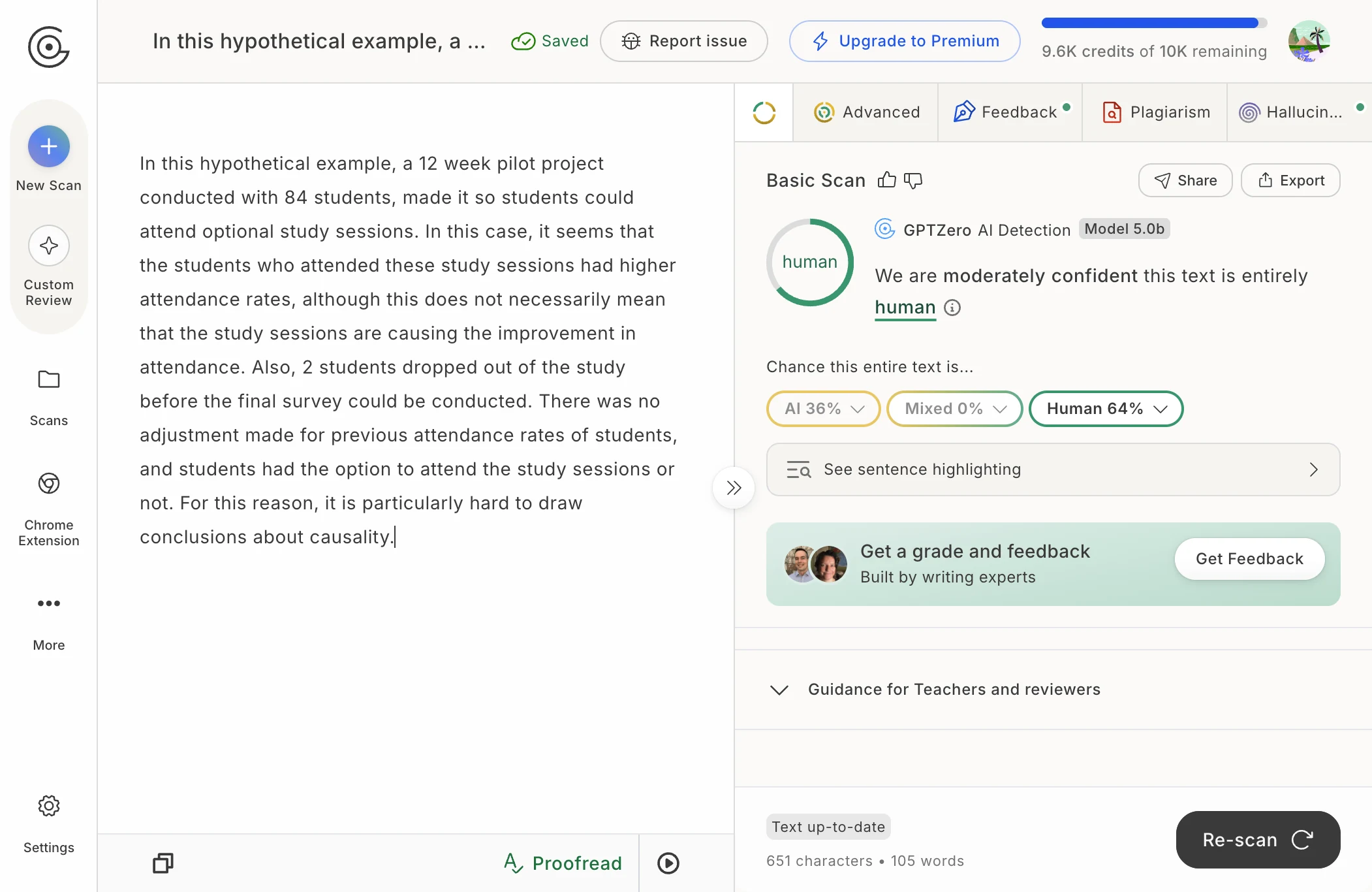
GPTZero gave this academic output a mixed probability rather than calling it fully human.
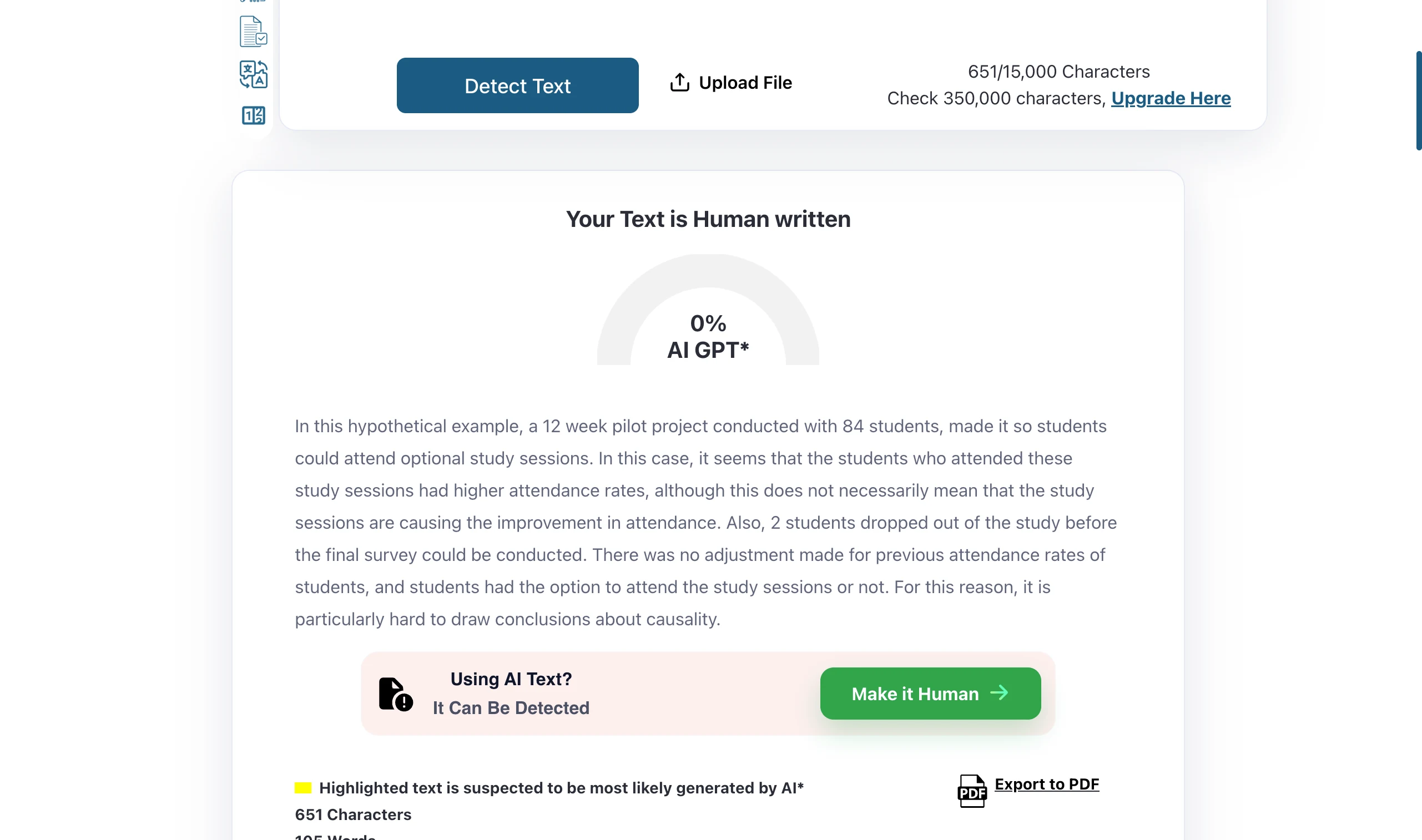
ZeroGPT labeled that same saved output human written at 0% AI, showing the disagreement between detectors on an unchanged text.
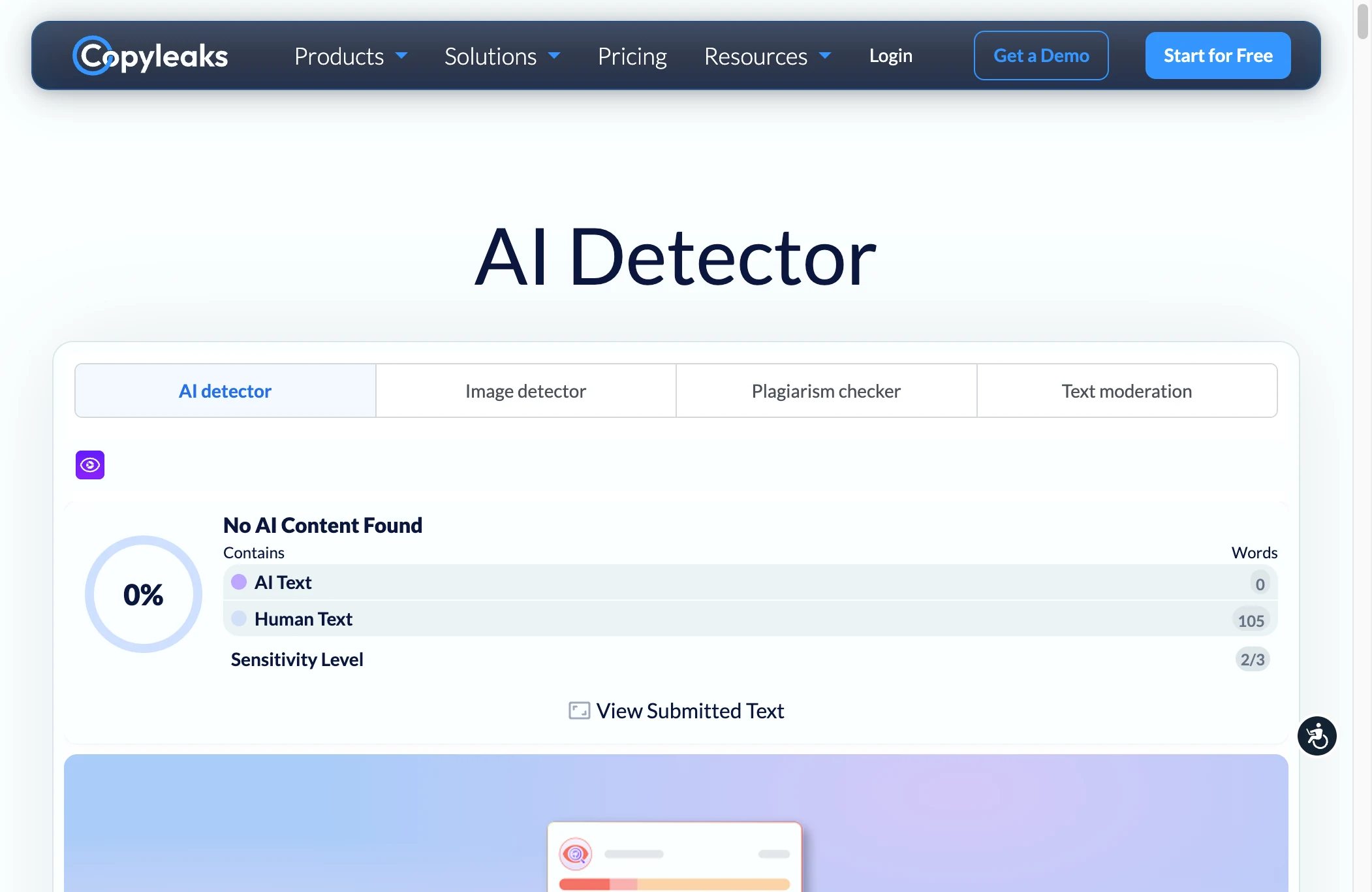
Copyleaks marked none of its 105 words as AI text; this result does not resolve the meaning error visible in the rewrite.
Email test: readable text, conflicting detector verdicts
Original input, 61 words
Hi Maya, I can send the draft by Thursday afternoon, but I cannot attend Friday's call. Could you put your comments in the document by noon on Friday? I will reply after 3 p.m. The figures in section two are still provisional, so please do not forward that page to the client yet. I will send a confirmed chart on Monday.
Complete GPTHuman output, 72 words
Hello Maya. I can get the draft to you by Thursday afternoon. Unfortunately, I won't be available for the call on Friday. I would like you to leave your comments in the document by noon Friday, and I will respond in the afternoon after 3 p.m. The numbers in section two are still preliminary. Please do not send that page to the client. I will get you a confirmed chart on Monday.
This is a usable rewrite after a quick edit. It keeps Thursday delivery, Friday's missed call, the noon request, the after 3 p.m. response, the warning not to send the provisional page, and Monday's confirmed chart. “Figures” becomes “numbers,” which may be too narrow if section two includes charts, but it does not reverse the sender's commitments. “I would like you to leave your comments” sounds more formal than the original's friendly request; that is a voice choice, not a factual error.
Oddly, the Humanizer displayed a much lower Human Score of 8.98% for this stronger email, alongside Readability 73.6 and Similarity 97.7%. ZeroGPT rated it 0% AI, and Copyleaks marked 0 of 72 words as AI text. GPTZero disagreed sharply: 100% AI, with its beta “Possible AI Paraphrasing” label. GPTZero also rated the original email 100% AI. These are different classifiers with different labels, and the results demonstrate why a vendor's own Human Score cannot stand in for external tests.
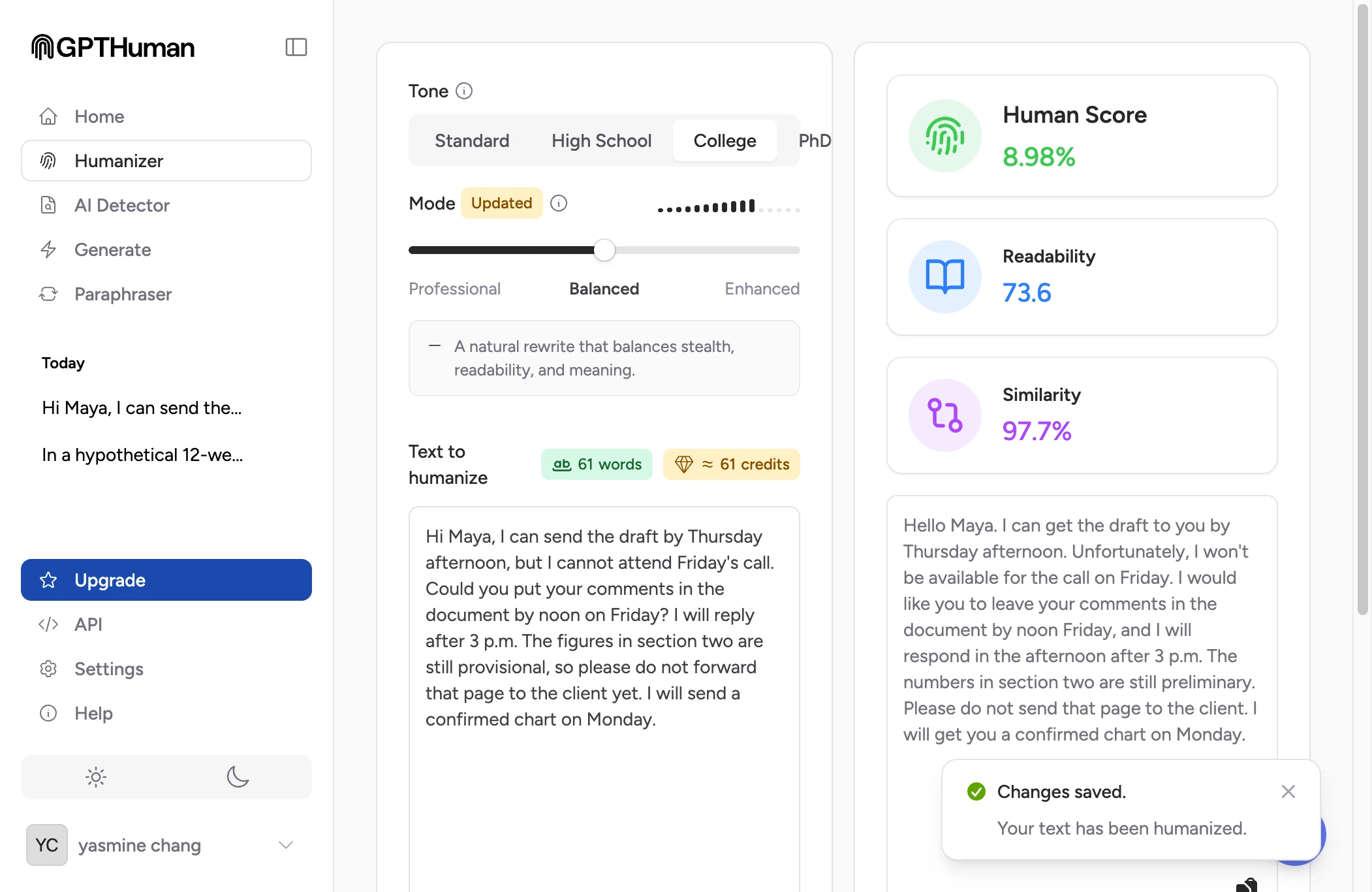
The email rewrite preserves the main deadlines, although GPTHuman's own Human Score falls to 8.98% on this more usable passage.
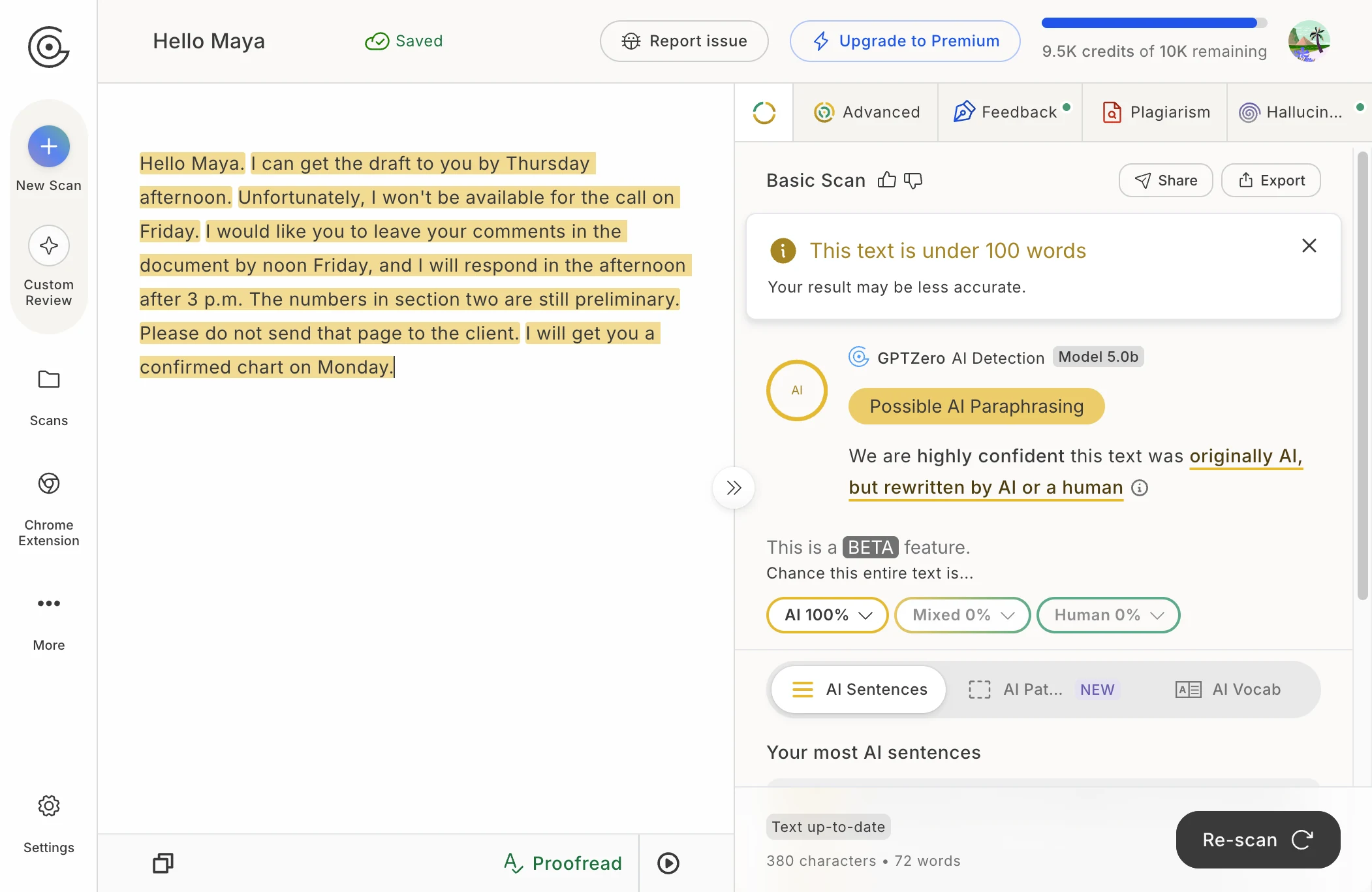
GPTZero called the rewritten email 100% AI and added a Possible AI Paraphrasing label, despite its readable wording.
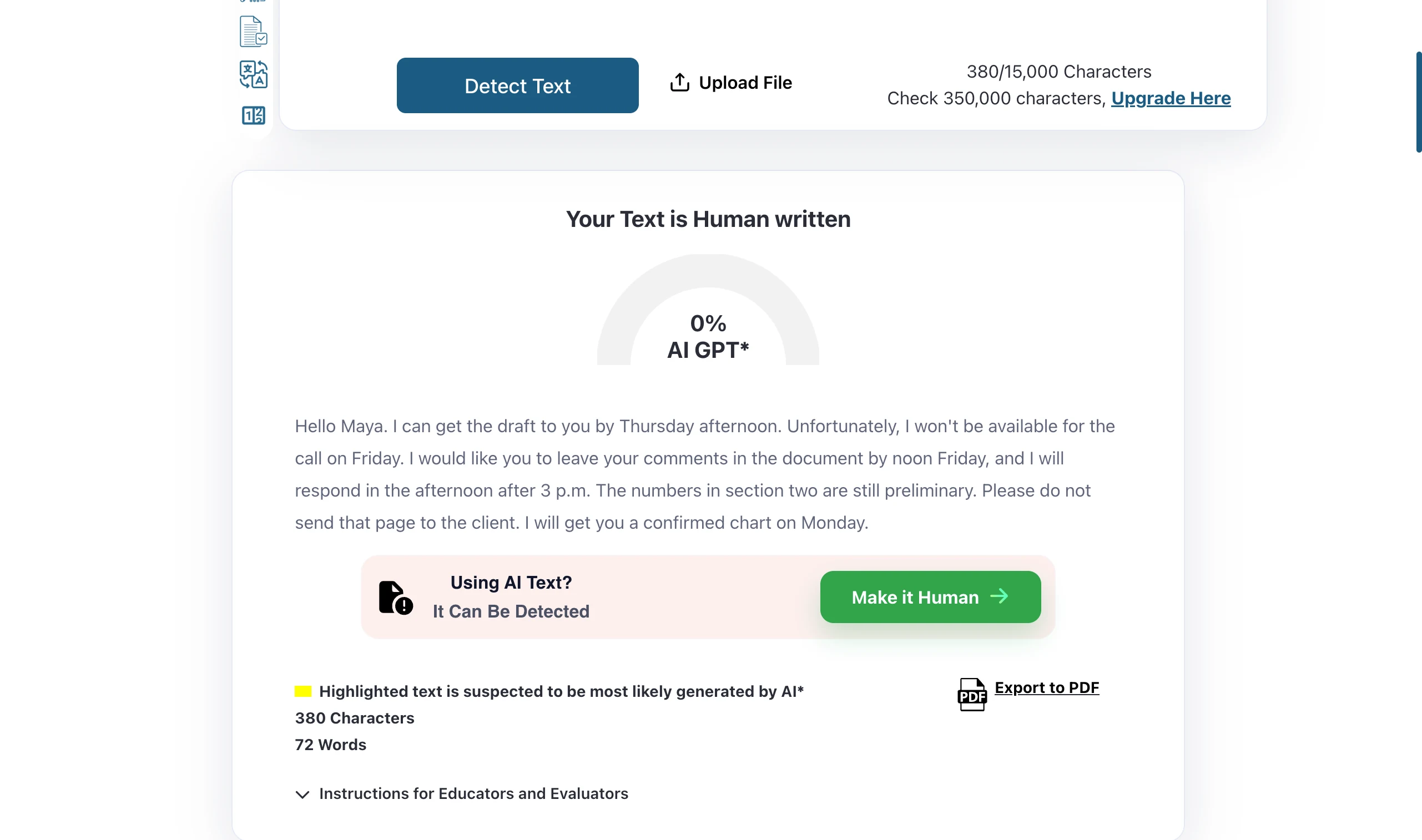
ZeroGPT returned 0% AI for the exact same email. A reader deciding whether to send it still needs to check the commitments, not pick the preferred score.
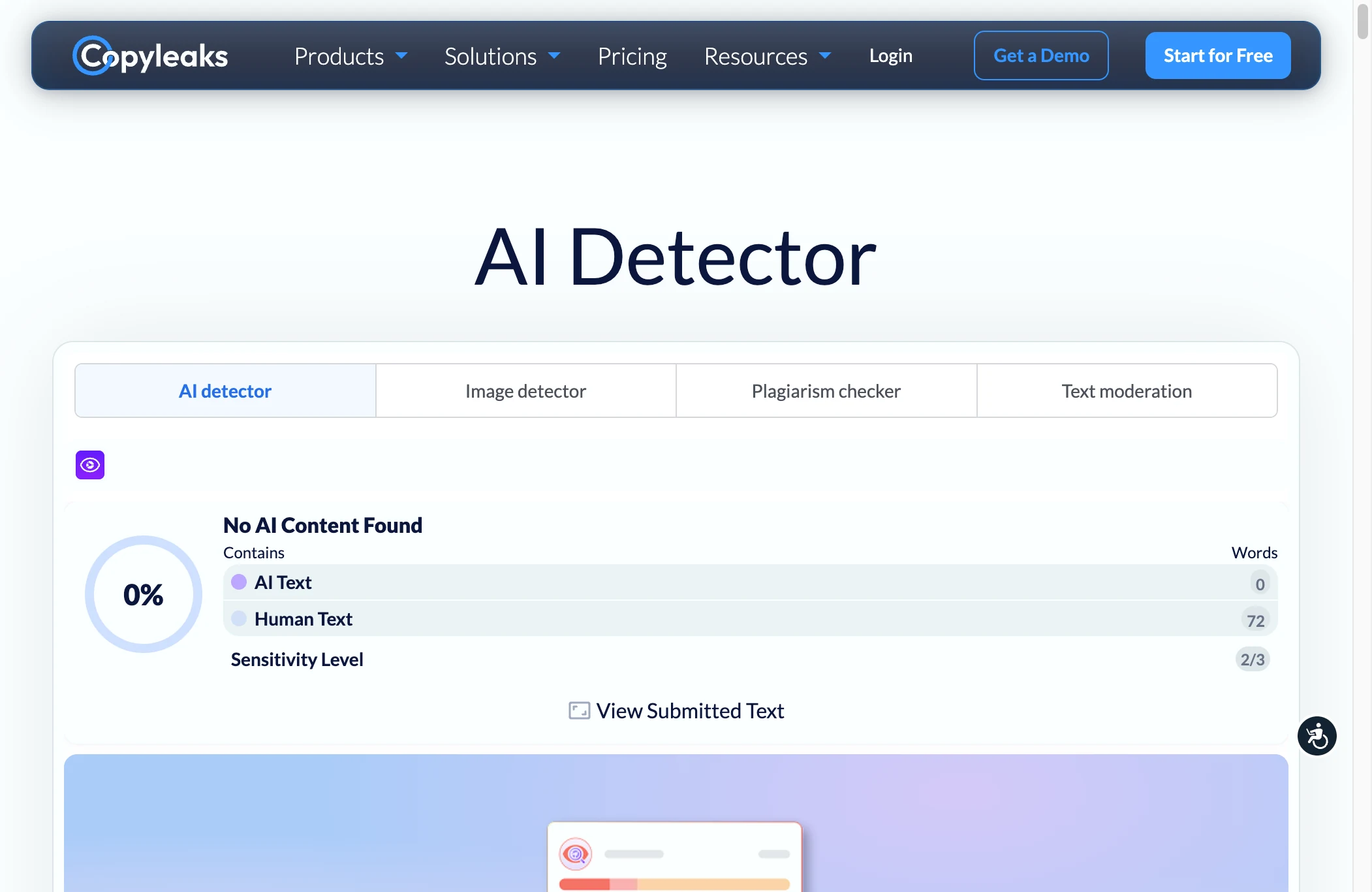
Copyleaks marked 0 of 72 words as AI text, agreeing with ZeroGPT's broad classification rather than GPTZero's.
Test results at a glance
| Sample | GPTZero | ZeroGPT | Copyleaks |
|---|---|---|---|
| Academic | 36% AI / 64% human | 0% AI | 0 of 105 words flagged as AI |
| 100% AI; Possible AI Paraphrasing | 0% AI | 0 of 72 words flagged as AI |
Copyleaks did not flag any words in these outputs as AI-generated. This does not prove human authorship.
- Academic: The rewrite became wordier and introduced an unsupported claim.
- Email: The rewrite was more readable and preserved the main deadlines.
Free and paid limits
| Plan | Price | Monthly allowance | Maximum per output |
|---|---|---|---|
| Free trial | $0 | 300 words to test | 300 words |
| Starter | $15/month; $99/year ($8.25/month) | 25,000 words | 1,000 words |
| Plus | $25/month; $168/year ($14/month) | 60,000 words | 1,500 words |
| Unlimited | $49/month; $312/year ($26/month) | Advertised unlimited, with abuse guardrails | 2,500 words |
These figures come from GPTHuman's public pricing page. The checkout-style upgrade modal we saw inside the app advertised 2,000 words per output for Unlimited, rather than the public page's 2,500. The older trial help page also gives a different Plus credit figure. If a per-output limit determines your purchase, confirm the limit in the actual checkout before paying. “Unlimited” describes monthly volume, not an unlimited single document.
Is GPTHuman.ai worth paying for?
For everyday rewriting, it is promising; for detector guarantees or unreviewed academic text, it is not. The email preserved all important timings and read naturally, while the academic rewrite became wordier and introduced a claim about what the pilot did. External detectors judged the same email in opposite ways. We would not buy a subscription on the promise of a universal detector pass, and we would not use the academic output without correcting it.
A paid plan makes sense only if the free output saves you editing time on the kind of text you write often, and if its output cap fits your documents. The free trial is enough to discover that. Save the source, compare each changed claim, and treat detector results as separate measurements rather than a quality grade. In our test, the email with the better readability received the worse GPTZero result; that is precisely why writing quality and detector classification need separate judgments.
If you want another version to weigh against GPTHuman's, try EssayDone Humanizer on a paragraph you know well and read both outputs beside the source. You should be able to recognize your facts, timing, and voice in the final draft; that is a better reason to keep a sentence than a reassuring detector label.