






Clever AI Humanizer Review: Is This Free Tool Worth It?

Clever AI Humanizer is a free online tool that rewrites AI-assisted drafts to make the wording sound more natural. You paste in your text, choose a style, and get a revised version to work with. With up to 3,000 words per request, it gives you room to try more than a few sentences.
In our test, Clever’s rewritten text received a 96% Human result from GPTZero, while ZeroGPT still flagged it as 100% AI. The rewrite was readable, although some sentences became longer and needed editing. That gives you two useful things to examine: how the wording changes and how different detectors judge the same passage. Here is a closer look at Clever’s features, free limits, results, and alternatives.
What Is Clever AI Humanizer?
Clever AI Humanizer revises wording, sentence structure, and tone in an existing draft. It is useful when you already have the ideas but want another way to express them. It does not do the research for you or supply evidence for an unsupported claim.
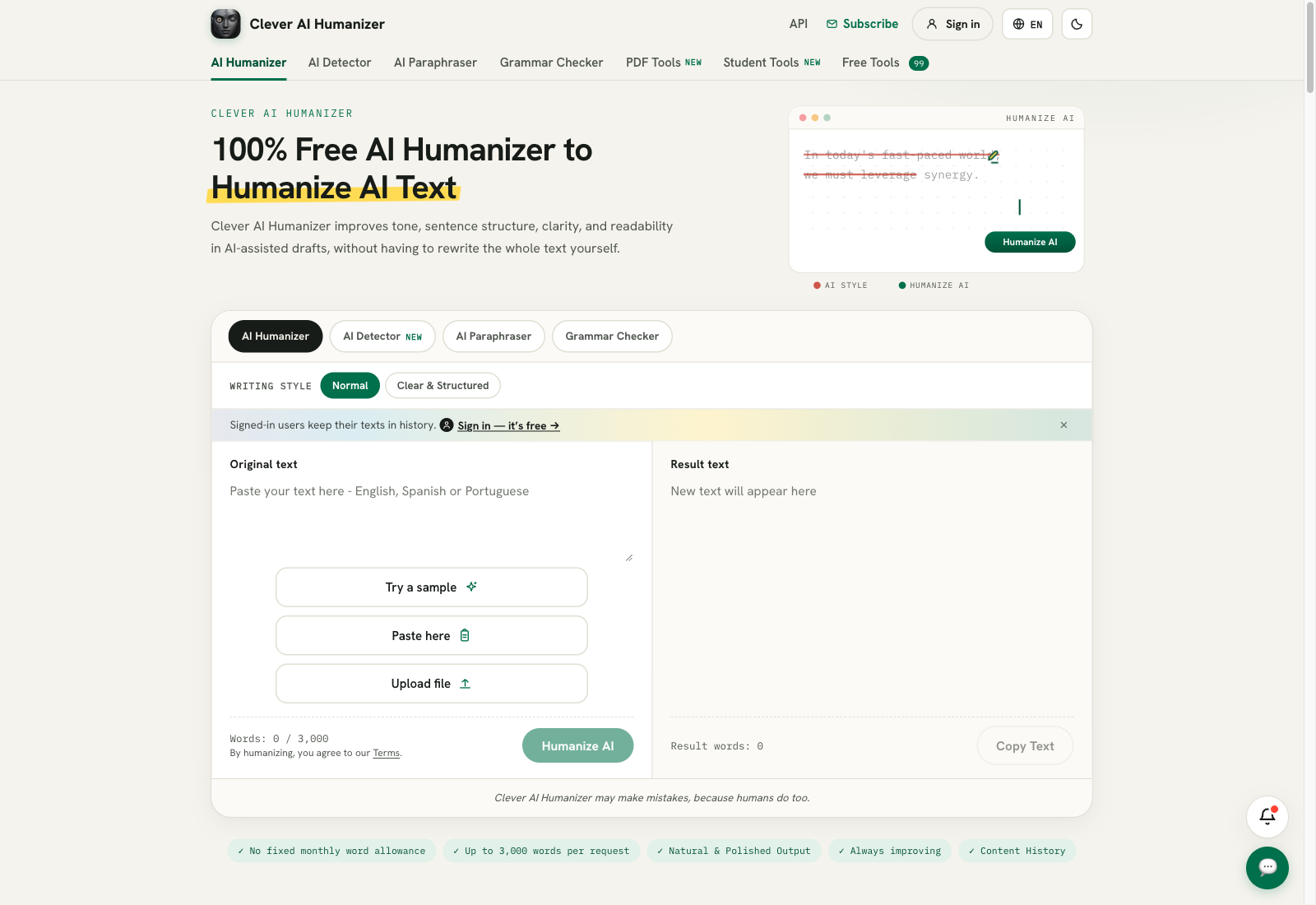
Clever’s free humanizer interface, including its writing styles and request limit.
The current tool offers two styles: Normal for straightforward, friendly writing, and Clear & Structured for reports and summaries. It supports English, Spanish, and Portuguese. The website also has separate detector, paraphrasing, and grammar-checking tools.
One helpful feature is Show changes, which highlights the edits beside your original. In the test capture, Clever also offered two output versions, with Version 1 marked Best Pick. That side-by-side view makes it easier to decide which changes you actually want to keep.
Is Clever AI Humanizer Really Free?
Yes. At the time of checking, the official Clever AI Humanizer page lists the service at $0, with no fixed monthly word allowance. Here is the free offer as of November 11, 2026:
What you get | Current free offer |
|---|---|
Price | $0 |
Maximum input | 3,000 words per request |
Monthly allowance | No fixed monthly word cap; service availability applies |
You can use the humanizer without registering. A free account adds text history, so signing up is mainly useful if you want to return to earlier drafts. “No fixed monthly allowance” does not mean uninterrupted access: processing can still be restricted by service capacity.
How to Use Clever AI Humanizer
The basic workflow is short. Start with a passage you understand well so you can spot a change in meaning.
Open Clever AI Humanizer and paste your draft into the original-text box.
Choose Normal or Clear & Structured for the kind of document you are editing.
Select Humanize AI, then compare the result with your original using Show changes.
Keep the useful edits, check any altered facts or qualifications, and copy the version you want to use.
For an essay with a word limit, check the length again after rewriting. A tool can make a paragraph more conversational while adding words you do not need. The example below shows exactly that trade-off.
Testing Clever AI Humanizer: The Original and the Rewrite
For this review, we examined a test sequence supplied to EssayDone on November 11, 2026. It began with a ChatGPT passage about sustainable living for university students. The prompt asked for a short explanation and practical examples:
Write a 180-word informative text for university students on the topic “Why Is Sustainable Living Important?” Explain what sustainable living means and give a few practical examples.
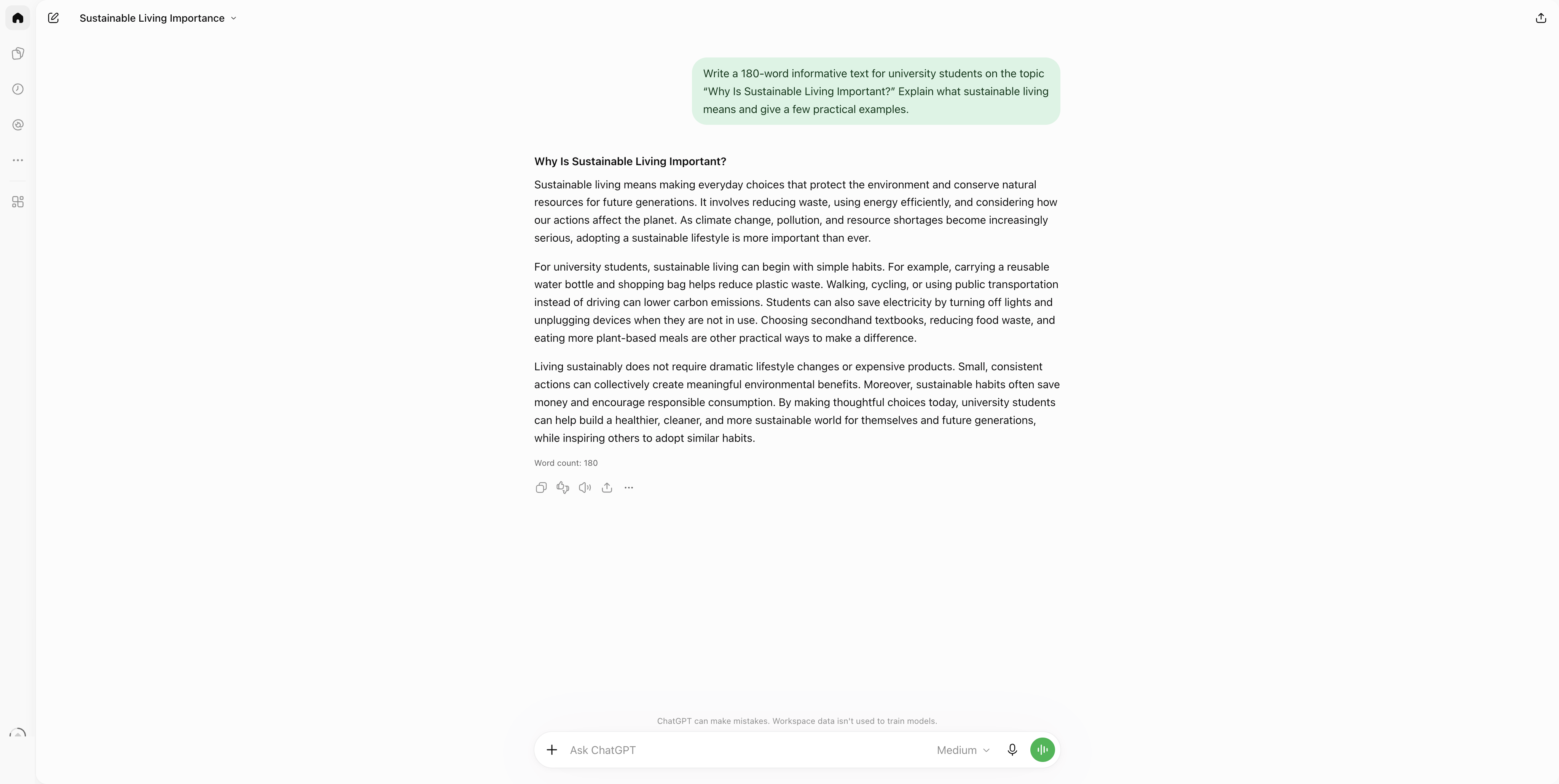
Original ChatGPT prompt and passage supplied for this review.
The submitted text contained 189 words including its title. Clever’s selected Version 1 contained 204 words and showed 36 changes. The examples stayed familiar—reusable bottles, public transport, saving electricity, and secondhand textbooks—but the wording became more conversational.
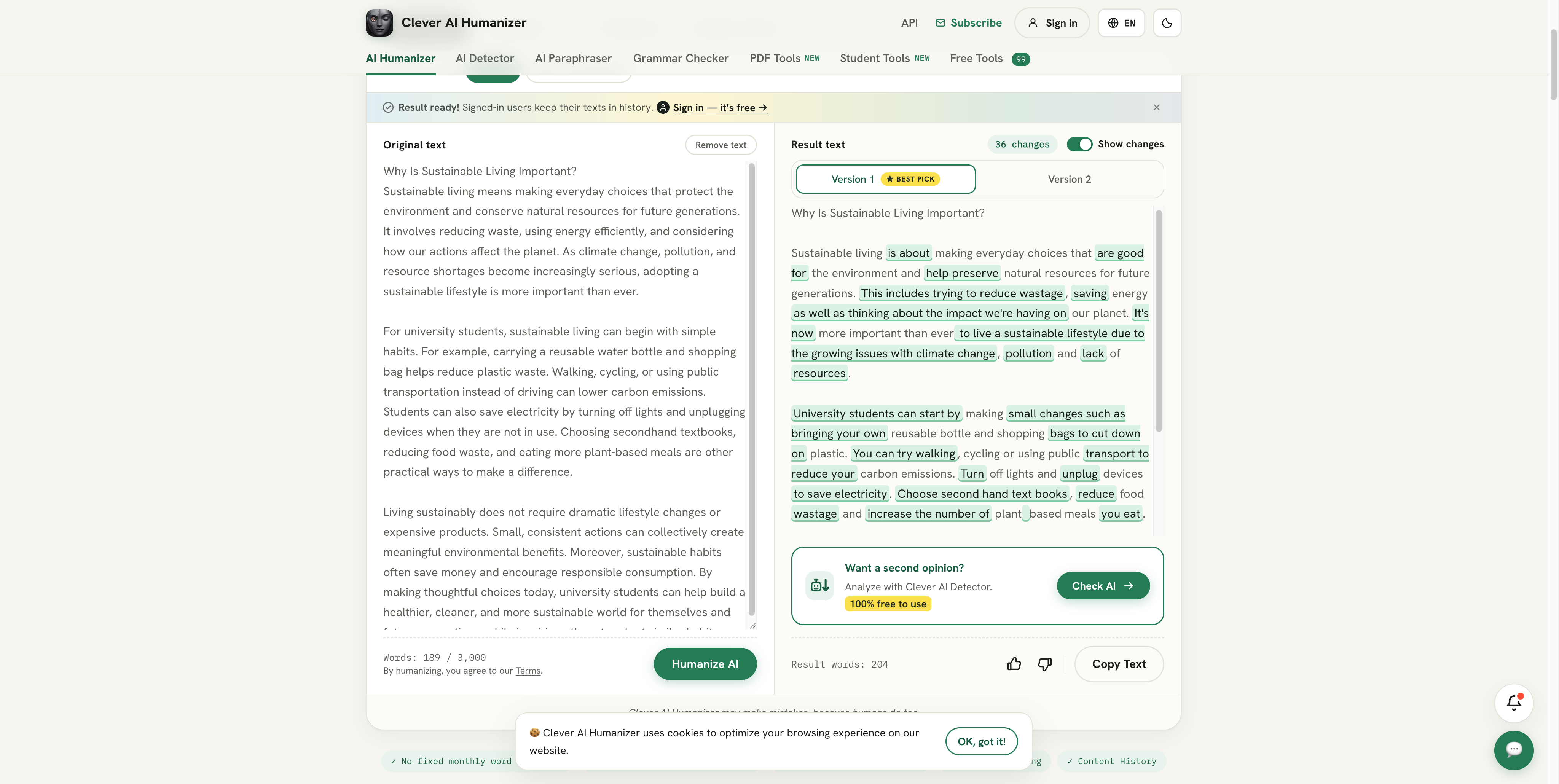
Selected Clever output: Version 1, labeled Best Pick, with 36 changes.
That is an extra 15 words, roughly an 8% increase. It is a small difference for a blog paragraph, but it means this rewrite would need trimming for a strict 180-word task.
Read the complete original and rewritten passage
Original passage
Why Is Sustainable Living Important?
Sustainable living means making everyday choices that protect the environment and conserve natural resources for future generations. It involves reducing waste, using energy efficiently, and considering how our actions affect the planet. As climate change, pollution, and resource shortages become increasingly serious, adopting a sustainable lifestyle is more important than ever.
For university students, sustainable living can begin with simple habits. For example, carrying a reusable water bottle and shopping bag helps reduce plastic waste. Walking, cycling, or using public transportation instead of driving can lower carbon emissions. Students can also save electricity by turning off lights and unplugging devices when they are not in use. Choosing secondhand textbooks, reducing food waste, and eating more plant-based meals are other practical ways to make a difference.
Living sustainably does not require dramatic lifestyle changes or expensive products. Small, consistent actions can collectively create meaningful environmental benefits. Moreover, sustainable habits often save money and encourage responsible consumption. By making thoughtful choices today, university students can help build a healthier, cleaner, and more sustainable world for themselves and future generations, while inspiring others to adopt similar habits.
Clever Version 1 rewrite
Why Is Sustainable Living Important?
Sustainable living is about making everyday choices that are good for the environment and help preserve natural resources for future generations. This includes trying to reduce wastage, saving energy as well as thinking about the impact we're having on our planet. It's now more important than ever to live a sustainable lifestyle due to the growing issues with climate change, pollution and lack of resources.
University students can start by making small changes such as bringing your own reusable bottle and shopping bags to cut down on plastic. You can try walking, cycling or using public transport to reduce your carbon emissions. Turn off lights and unplug devices to save electricity. Choose second hand text books, reduce food wastage and increase the number of plant based meals you eat.
Living a sustainable lifestyle doesn't have to be a big change. Making small changes will all add up to make a positive impact on the environment. Sustainable choices usually save you money and encourage you to be a responsible consumer. University students can help create a healthier, cleaner and more sustainable world for themselves and future generations by making conscious choices. This can also encourage others to do the same.
Test Results: Can Clever Lower AI Detection Scores?
Clever’s own detector gave the original passage a 99% AI reading. After rewriting, the reading fell to 51% AI—a drop of 48 percentage points. The new label was Unclear, so the tool had changed its assessment without classifying the result as clearly human.
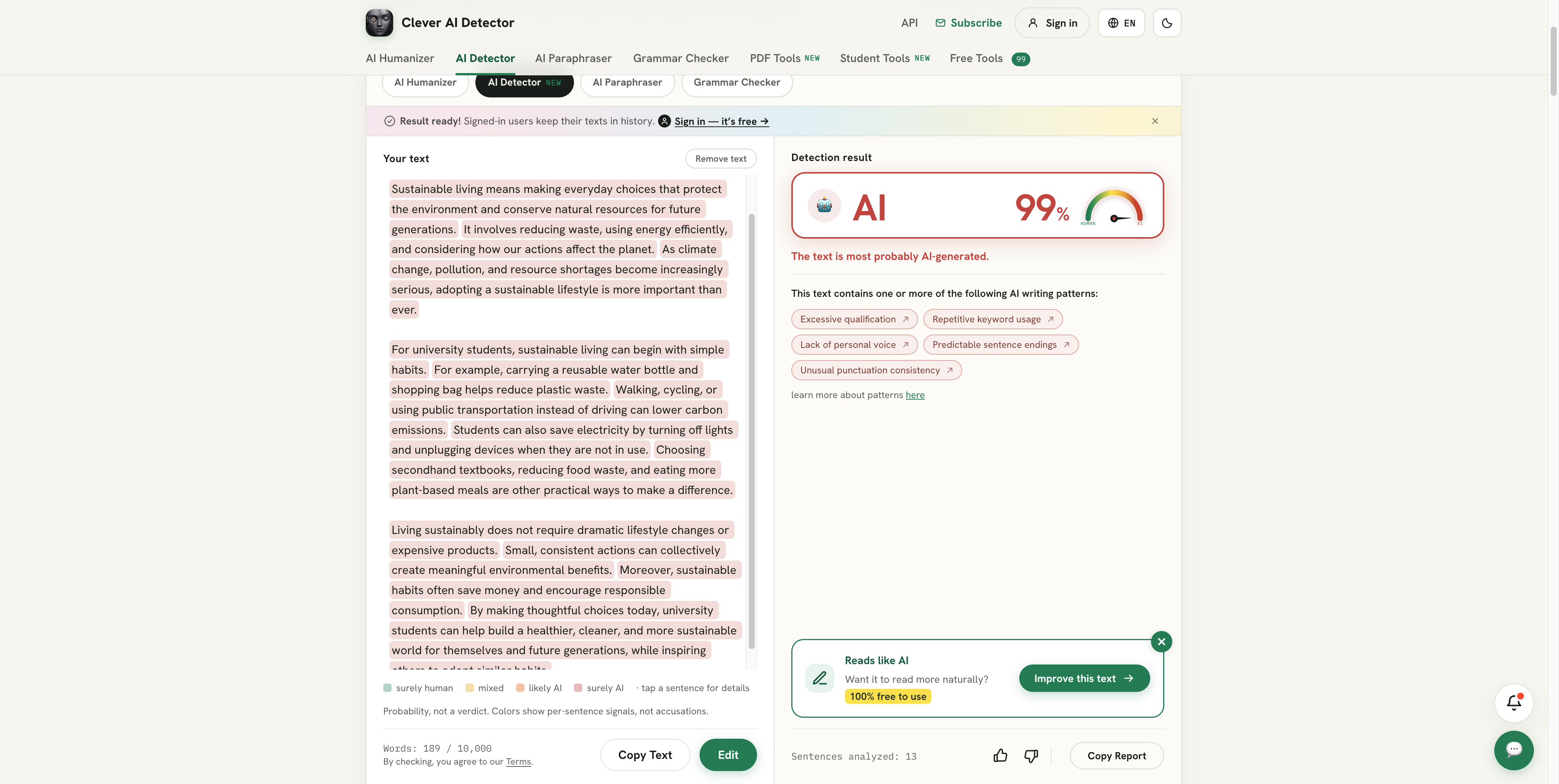
Original passage: Clever AI Detector displays 99% AI.
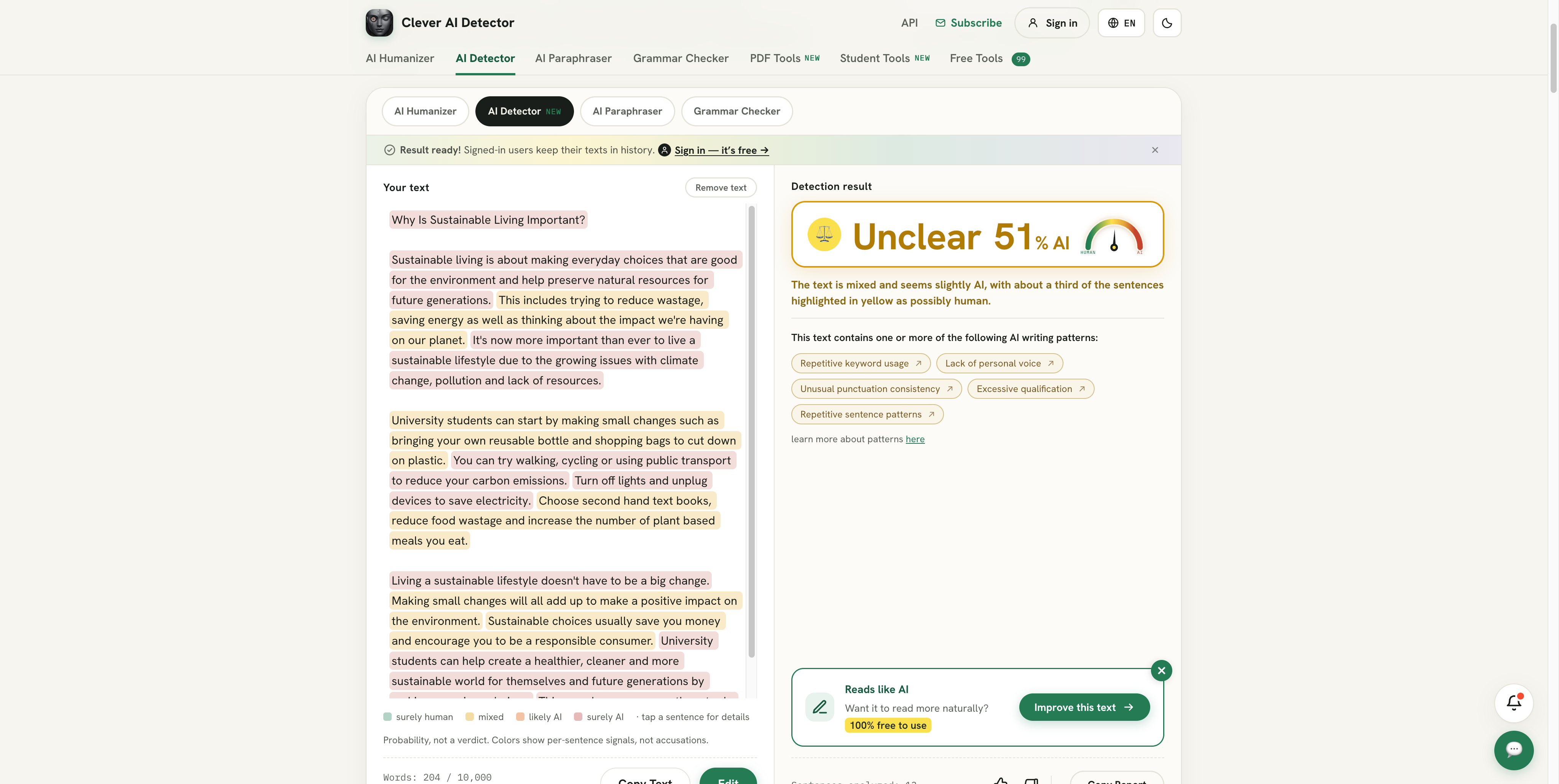
Rewritten passage: Clever AI Detector displays Unclear and 51% AI.
The third-party results were less consistent. GPTZero gave the rewrite a strong human classification, while ZeroGPT flagged it entirely. QuillBot marked just over half the passage as likely AI. Here are the readings shown in the test captures:
Detector | Result for the rewritten passage |
|---|---|
Clever AI Detector | 51% AI; Unclear label (original: 99% AI) |
QuillBot · model v7.1.0 | 52% likely AI; 0% AI-refined; 48% human-written |
GPTZero · model 5.0b | AI 4%; Mixed 0%; Human 96% |
ZeroGPT | 100% AI GPT |
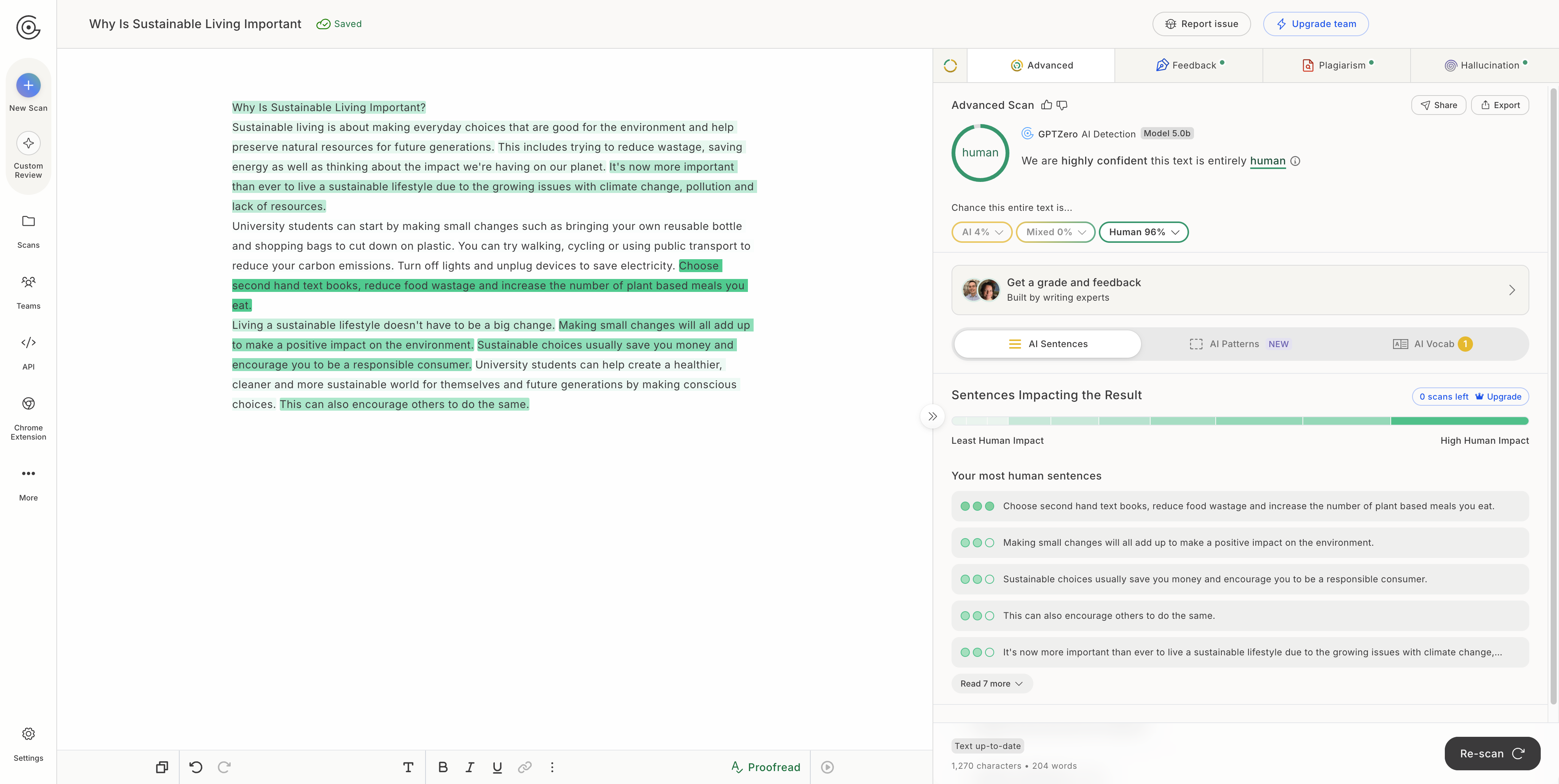
GPTZero result for the rewrite: AI 4%, Mixed 0%, Human 96%.
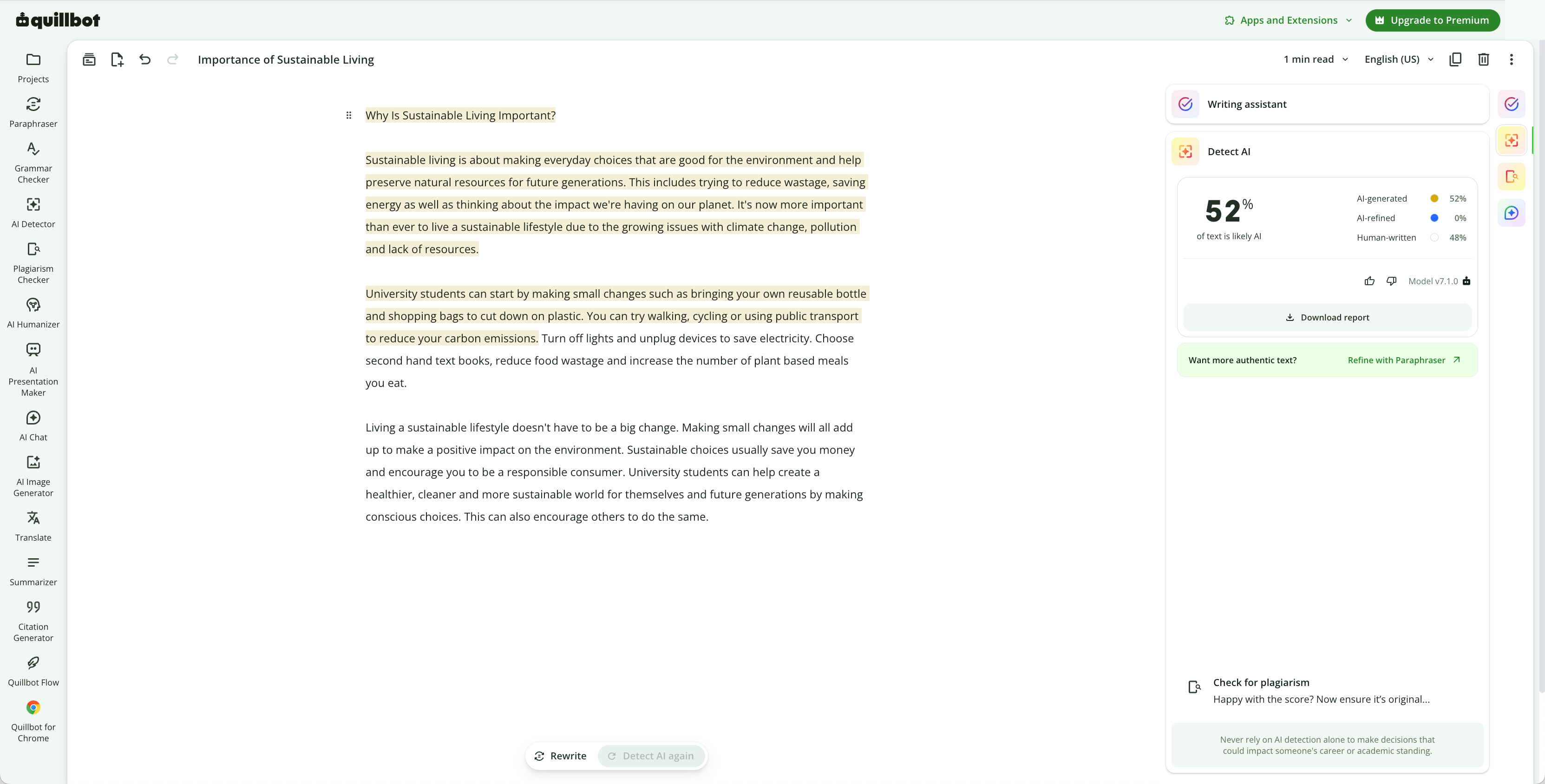
QuillBot rated 52% of the rewrite as likely AI.
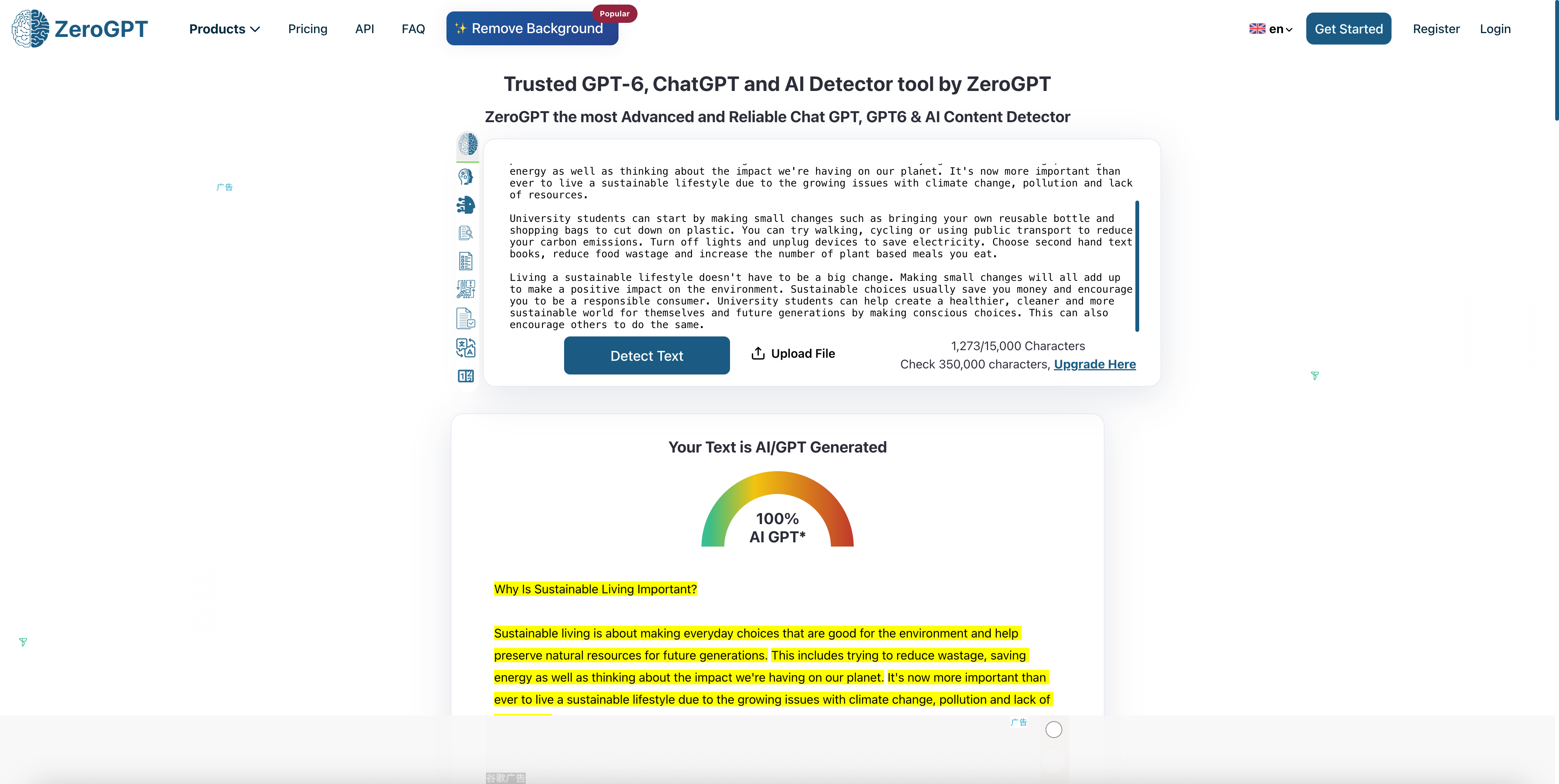
ZeroGPT result for the rewrite: 100% AI GPT.
The result was mixed: improvement on Clever’s own checker, a favorable classification from GPTZero, and a strong AI flag from ZeroGPT. For this passage, changing the wording was not enough to get agreement across detectors.
These results cover one documented passage. Only Clever’s own detector has a captured original-text baseline; the other readings describe the rewrite. The tools also report different kinds of percentages, including flagged-text shares and classification probabilities, so their values should not be averaged into a pass rate.
How Good Is Clever’s Rewritten Text?
The rewrite is readable, and it keeps the main message: students can make everyday choices that reduce waste and conserve resources. Direct instructions such as turning off lights and unplugging devices could work well in a casual advice article.
The weaker changes become clearer when you compare individual sentences. “University students” turns into “your own reusable bottle” within the same sentence. That shift makes the audience less consistent. You could write directly to “you” throughout, or keep the original third-person approach.
Original wording | Clever’s wording | Our assessment |
|---|---|---|
“secondhand textbooks” | “second hand text books” | The original uses the more conventional word forms. |
“eating more plant-based meals” | “increase the number of plant based meals you eat” | The idea survives, but the rewrite is longer. |
“Small, consistent actions can collectively create meaningful environmental benefits.” | “Making small changes will all add up to make a positive impact on the environment.” | The rewrite changes a cautious claim into a more definite statement. |
The final example matters beyond style. “Can” leaves room for variation; “will” expresses more certainty. A rewrite should not strengthen a claim simply to make it sound smoother. Here, keeping the original qualification would be the better editing choice.
What Did Grammarly Find?
We checked the complete original and the complete Clever rewrite in separate Grammarly documents on November 11, 2026, using the same account and unchanged default settings. We did not accept any suggestions before recording the results.
Passage | Words, including heading | Grammarly score | Suggestions displayed |
|---|---|---|---|
Original ChatGPT passage | 189 | 94 | 3 Clarity suggestions; no Grammar suggestions |
Clever Version 1 rewrite | 204 | 68 | 13 total: 8 Grammar and 5 Clarity |
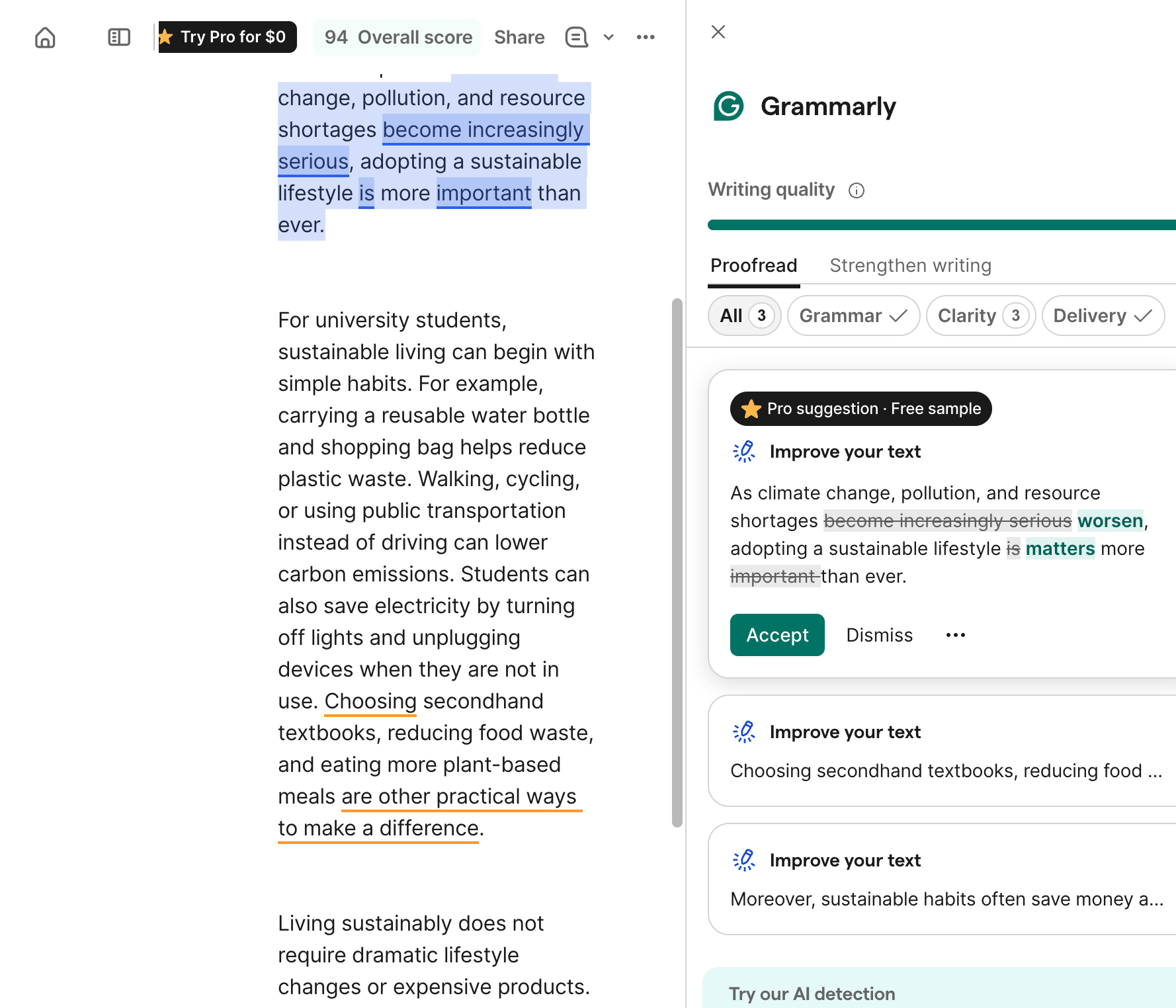
Grammarly’s result for the original passage.
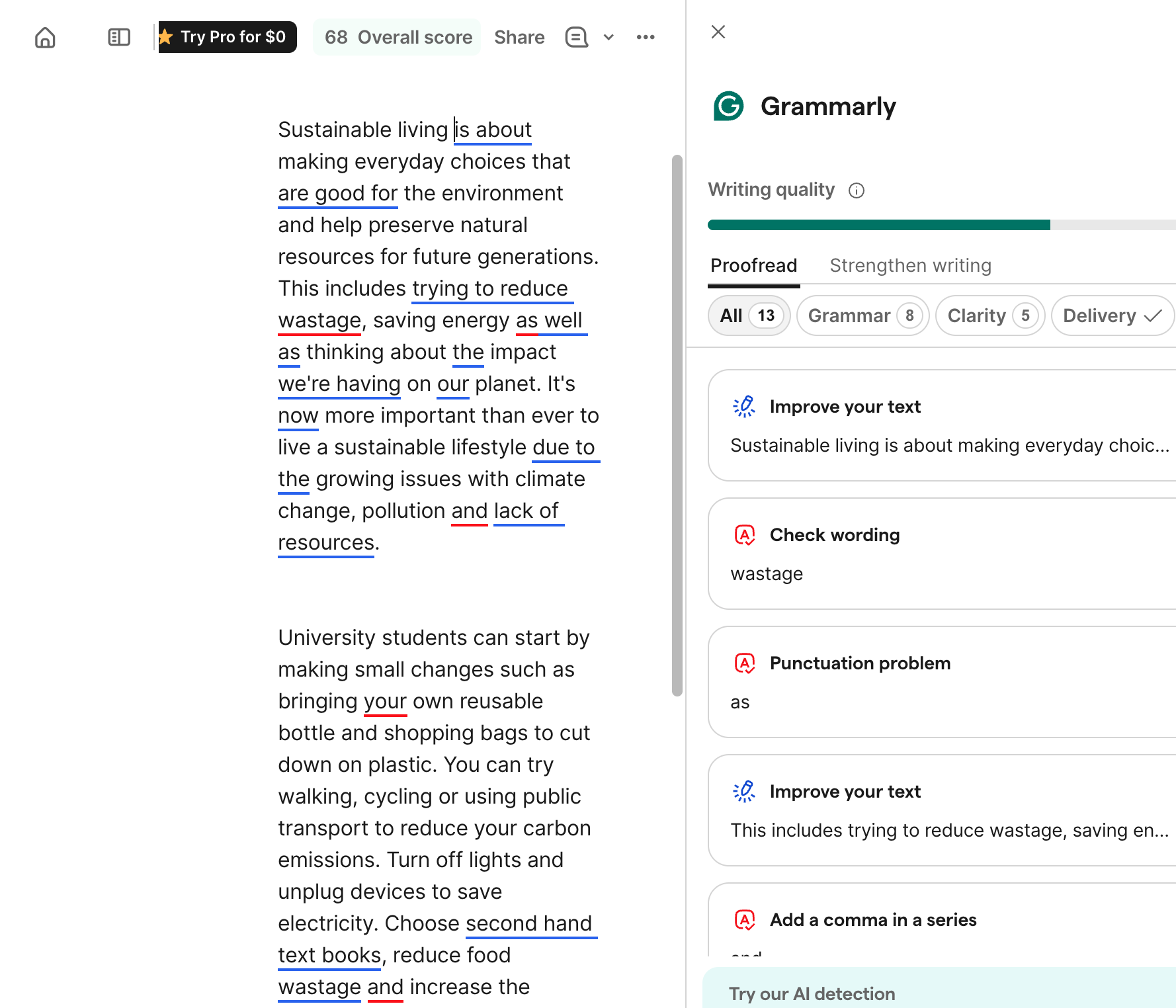
Grammarly’s result for Clever’s rewritten passage.
Grammarly flagged “second hand text books” and “plant based” for spelling, and “your” in “University students can start … bringing your own” for agreement. It also suggested punctuation changes and clearer wording. Some punctuation recommendations are style choices, but the spelling and person shift are concrete reasons to edit this rewrite.
For this passage, Clever did not improve proofreading quality: the original received a higher Grammarly score and required fewer suggested changes. The rewrite remains understandable, and its alternative phrasing can still be useful, but a lower AI-detector reading should not be treated as evidence of cleaner writing.
A separate LanguageTool public-API check returned zero flagged issues for both texts. The different feedback is a reason to review the actual sentences rather than rely on one checker’s count.
A practical edit would be to keep the useful advice and tighten the wording: “Students can carry reusable bottles and shopping bags to reduce plastic waste.” That is our suggested revision, not a sentence generated in the recorded Clever run.
Clever AI Humanizer: Pros, Cons, and Who It Suits
Pros
Free access with a 3,000-word request limit makes it easy to try a substantial passage.
The original and rewrite appear together, with highlighted changes to help you review edits.
The tested rewrite kept the main topic and practical examples understandable.
Cons
Some changes added words or weakened the precision of an already clear sentence.
The two current styles give you a small set of broad choices for tone and structure.
The tested output received conflicting detector readings and still needed manual editing.
Clever is a reasonable starting point for bloggers, content writers, and students who want an alternative phrasing to compare with their own draft. It is less useful when you only need to fix a couple of sentences, or when specialized wording must remain exact. Students should also check what AI assistance their assignment allows.
Check privacy before pasting confidential work. Clever’s privacy policy says guest records retain the first 100 input characters with technical information for two days; signed-in text and output are generally retained for 30 days. It also permits staff quality checks on samples, even though it says content is not used for model training.
Clever AI Humanizer Alternatives Worth Considering
EssayDone Humanizer for More Rewrite Choices
If you want more control over which wording you keep, EssayDone Humanizer is worth exploring. Its current product page describes multiple model choices, three rewritten drafts, and the ability to swap a sentence for an alternative from another draft. Those options may suit writers who want to combine useful edits rather than accept one whole rewrite.
Start with the same paragraph you used in Clever and compare the results for clarity, meaning, and the amount of editing left to do. The useful question is which version sounds closer to your intended voice and gives you edits worth keeping.
Grammarly or LanguageTool for Focused Editing
If the original is already clear and only needs proofreading, a grammar tool may be a better fit. Grammarly’s grammar checker offers spelling, punctuation, and writing suggestions, and our Grammarly comparison above shows why checking an already clear original can be more useful than rewriting every sentence. You can address specific issues and keep more of the wording you already like.
Final Verdict: Is Clever AI Humanizer Worth Using?
Clever is worth trying if you want a free way to explore a more natural version of your draft. The 3,000-word request allowance is generous, and the comparison view makes it easy to spot changes. In our sample, the rewrite kept the main ideas and remained readable. For cleaner writing, our Grammarly result favors keeping the original and making targeted edits: it scored 94, compared with 68 for the rewrite. If you use Clever for alternative phrasing, keep only the changes that improve your voice, then correct the spelling, person shifts, and longer sentences before using the text.
For readers interested in AI detection, the strongest result was GPTZero’s 96% Human classification. Clever’s own AI reading also fell from 99% to 51%. Those are encouraging results for this passage, while ZeroGPT’s 100% AI result shows why one favorable score cannot promise success elsewhere. Try Clever on a short sample, compare it in the checker relevant to your workflow, and judge the writing itself before keeping the rewrite.