






SuperHumanizer Review: Does It Make AI Text Sound Human?

SuperHumanizer can substantially change detector results, but its rewrites still need a careful read. In our two short tests, QuillBot rated the originals 100% likely AI and the rewritten versions 0% and 7%. ZeroGPT rated both originals 100% AI; after rewriting, it returned 32.6% and 0%, respectively. GPTZero still rated the rewritten recycling passage 100% AI, highlighting how differently detectors can respond to the same text.
Those are encouraging results for these samples. The trade-off was writing quality: one rewrite preserved dates and a deadline but added an awkward phrase and changed the tone of a compliment. Here's how the free tool works and what happened when we tried it.
What Is SuperHumanizer?
SuperHumanizer is an online tool that rewrites text to make it sound more human. You paste a passage, choose Super Lite or Super Ultra, and select Humanize. The interface also offers a Proofread option and sentence alternatives.
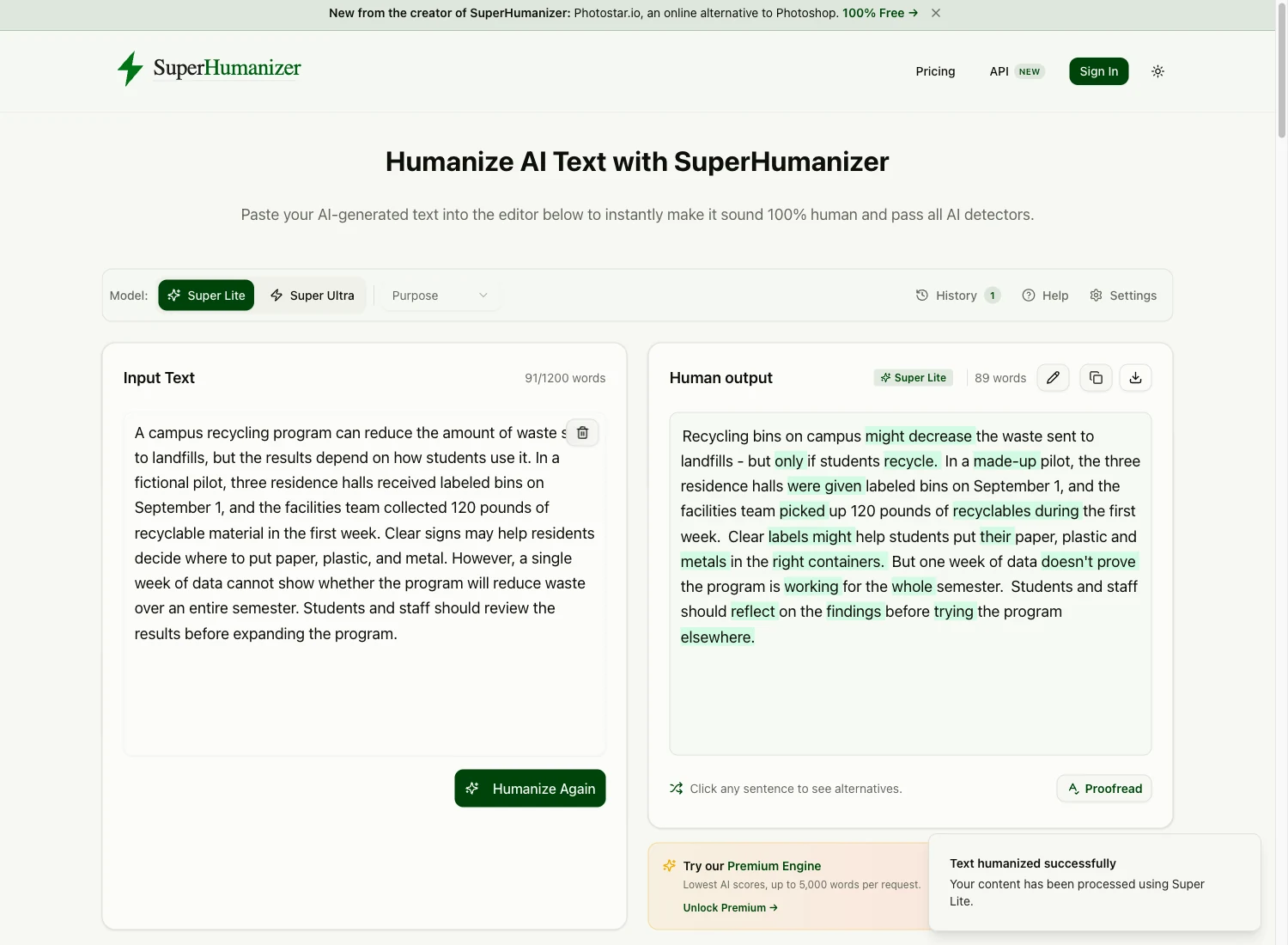
The free editor displayed a 1,200-word limit per run during our visit, and we could use it without signing in. Its site describes Super Lite as a quicker rewrite and Super Ultra as a deeper rewrite. It also lists writing purposes such as academic, blog, formal and friendly, as well as file upload and a Chrome extension.
How to Use SuperHumanizer
- Open the editor and paste the text you want to revise.
- Select Super Lite or Super Ultra, and choose a purpose if you want a particular style.
- Select Humanize and read the result.
- Compare dates, numbers, names and qualifications with the original. Edit any changes before copying the text.
The editor also shows a Proofread button and offers sentence alternatives when you select a sentence. Those can help you revise individual passages instead of accepting the first output unchanged.
Our Test: Two Passages and Three Detectors
We ran two short, fictional passages through the free editor on November 13, 2026: a campus recycling explanation using Super Lite and a natural-sounding draft-feedback message using Super Ultra. We submitted each original and its corresponding rewrite to QuillBot and ZeroGPT. We also checked the recycling passage before and after rewriting with GPTZero.
Campus recycling explanation — Super Lite
| Detector | Original | Rewrite |
|---|---|---|
| QuillBot | 100% likely AI | 0% likely AI |
| ZeroGPT | 100% AI | 32.6% AI |
| GPTZero | 100% AI | 100% AI |
Short feedback message — Super Ultra
| Detector | Original | Rewrite |
|---|---|---|
| QuillBot | 100% likely AI | 7% likely AI |
| ZeroGPT | 100% AI | 0% AI |
QuillBot and ZeroGPT gave lower AI scores to both rewrites. GPTZero gave the recycling passage a very different result: it classified both versions as 100% AI and labeled the rewrite “Possible AI Paraphrasing.”
QuillBot
QuillBot rated the recycling original 100% likely AI and the Super Lite rewrite 0% likely AI. On the feedback message, the same detector went from 100% to 7%.
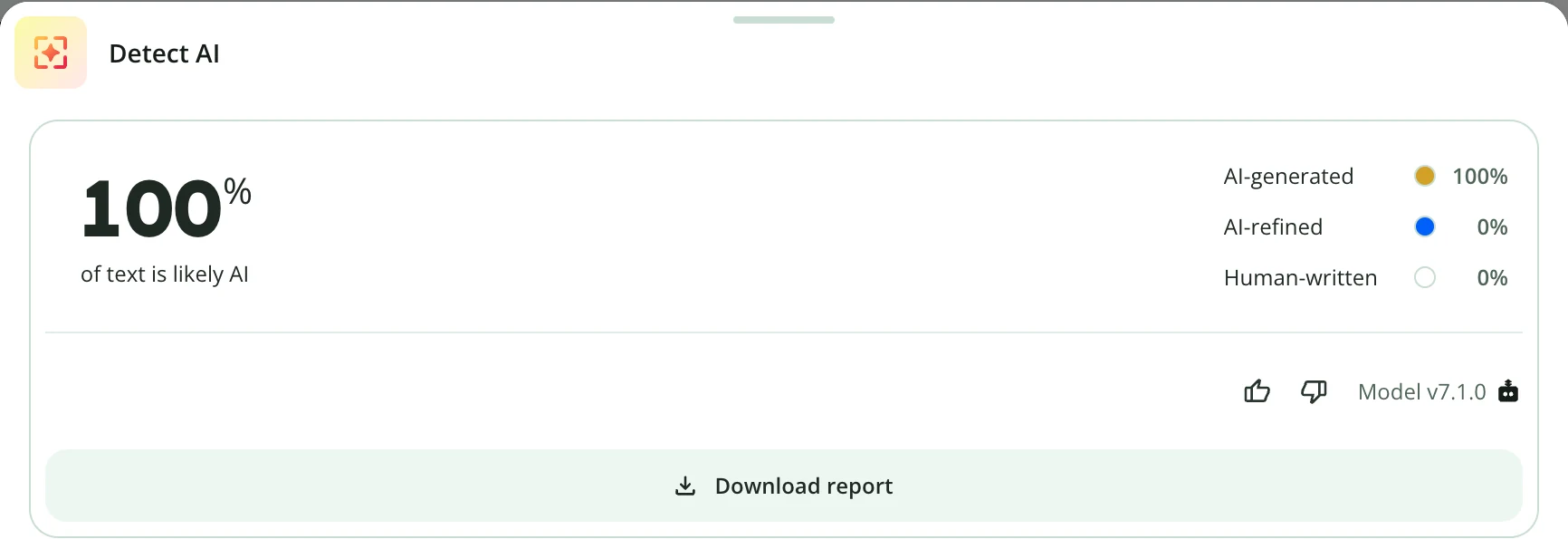
QuillBot result for the recycling passage before rewriting: 100% likely AI.
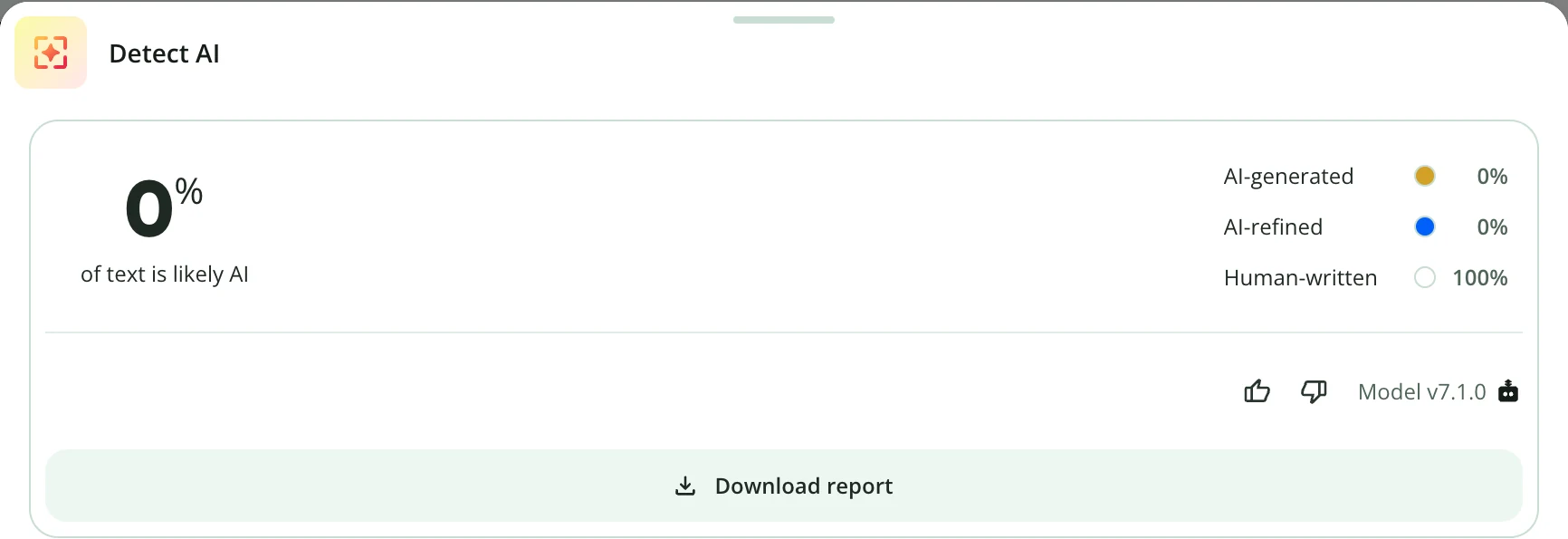
QuillBot result for the Super Lite rewrite: 0% likely AI.
ZeroGPT
ZeroGPT rated the recycling original 100% AI and the rewrite 32.6% AI. The feedback message went from 100% AI to 0% AI.
ZeroGPT result for the recycling passage before rewriting: 100% AI.
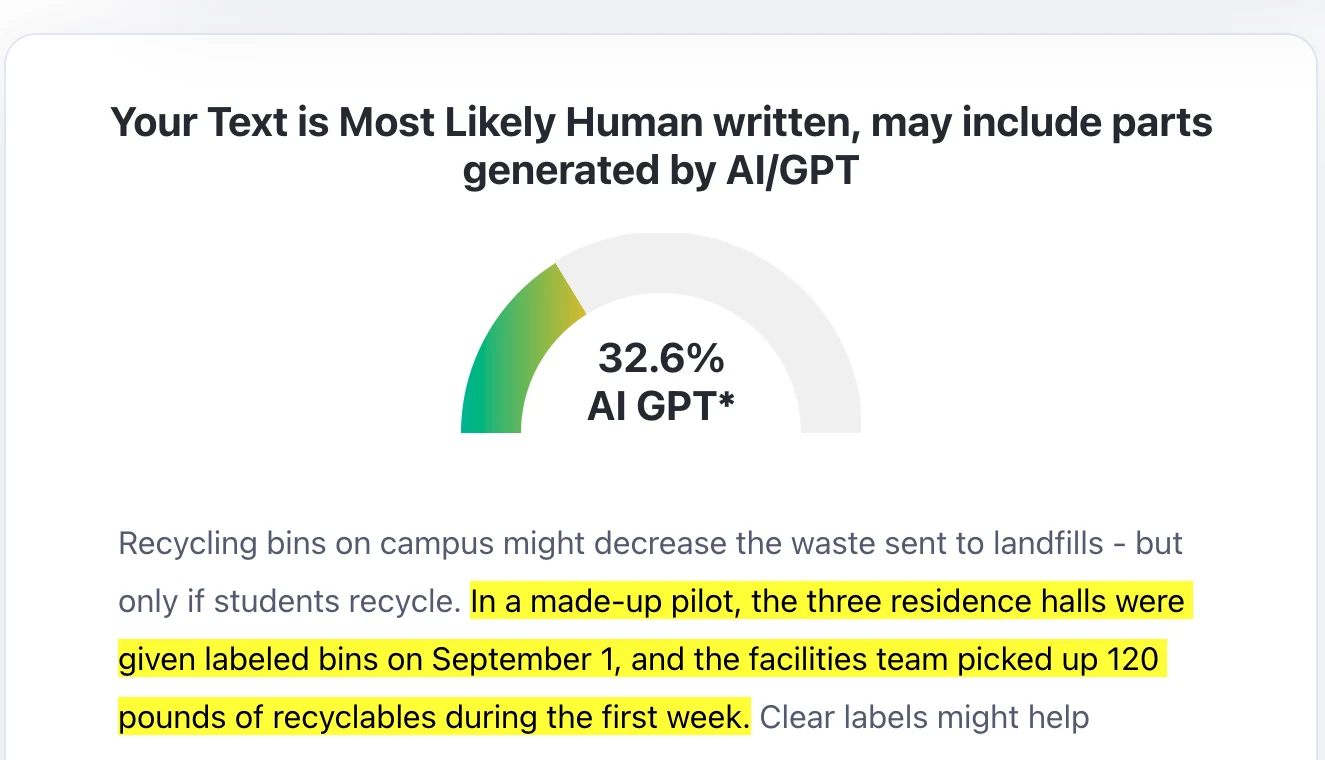
ZeroGPT result for the Super Lite rewrite: 32.6% AI.
GPTZero
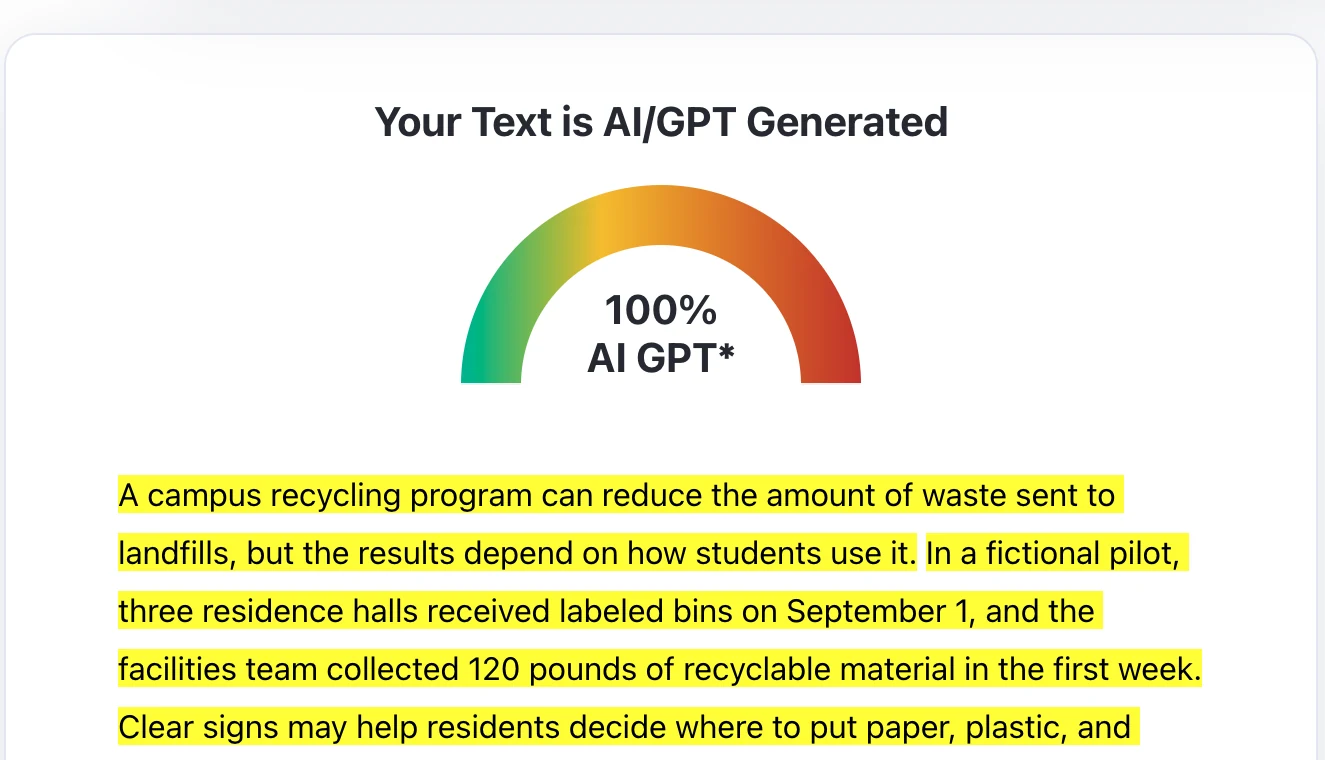
GPTZero gave both recycling versions a 100% AI classification. For the rewrite, it also displayed its beta “Possible AI Paraphrasing” label. This is the strongest indication in our test that a favorable result from one checker does not mean the same passage will get a similar result everywhere.
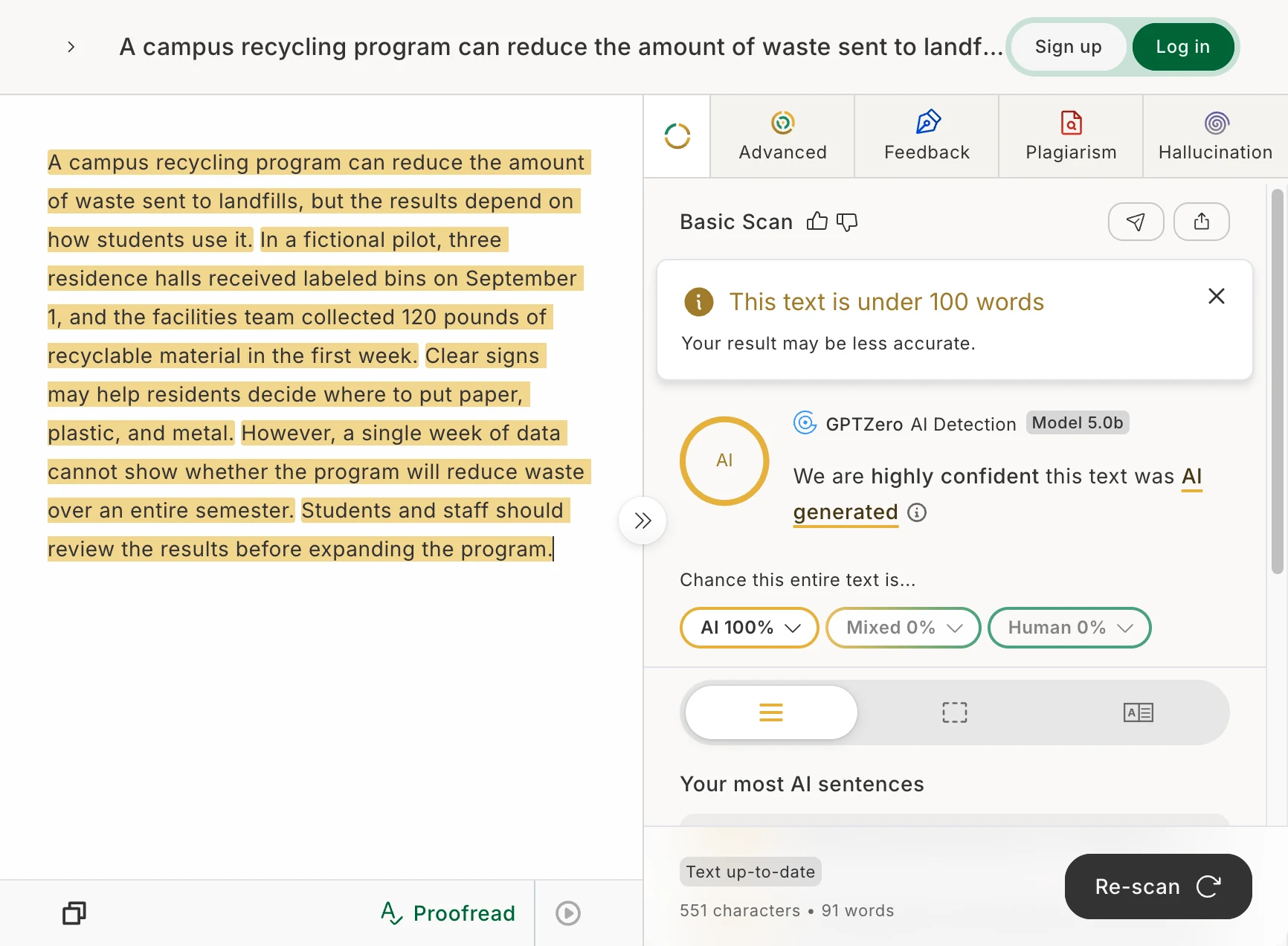
GPTZero result for the recycling passage before rewriting: 100% AI.
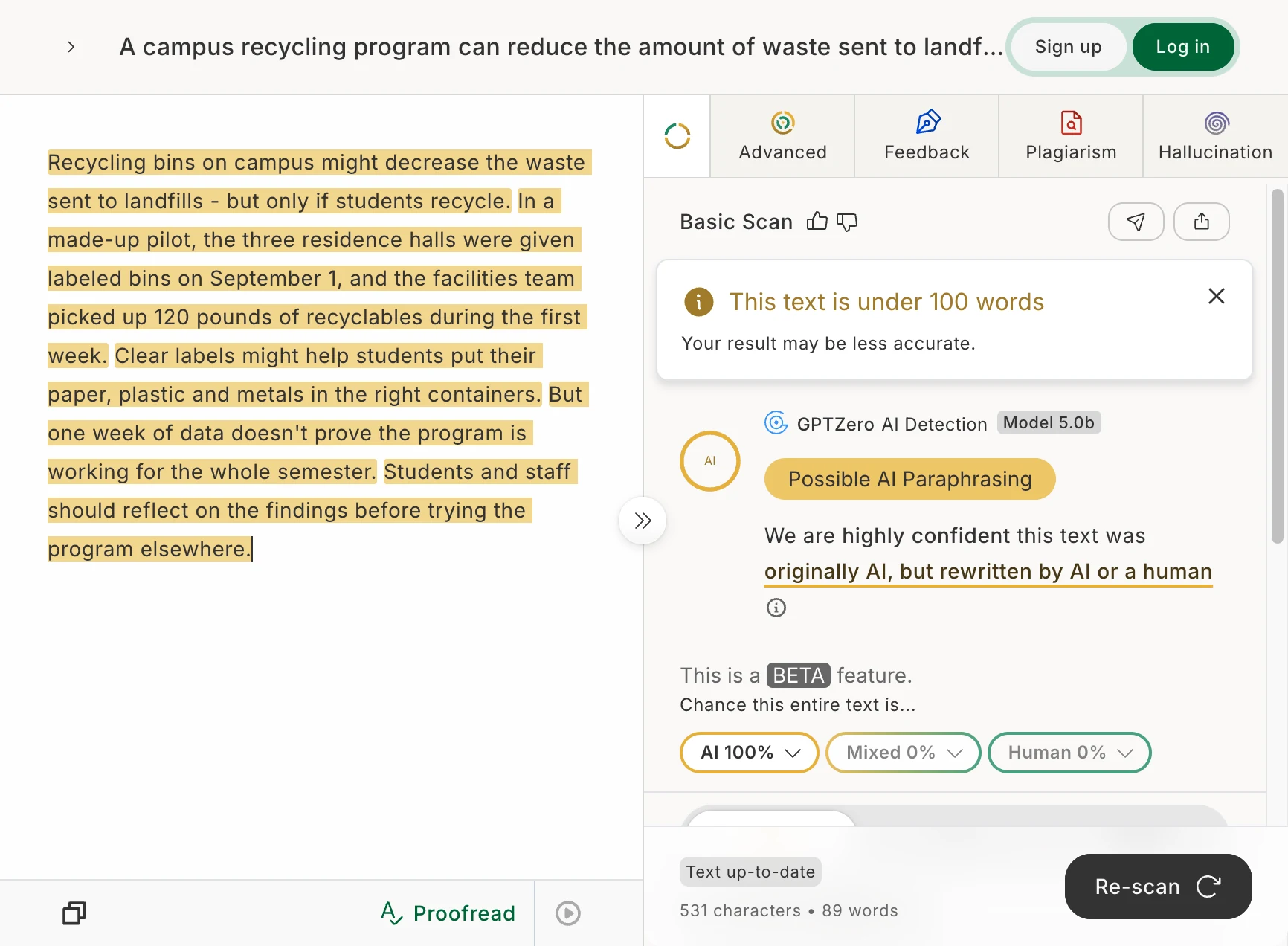
GPTZero result for the Super Lite rewrite: 100% AI, with a possible AI paraphrasing label.
Test 1: A Campus Recycling Explanation
The 91-word original described a fictional pilot: three residence halls received labeled bins on September 1, and the team collected 120 pounds of recyclables in the first week. The 89-word Super Lite rewrite retained the three halls, date, amount and first-week timeframe. It also kept the warning that one week of results cannot establish performance over a whole semester.
The language became more conversational, but not every change was neutral. The original said results depend on how students use the program; the rewrite said it could reduce waste only if students recycle. That narrower condition changes the emphasis. It also replaced “expanding the program” with “trying the program elsewhere,” which could suggest a different next step. The passage is readable, but a writer should restore those distinctions where they matter.
Test 2: A Short Feedback Message
Our second passage asked a colleague to add an example, correct a meeting date to November 18 rather than November 16, and send a revision by Friday at 3 p.m. Super Ultra kept the date contrast and the deadline. It also changed “the main idea is clear” into “this is good enough and I understand it”—a less positive and less precise message. The phrase “the last part of the article has new date of the event” was awkward and introduced an assertion that the original had not made.
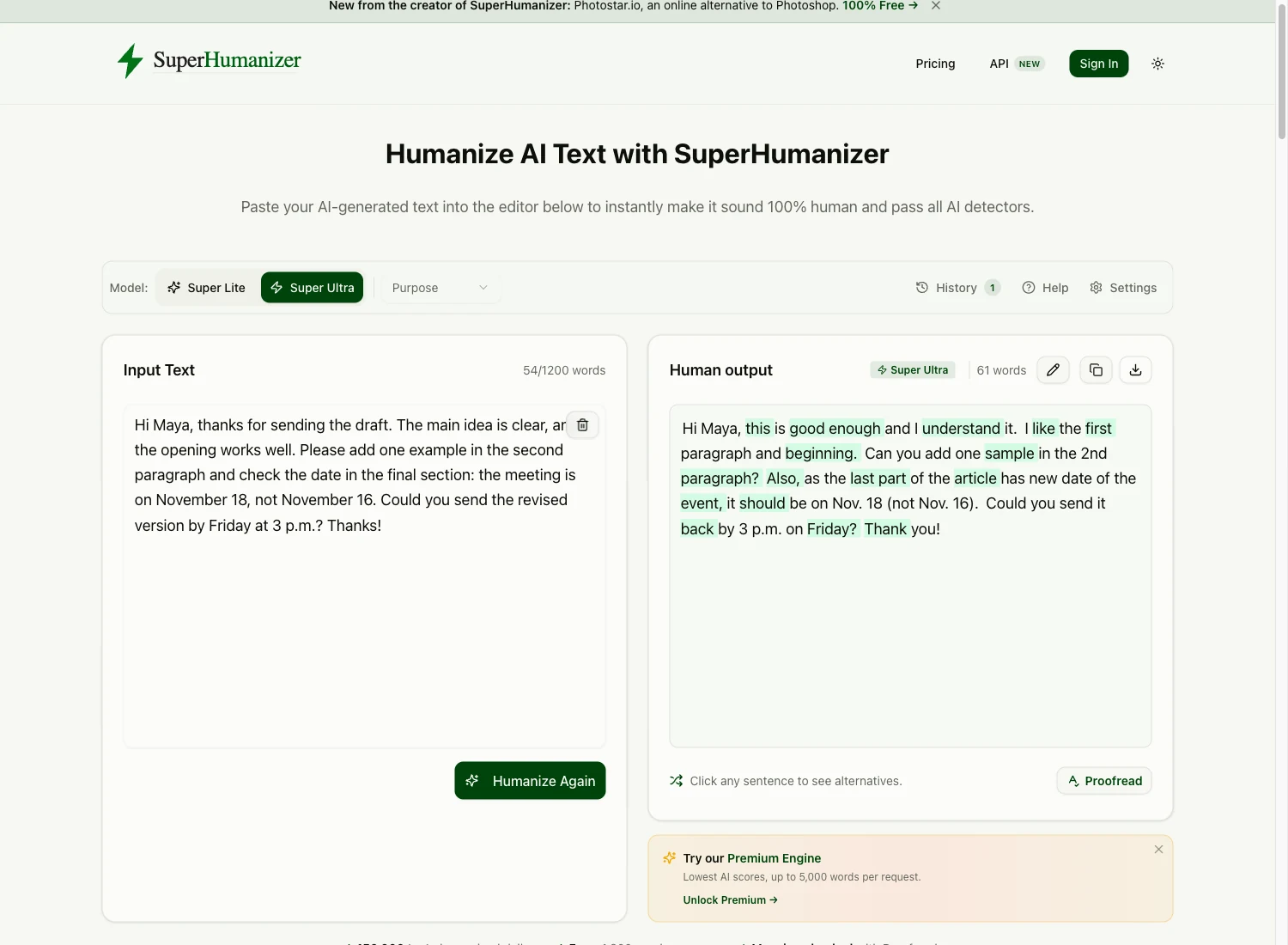
For a message you intend to send, the original was more natural in this case. The rewrite lowered both detector scores, but it needed editing before it expressed the same feedback reliably.
Before and After: What Changed?
| Original | SuperHumanizer rewrite | What changed |
|---|---|---|
| “In a fictional pilot, three residence halls received labeled bins on September 1, and the facilities team collected 120 pounds of recyclable material in the first week.” | “In a made-up pilot, the three residence halls were given labeled bins on September 1, and the facilities team picked up 120 pounds of recyclables during the first week.” | The rewrite is more conversational and retains the numbers and timing. |
| “the results depend on how students use it” | “but only if students recycle” | The rewrite narrows the original condition. |
| “The main idea is clear, and the opening works well.” | “this is good enough and I understand it. I like the first paragraph and beginning.” | The specific, positive feedback becomes less precise and less enthusiastic. |
| “check the date in the final section: the meeting is on November 18, not November 16.” | “as the last part of the article has new date of the event, it should be on Nov. 18 (not Nov. 16).” | The dates remain, but the rewrite introduces an awkward phrase and suggests the article already has a new date. |
Grammarly Check: Does the Rewrite Read Better?
Yes—the feedback rewrite introduced a grammar error. It changed the date instruction to “the article has new date,” missing the article before “new date.” It also made the compliment less precise. Grammarly scored that rewrite 64, compared with 100 for the original, and identified five grammar and two clarity suggestions.
The recycling rewrite was more readable, but it also received one grammar and two clarity suggestions: Grammarly scored it 89, compared with 96 for the original. The dates and quantities were retained. For both samples, review the rewritten wording before using it.
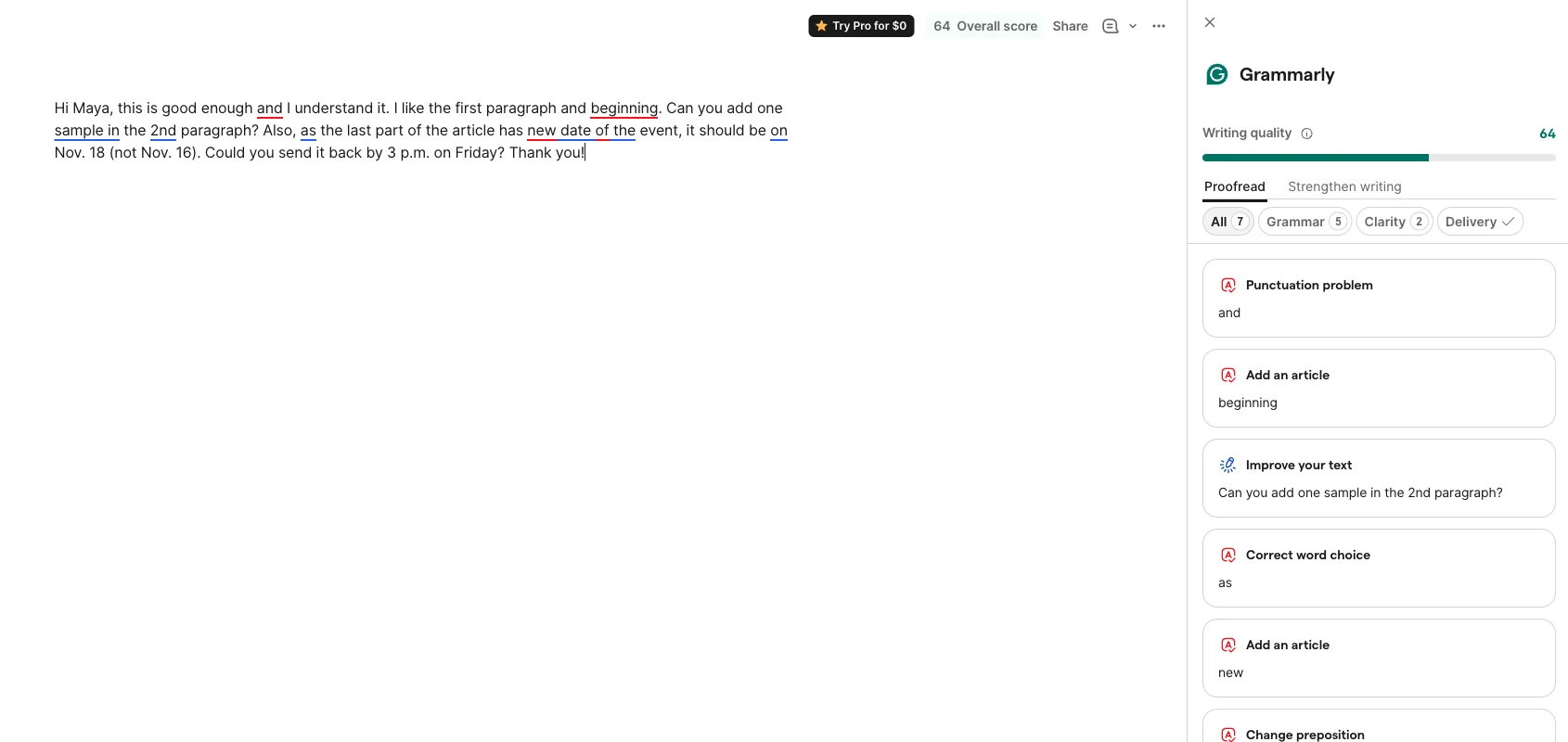
Grammarly flagged grammar and clarity issues in the feedback rewrite.
Is SuperHumanizer Free?
The editor displayed 1,200 words per run when we used it, and both tests ran without signing in. The site also advertises a Premium Engine, including a higher per-request word limit and its own detector. Check the current pricing and feature details before paying; the free editor is enough to try a short passage first.
Pros and Cons
| Pros | Cons |
|---|---|
| Free editor works without sign-in | Rewrites can change emphasis or add unsupported wording |
| Two modes and a clear input/output view | Natural prose can become awkward or less precise |
| Lower scores on QuillBot and ZeroGPT for both samples | GPTZero still rated the tested rewrite 100% AI |
| Main dates and quantities survived our examples | You still need to review the final version |
Who Should Try SuperHumanizer?
SuperHumanizer is useful when you want a quick alternative phrasing for a passage and are willing to edit the result. It is also a practical free option for seeing how a rewrite performs in different detectors. Try a representative sample before relying on it for a longer document.
For emails, feedback or source-based writing, check tone and factual details closely. If the original already reads naturally, rewriting may make it worse rather than better. For another rewriting option, you can also try EssayDone Humanizer and compare its suggestions with your original text.
Verdict
SuperHumanizer lowered QuillBot and ZeroGPT scores in both examples. For the Super Lite recycling rewrite, QuillBot returned 0% likely AI and ZeroGPT 32.6% AI, while GPTZero still returned 100% AI and flagged possible paraphrasing. The Super Ultra feedback rewrite also received low scores, but its awkward phrasing and changed compliment made the original better to send.
Use the tool for an alternative draft or a detector check, then keep only the wording that accurately communicates your meaning. Its free allowance makes it easy to try, but the final edit still belongs to you.
Curious how SuperHumanizer might handle a longer essay or a different kind of writing? We are too. We’ll keep trying it with new examples and share what we find here.