



AI-Detector Review: How Accurate Is This AI Detection Tool?

Ever wondered if AI-Detector really spots AI-written text? You might be unsure how accurate it is or how it handles different types of writing.
In this review, we’ll walk you through how it performs on pure AI text, mixed content, and humanized AI writing.
By the end, you’ll get a clear idea of what it can do and what to watch out for.
Let’s dive in and see the results.
What Is AI-Detector
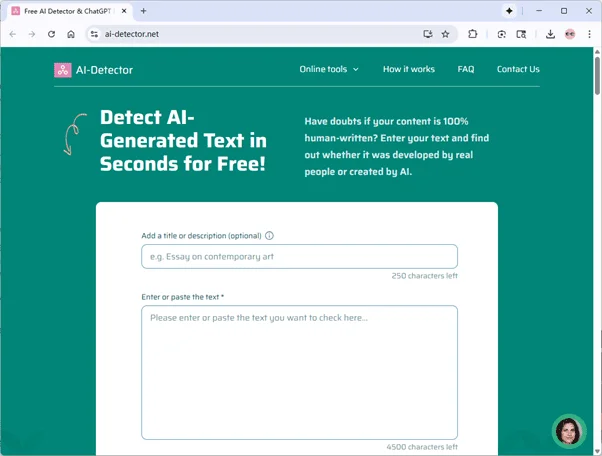
AI-Detector.net is an online platform that analyzes text to determine whether it was written by a person or generated by an AI model.
It’s mainly used by students, educators, and editors who want to check the authenticity of written work.
The main feature of the site is its AI Content Checker, which detects linguistic patterns typical of AI-generated writing. The tool supports pasted text only and uses a combination of natural language processing, semantic analysis, and linguistic modeling—the same kinds of patterns used by ChatGPT and other AI systems—to predict whether a passage was written by a person or machine.
The tool works in three basic steps:
Paste or type the text you want to analyze.
Optionally add a topic or short description to refine the analysis.
Review a report that highlights sections likely generated by AI.
What Does the Report Show
The report gives a short verdict stating whether the text appears to be AI-generated or human-written, without showing probability scores or confidence levels like some other detectors do.
A simple visual chart displays the proportion of words that match AI writing patterns.
It also highlights specific words or phrases that the system identifies as likely AI-generated, allowing users to see which parts of the text may have triggered the result.
Extra Tools of AI-Detector
In addition to the AI detector, the platform includes a few text-related utilities:
Reworder – Rephrases sentences to make them different from the original wording.
Thesis Statement Generator – Produces a draft thesis statement based on user input.
Text Summarizer – Condenses long text into shorter summaries.
Random Topic Generator – Suggests general writing topics or research ideas.
How Accurate Is AI-Detector
According to AI-Detector’s website, the tool can accurately distinguish between human-written and AI-generated text using language pattern analysis. To see how well that claim holds up, I ran several tests with different types of writing—pure AI text, mixed human and AI writing, and AI text rewritten through a humanizer. Each test followed the same process: paste the text, run the scan, and review the report.
Test 1: Pure AI Text
Setup:
For this test, I used a short essay written completely by ChatGPT-4. No edits or prompts were added to make it sound more natural.
Results:
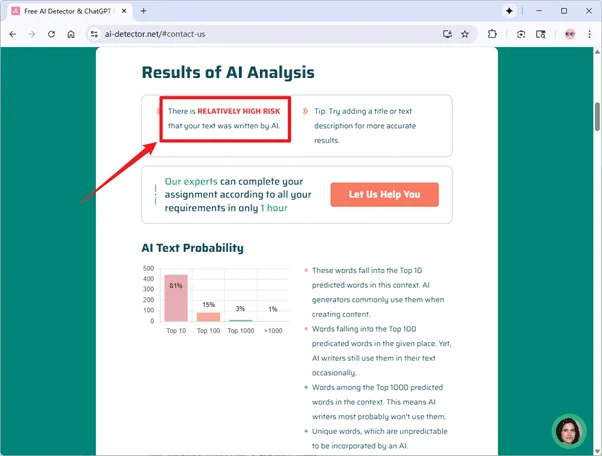
AI-Detector reported: “There is relatively high risk that your text was written by AI.”
Observations:
This judgment was accurate. The text was indeed fully AI-generated, and the detector correctly classified it as such.
It shows that the tool can reliably recognize text created entirely by an AI model.
Test 2: Mixed AI + Human Writing
Setup:
The second sample combined both human and AI writing. I took a human-written paragraph from an older academic essay (pre-ChatGPT) and asked ChatGPT-5 to continue it.
The total length was 454 words, with 187 written by a human (41%).
Results:
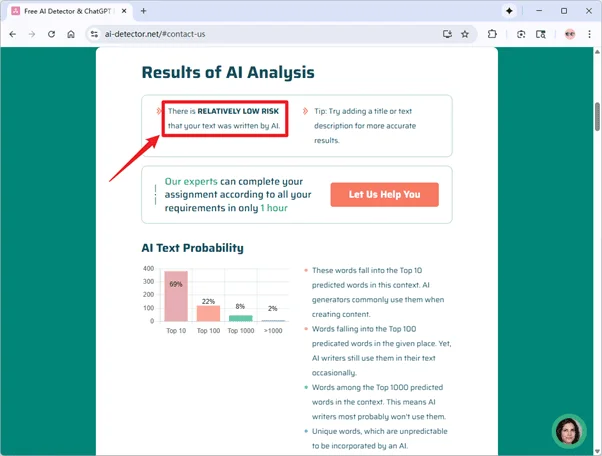
AI-Detector thinks the text was written by human
Observations:
Well, not really accurate. Nearly 60% of the text came from AI, but the detector still judged the overall piece as mostly human-written.
It suggests that AI-Detector has limited sensitivity to mixed or partially edited AI text, especially when the transition between human and AI writing is smooth.
Test 3: Humanized AI Text by QuillBot
Setup:
For the last test, I used the same 100% AI-generated text from Test 1 but rewrote it using QuillBot Humanizer in Advanced mode.
The goal was to see whether paraphrased AI writing could still be detected.
Results:
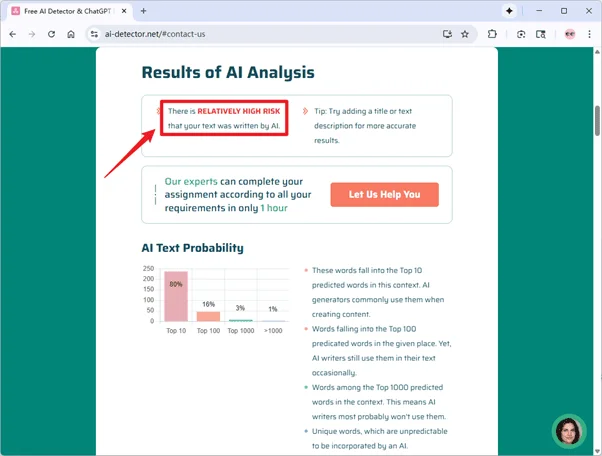
AI-Detector again concluded that the text was written by AI
Observations:
This result was correct. Even though the text had been rephrased by another AI, the detector still identified it as likely machine-written.
This indicates that QuillBot’s "advanced" rephrasing was not enough to fool AI-Detector.
Pros and Cons of AI-Detector
Pros
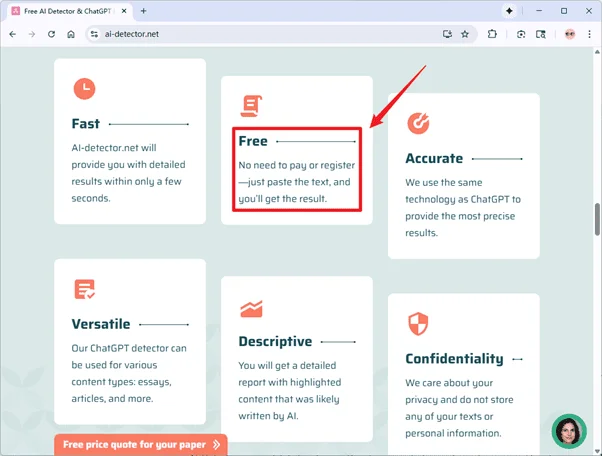
Free access: Users can run checks without registration or payment.
Word-level breakdown: The tool divides words into categories based on how likely they are to appear in AI writing, offering a basic linguistic overview.
Extra tools: The website also includes other small utilities such as a reworder, thesis statement generator, and text summarizer.
Cons
Limited accuracy feedback: The detector only gives a brief statement rather than a probability or confidence score, so the results are less transparent.
Occasional false positives: Some human-written passages may still be flagged as AI-generated.
No file upload support: Users can only paste or type text directly into the input box.
AI-Detector Pricing
AI-Detector is completely free to use. There’s no registration, subscription, or credit system required.
Its additional tools, like the Reworder and Thesis Generator, also don’t mention any pricing information.
Can You Bypass AI-Detector
Well, the short answer is yes — but it’s not easy.
In theory, bypassing AI-Detector might sound simple—just rewrite or replace a few words and hope it passes as human.
However, as shown in Test 3, even when the text was rewritten through QuillBot’s Advanced Humanizer, AI-Detector still judged it as “high risk of AI-generated.”
This suggests that basic rephrasing or surface-level editing doesn’t change the deeper sentence structures or semantic patterns that the detector relies on.
To reduce the AI signal effectively, the text needs to be modified at both the linguistic and structural levels. This is where a more advanced tool like EssayDone Humanizer becomes relevant.
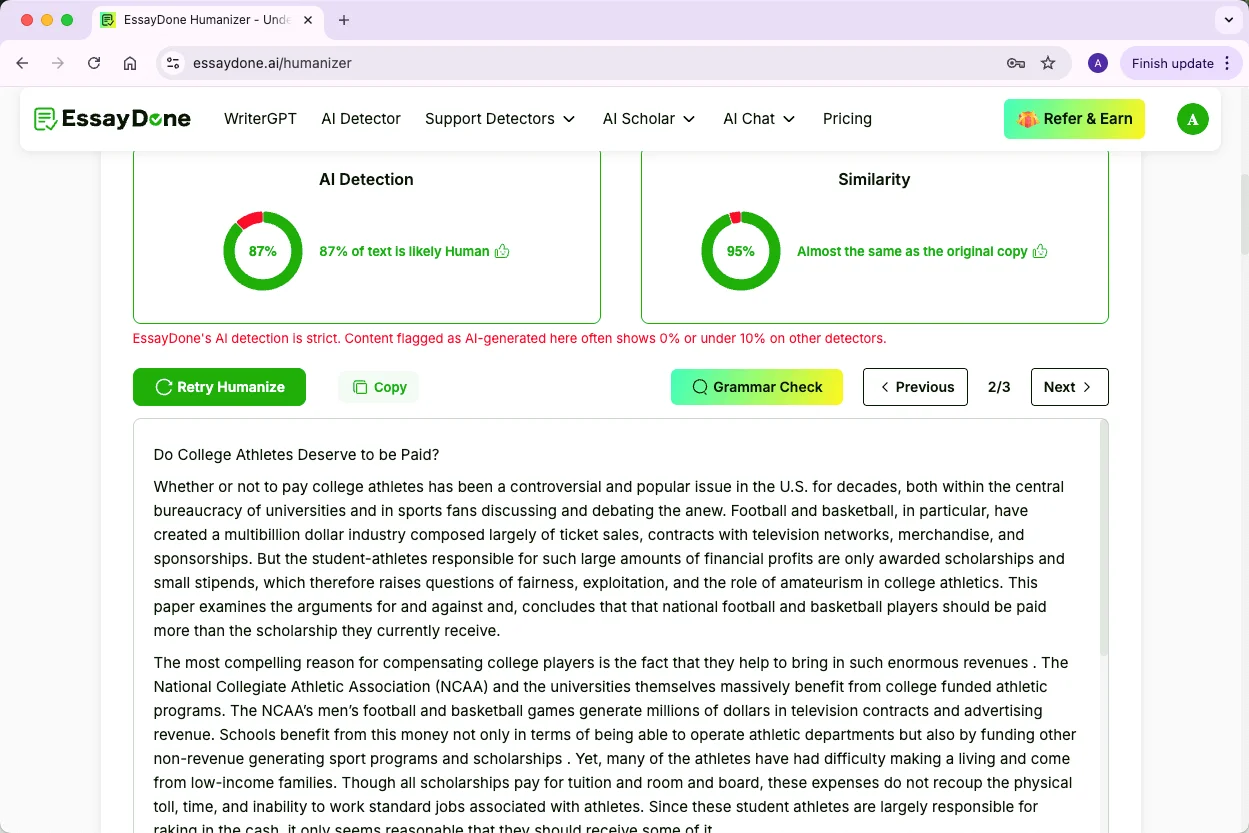
EssayDone Humanizer is designed to rewrite AI-generated content by adjusting grammar flow, sentence rhythm, and overall composition style rather than just swapping words. It focuses on reshaping paragraphs to reflect human-like pacing and varied syntax—elements that AI detectors often use to flag machine writing.
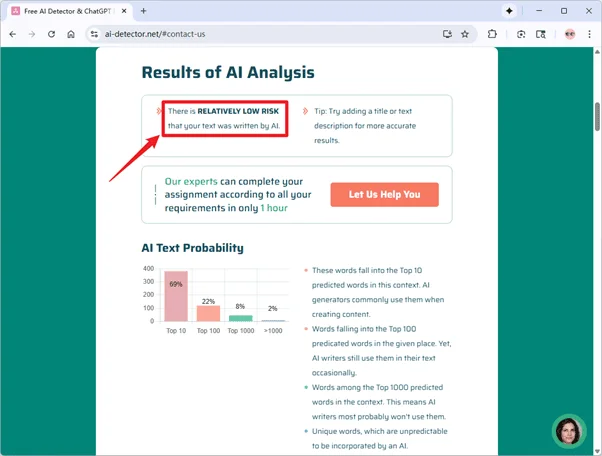
When the same 100% AI-generated text from Test 1 was rewritten with EssayDone Humanizer, AI-Detector classified it as human-written. This indicates that comprehensive rewriting that alters both the structure and logic of sentences is far more effective in passing AI-Detector’s checks than basic paraphrasing.
Alternatives to AI-Detector
There are many AI detectors on the market, some with high accuracy and others less reliable. If you’re looking for alternatives, here are some of the top options to consider:
1. Originality.ai
Originality.ai supports multiple languages and offers a limited free trial. Its paid plan starts at $12.95 per month for 200,000 words or 2,000 credits. You can upload PDF, DOCX, and DOC files, or even scan websites. It requires a login and provides sentence-level analysis. Extras include plagiarism and fact checks, readability and grammar scoring, team collaboration tools, and a Chrome extension.
2. GPTZero
GPTZero is also multilingual and allows up to 5,000 characters per free test. Paid plans start at $14.99 per month for 100,000 characters. Supported formats include PDF, DOC, DOCX, and TXT files up to 50MB. A login is required, and it gives sentence-level analysis. Additional features include writing feedback, plagiarism detection, and citation tools.
3. EssayDone
EssayDone AI Detector stands out by letting you see results from multiple AI detectors — including GPTZero, Originality.ai, and Winston AI — all at once. It supports multiple languages and allows up to 4,000 words per input, making it convenient for longer essays or articles. This all-in-one approach gives users a broader perspective on content authenticity without switching between different tools.
4. ZeroGPT
ZeroGPT supports multiple languages and has a free plan. Paid access begins at $9.99 per month. It only works with text input and doesn’t require a login. Sentence-level analysis isn’t included, but it offers plagiarism checks, an AI summarizer, and an AI paraphrasing tool.
5. QuillBot
QuillBot allows up to 1,200 words per test on its free plan. Premium starts at $8.33 per month with unlimited scans. Multiple file formats are supported, though a login isn’t required for free scans. Sentence-level analysis is available. Beyond detection, it offers a paraphraser, summarizer, grammar check, plagiarism check, and text humanizer.
6. Copyleaks
Copyleaks supports over 30 languages, with a free limit of 15,000 characters per test. Paid plans start at $16.99 per month for 100,000 characters. Only copy-paste input is supported; file uploads aren’t available. It doesn’t offer sentence-level analysis. Its main perks include combined AI and plagiarism reporting, a shared data hub, and integrations with Google Docs and a Chrome extension.
FAQ
Is AI-Detector 100% accurate?
No. AI-Detector can identify clear AI-generated text fairly well, but its accuracy drops when the text mixes human and AI writing or has been rewritten with advanced tools.
How to bypass AI-Detector?
Simple word changes or paraphrasing tools usually don’t work. To lower AI detection, the text needs deeper linguistic and structural rewriting, such as through a professional humanizer.
Will my professor use an AI detector?
Many professors now use AI detectors to check student papers, especially for take-home essays or online submissions. However, each school’s policy varies.
Can I use AI detectors on my own work before submission?
Yes. Checking your text before submission can help you see whether your writing appears AI-generated and make adjustments if necessary.
Are AI detectors legal?
Yes. Using an AI detector is legal, but results should be interpreted carefully since no detector is fully reliable.
Is AI-Detector free?
Yes. AI-Detector is completely free to use, with no registration or paid plans currently offered.
Conclusion
So, that’s basically what we found with AI-Detector. It’s straightforward and free, but the results can be a bit hit or miss since it doesn’t give clear AI probability scores.
Hopefully, this breakdown helps you get a sense of how it works and what it can catch.