






Writer AI Detector Review: How Accurate Is It Really?

The free Writer AI Content Detector reviewed here is no longer available through its former public page. The three results below remain historical observations from the tool when it was accessible; the old input limit and free interface should not be presented as a current feature.
The old detector address now redirects to WRITER’s enterprise platform. That is a different product journey from pasting an essay into the free detector shown in our screenshots. Our review still answers a useful question: what happened when this detector saw fully generated, mixed, and rewritten text? The mixed draft is particularly revealing: it contained 41% human-written words, yet received a 95% human-generated label.
Writer.com AI Detector Accuracy Test: Three Scenarios Compared
The screenshots record three different inputs. All three scores below are labelled human-generated content in the old interface; they are not percentages of AI detected or a general accuracy rating.
Known input | Writer’s recorded result | What that meant in this test |
|---|---|---|
Entirely AI-generated essay | 75% human-generated content | A high human label despite a fully generated input. |
187 human-written words in a 454-word mixed draft | 95% human-generated content | The score did not reconstruct the known 41% human / approximately 59% AI composition. |
The AI essay rewritten with QuillBot Basic Humanizer | 90% human-generated content | Rewriting changed the output without changing the starting text’s AI origin. |
These percentages are historical classifications, not a record of who wrote each sentence. A fair comparison between detectors uses the same input and records the scan date, supported language and minimum text length. The former free Writer detector is no longer available at its old address; the tests below document that earlier tool.
What is Writer AI
WRITER now presents itself as an enterprise AI platform for marketing and revenue teams, with agents, shared workflows, connected business knowledge, and governance. That current platform should be distinguished from the former public AI Content Detector tested in this article. Buying access to an enterprise writing platform is not the same as restoring the old free detector.
What is Writer AI Detector
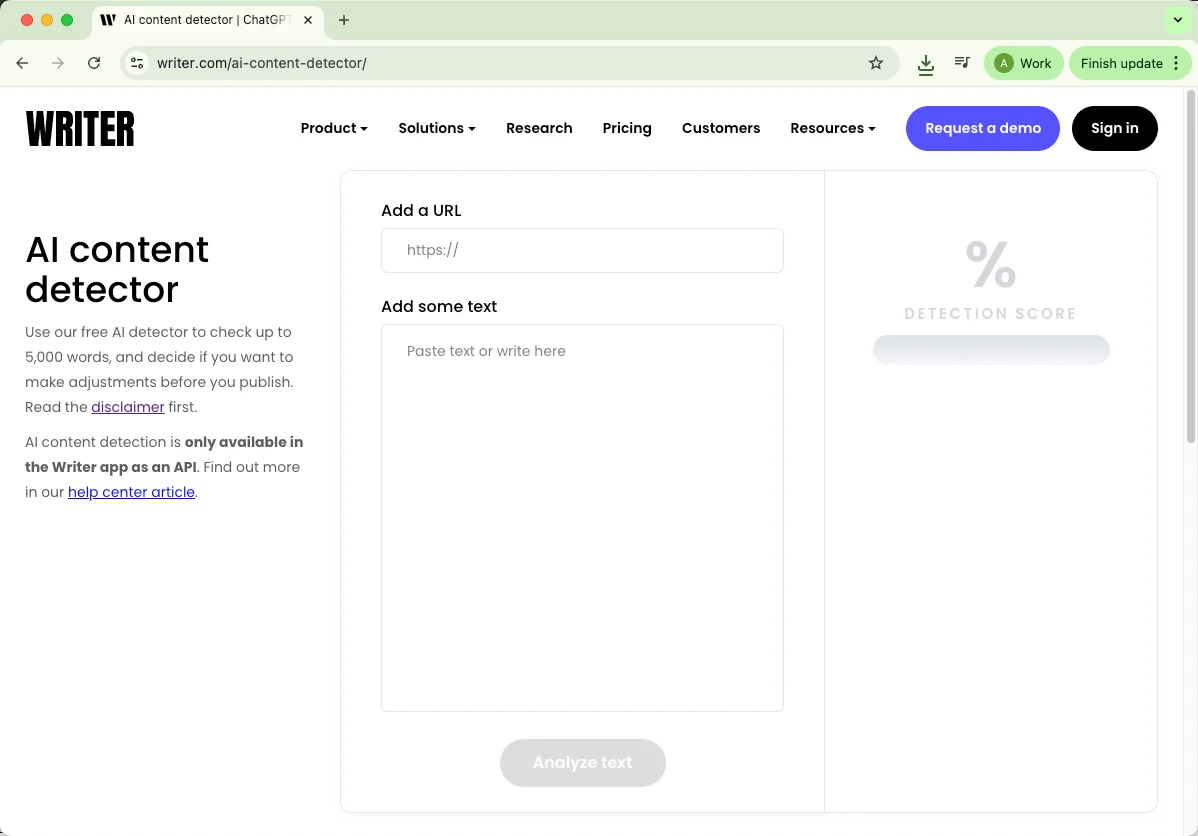
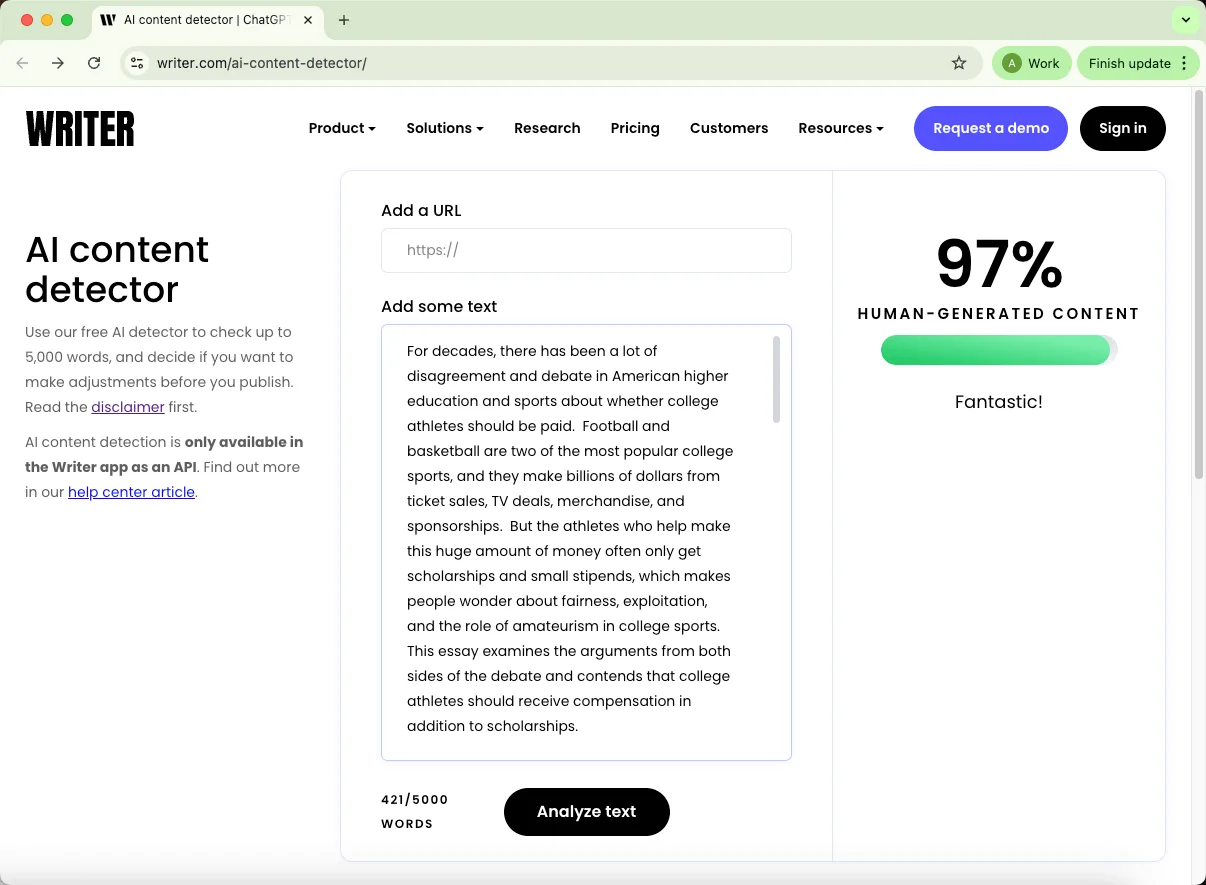
The former public Writer AI Detector accepted pasted text or a URL and returned an overall human-generated content percentage. The screenshots below show that interface and its 5,000-word counter. They document how the historical tool worked; they do not describe a free detector currently available at the old address.
How Accurate is Writer AI Detector
The three stored tests show substantial missed AI signals: the entirely generated sample received 75% human, the mixed draft 95% human, and the QuillBot rewrite 90% human. None of these results establishes a general accuracy rate. They do show why a reassuring “human” label could be misleading for a student reviewing a mixed draft.
Here are the original setups and results. We have kept the recorded scores and screenshots rather than rerunning a tool that is no longer offered through its former public page.
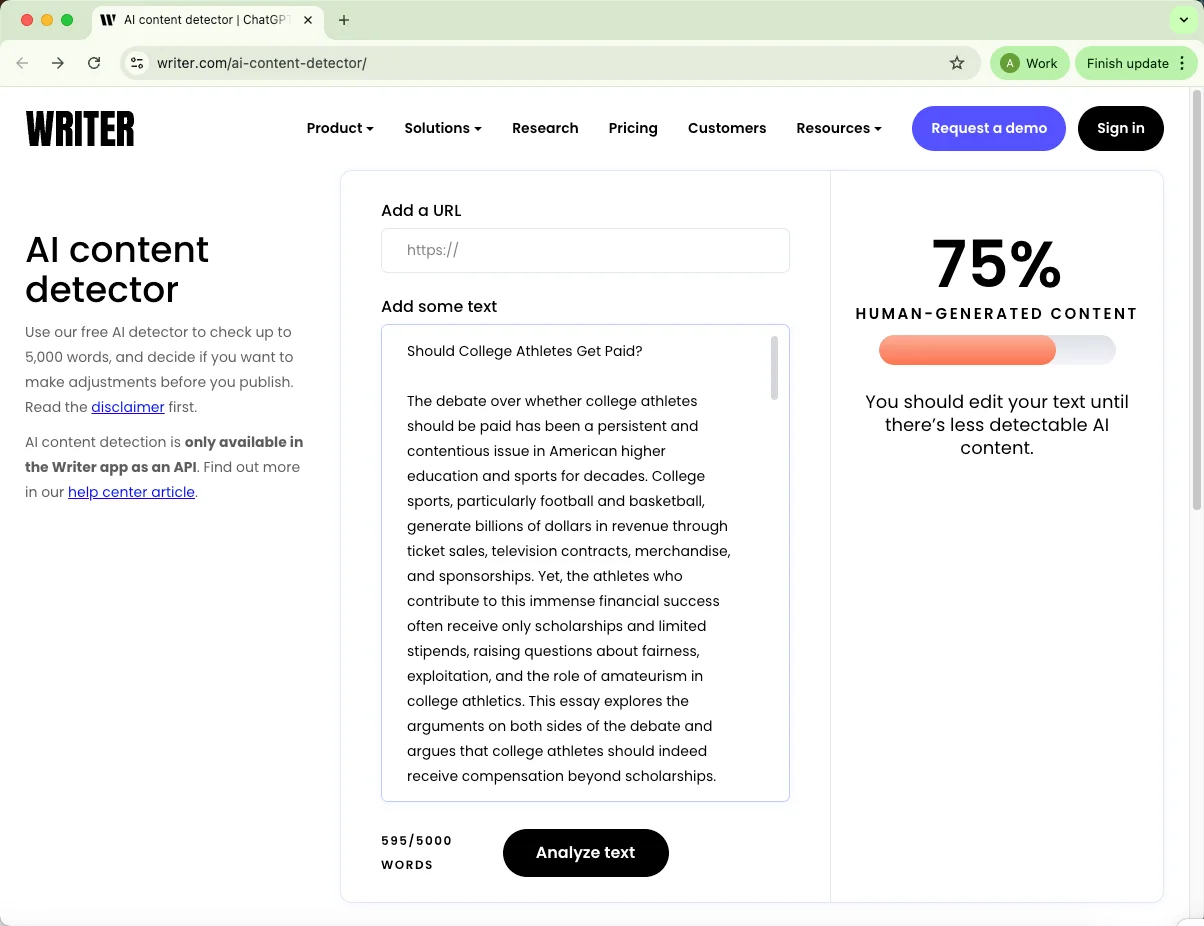
Test 1: Pure AI Text
Setup: The test text was generated entirely by ChatGPT-5.
Results: Writer AI Detector marked the text as 75% human-generated content.
Observations: The detector significantly underestimated AI content, highlighting limitations in recognizing fully AI-generated material.
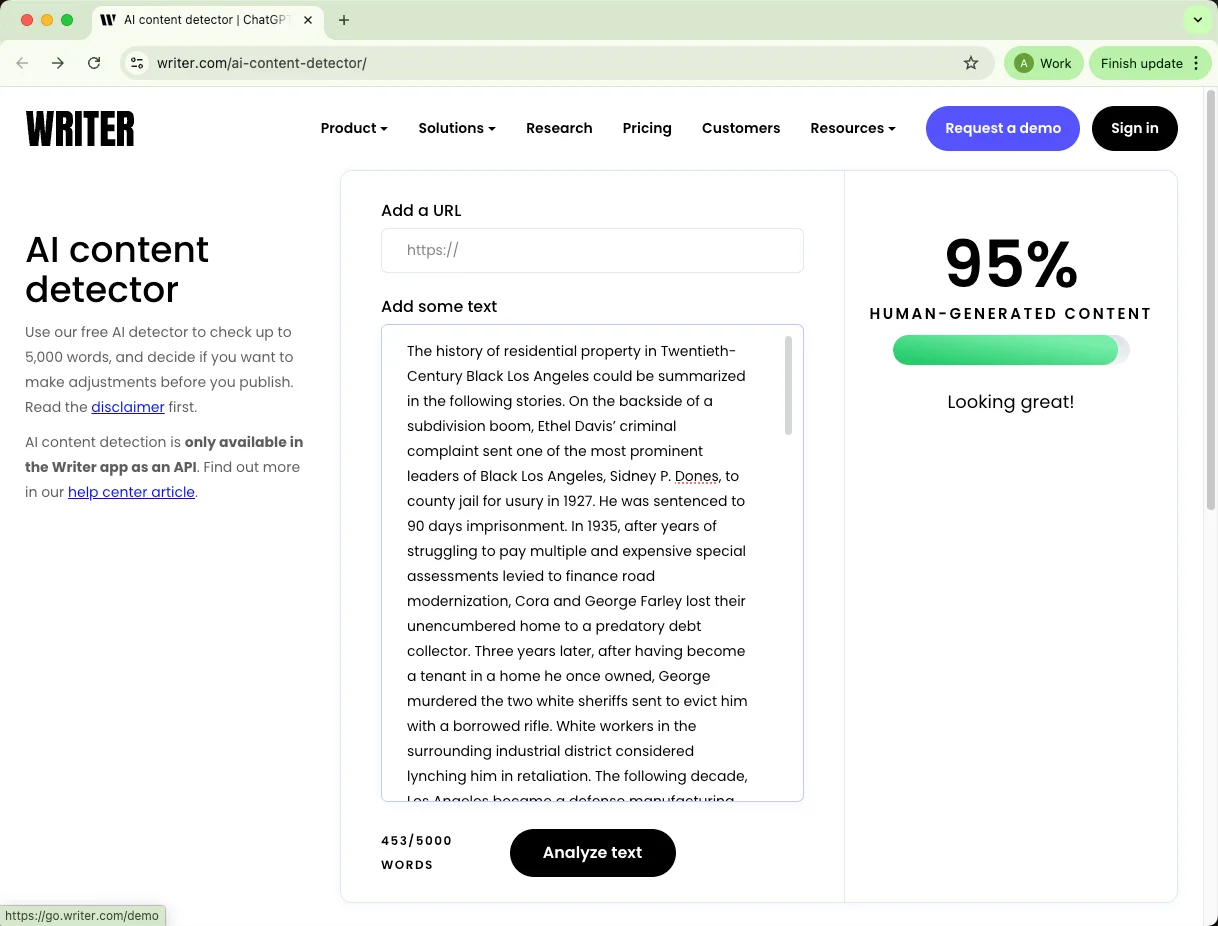
Test 2: Mixed AI + Human Writing
Setup: A pre-ChatGPT human-written essay paragraph was extended by ChatGPT-5. The text contained 187 human-written words (41%) out of 454 total.
Results: The detector marked it as 95% human-generated content.
Observations: The AI contribution was under-detected, suggesting the tool struggles with mixed content when AI input is blended with human writing.
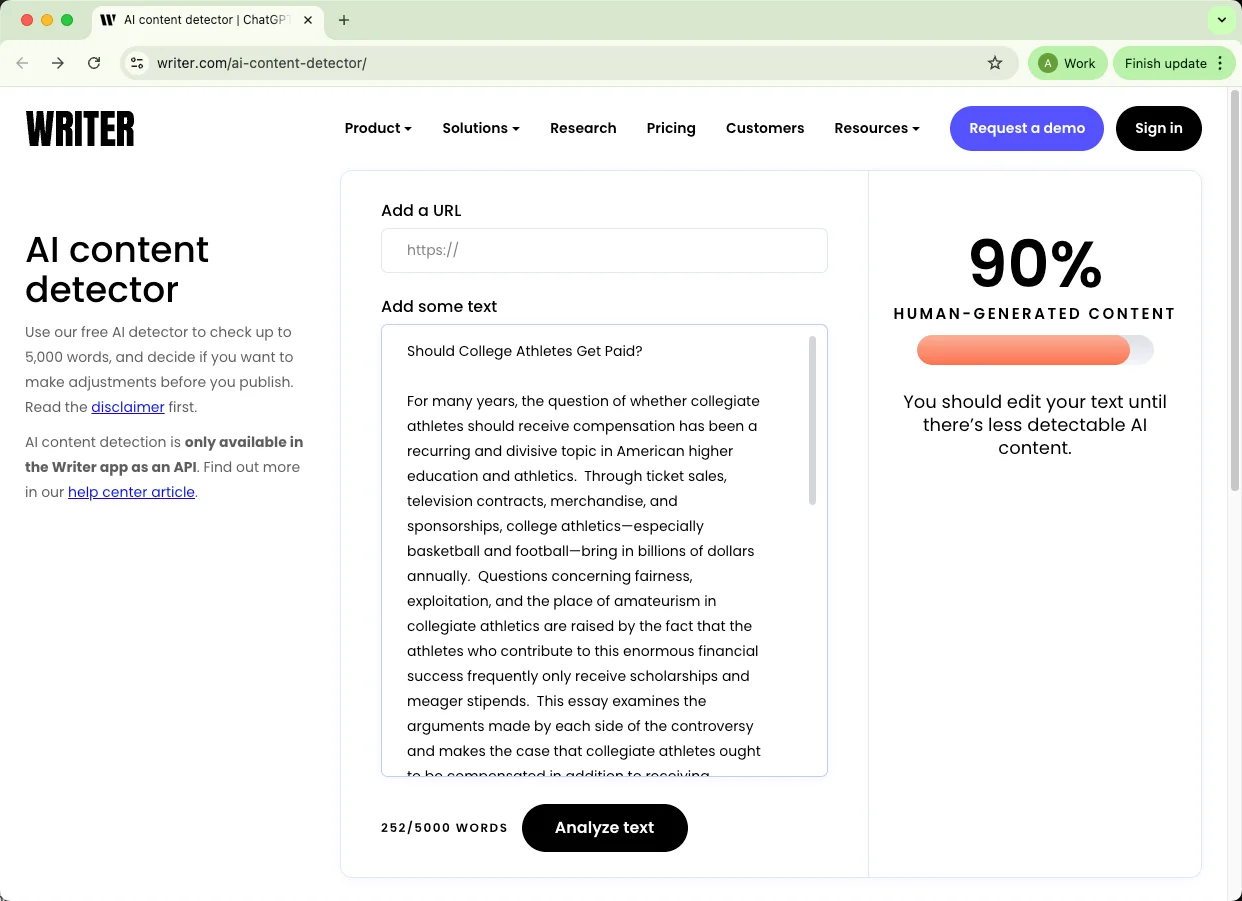
Test 3: Humanized AI Text by QuillBot
Setup: 100% AI text from Test 1 was humanized using QuillBot’s Basic Humanizer mode.
Results: The detector marked it as 90% human-generated content.
Observations: The detector overestimated human content, showing that humanizing AI text can easily bypass its detection.
The mixed draft contained 267 AI-written continuation words, but the detector’s human label was higher than for the fully generated essay. A student who read “95% human” as “only 5% was written with AI” would reach the wrong conclusion. The score describes the detector’s response to the finished text; it does not recover the document’s writing history.
How to judge a mixed draft before submission
Start with the earliest saved draft, the AI continuation, and the submitted version. Mark which passages came from each source, then compare the detector’s overall label with those actual changes. In our mixed sample, the saved 187-word human passage and 267-word continuation explain the composition more directly than the 95% label.
Next, open the cited sources and check whether each quotation, fact, and reference supports the sentence using it. A detector score does not verify a citation. Finally, compare the documented writing process with the assignment’s AI-use rules: permitted editing, generated passages, and required disclosure are separate questions. If a label conflicts with your records, keep the report and version history together and explain the specific passage or revision at issue. Repeatedly rewriting until a score turns green would obscure that evidence rather than resolve the disagreement.
Writer AI Detector Pros and Cons
Pros:
Simple historical interface: pasting text or supplying a URL produced a single, easy-to-find result.
No account needed for the old public page: our screenshots document the accessible free workflow.
Comparable saved samples: the pure, mixed, and rewritten inputs make the limitations visible rather than relying on a general accuracy claim.
Cons:
Missed AI involvement in all three examples: the fully generated essay and its rewrite both received high human labels.
A mixed draft could look reassuring: 95% human did not reflect the known composition.
Little detail in the saved reports: an overall percentage did not identify who wrote each passage or validate references.
The former free page is no longer available: its old interface and allowance cannot be used as a current buying recommendation.
Writer AI Detector Pricing
The former detector was free and displayed a 5,000-word per-submission limit, as the test screenshots show. As of our 9 November 2026 check, its public address redirects to WRITER’s main enterprise site instead of opening that detector. There is therefore no current free scan to start at the former page.
WRITER’s present enterprise offering covers agents, business workflows, knowledge connections, and administration. Its plans are not a premium version of the old detector. The older Starter-plan image below belongs to the platform’s previous offer, not to a current standalone AI-detection subscription.

Can You Bypass Writer AI Detector?
While Writer AI Detector provides an AI score, its limitations mean that some high-quality humanization techniques can reduce detection—but it’s not straightforward. Simple word swaps or basic rewording often fail, especially when aiming for a low AI score.
Professional tools like EssayDone Humanizer offer advanced language and structural modifications to more effectively lower detection rates. This tool rewrites sentences, adjusts grammar, and enhances overall readability, making AI-generated content appear more human-like.
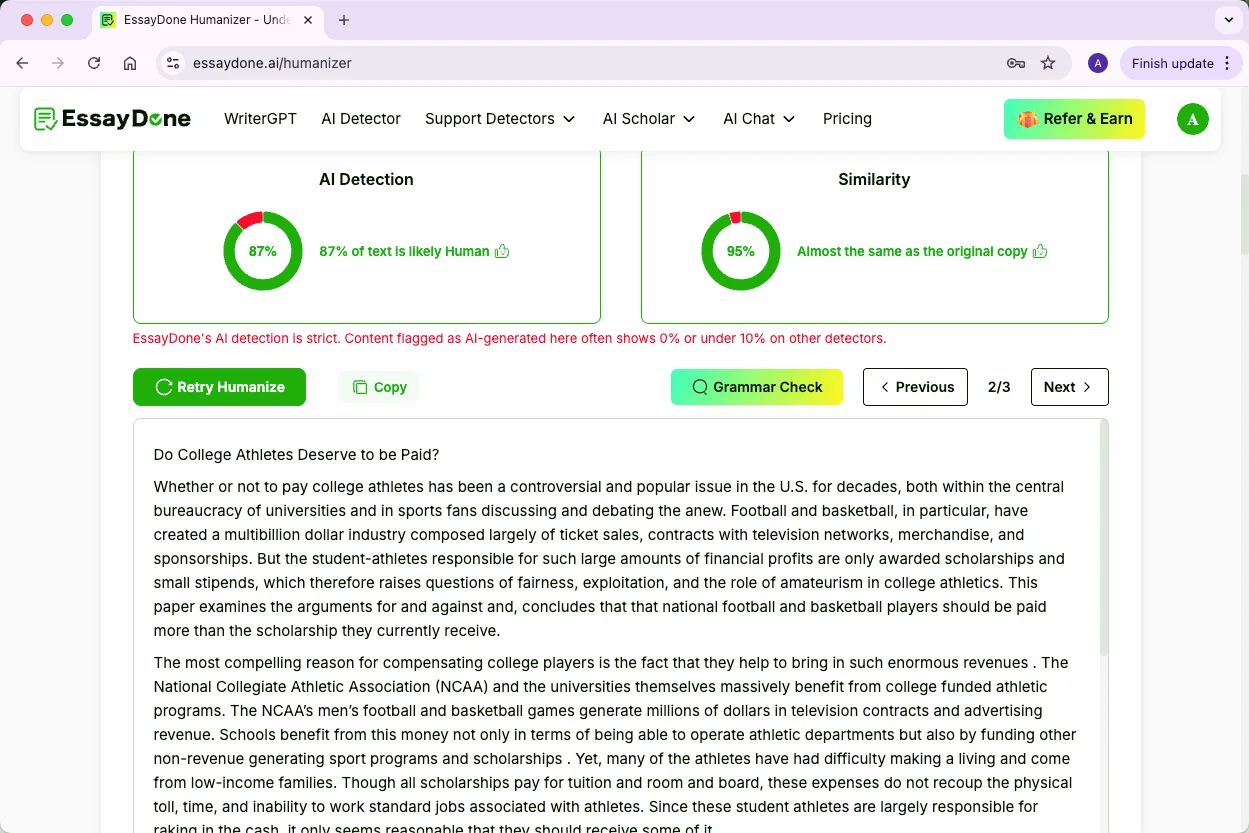
In practice, applying EssayDone Humanizer to the 100% AI-generated text from Test 1 successfully reduced its AI score to just 3% AI-generated content, demonstrating its ability to maintain natural flow and clarity while minimizing detection.
5 Alternatives to Writer AI Detector
Tool | Multilingual | Free Plan | Paid Plan | File Formats | Login Required | Sentence-Level Analysis | Extra Features |
Yes | Limited free tools | Pro: $14.95/month or $12.95/month billed annually; 2,000 credits/month (200,000 words with 5.0 or 20,000 with 5.0 Max, AI only) | DOCX, PDF, DOC; bulk and web scans on Pro | Account for saved scans and paid tools | Yes | 5.0: 1 credit/100 words for AI only, or 2 with plagiarism. 5.0 Max: 10 credits/100 words for AI only. Readability, grammar and fact-checking tools are separate from detector scores. | |
GPTZero | Yes | 10,000 words/month; 10,000 characters/scan | Premium: $23.99/month or $12.99/month billed annually; 300,000 words/month | Text and files; Premium batches up to 50 files | Account for the monthly allowance and history | Advanced Scan: one free trial, then paid | Writing feedback, citations and plagiarism checks; Premium scans up to 50,000 characters. |
Copyleaks | Yes: 30+ AI-detection languages | 25,000 characters per public scan | Personal: $16.99/month (100 credits/month) or $167.88/year (1,200 annual credits) | Text and documents; multiple-file uploads | No for the public check; account for saved reports | Sentence insights with an account; AI Logic on subscription | AI + plagiarism report. 100 credits cover up to 25,000 words or 100 images. |
ZeroGPT | Yes | 15,000 characters per scan | Pro: $14.99/month or $8.99/month billed annually; 100,000 characters/scan | Text; paid batch-file checking and PDF reports | Public check available; account for subscription | Highlights and document/paragraph/sentence analysis | Summarizer, paraphraser, grammar, translator; plagiarism has a separate quota. |
QuillBot | Yes | 1,200 words/scan; up to 6 scans/day | Premium: $19.95/month or $8.33/month billed annually; unlimited AI scans | Text and document uploads | Public trial available; account for Premium | Explainer cards; more detail on Premium | Paraphraser, Humanizer, grammar and summarizer; plagiarism: 25,000 words/month on Premium. |
FAQ
Is Writer AI Detector 100% accurate?
No AI detector, including Writer AI Detector, is 100% accurate. It provides an estimated AI content score, but results can vary depending on text complexity, writing style, or AI-human mixed content. Human review is always recommended.
How to bypass Writer AI Detector?
Simple word replacement or basic rewriting usually won’t fool the detector. Professional humanizing tools, like EssayDone Humanizer, can reduce detection rates by restructuring sentences, improving grammar, and making AI-generated text appear more natural—but bypassing detection completely is difficult.
Will my professor use an AI detector?
Some professors may use AI detection tools, especially for academic integrity checks, but usage varies by institution. Policies differ, so it’s important to follow your school’s guidelines on AI-assisted writing.

Can I use AI detectors on my own work before submission?
A detector can provide an extra signal about wording, but it does not check originality, validate references, or establish who wrote a passage. For a mixed draft, save the source text and revision history first, then compare any report with those records and the assignment’s AI-use rules. The former free Writer page is no longer available for this workflow.
Are AI detectors legal?
Yes, AI detection tools are legal to use. They are meant for academic integrity, content verification, and editorial purposes. Users should respect copyright and privacy laws when submitting or scanning content.
Is Writer AI Detector free?
The detector in our screenshots used to be free, with a 5,000-word counter. Its former public URL now redirects to WRITER’s enterprise site, so that old free detector is no longer accessible there. The enterprise platform should not be described as the same free tool.
Conclusion
Writer’s historical results were 75% human for fully AI-generated text, 95% human for a mixed draft, and 90% human after QuillBot rewriting. The mixed result is the clearest warning against treating a human label as a writing-history measurement. Keep those results in context: the former free detector page is no longer available, and today’s enterprise WRITER platform is a different offering.