






EssayGenius AI Review: My Honest Take on Its Performance

If you’ve ever stared at a blank page, struggling to start an essay, you know the frustration is real.
That’s why I decided to test EssayGenius, an AI-powered writing assistant that promises to take your ideas from zero to a structured draft in minutes.
In this review, I’ll share my firsthand experience, break down its features, and give you a realistic sense of what works—and what doesn’t—so you know if it’s worth your time.
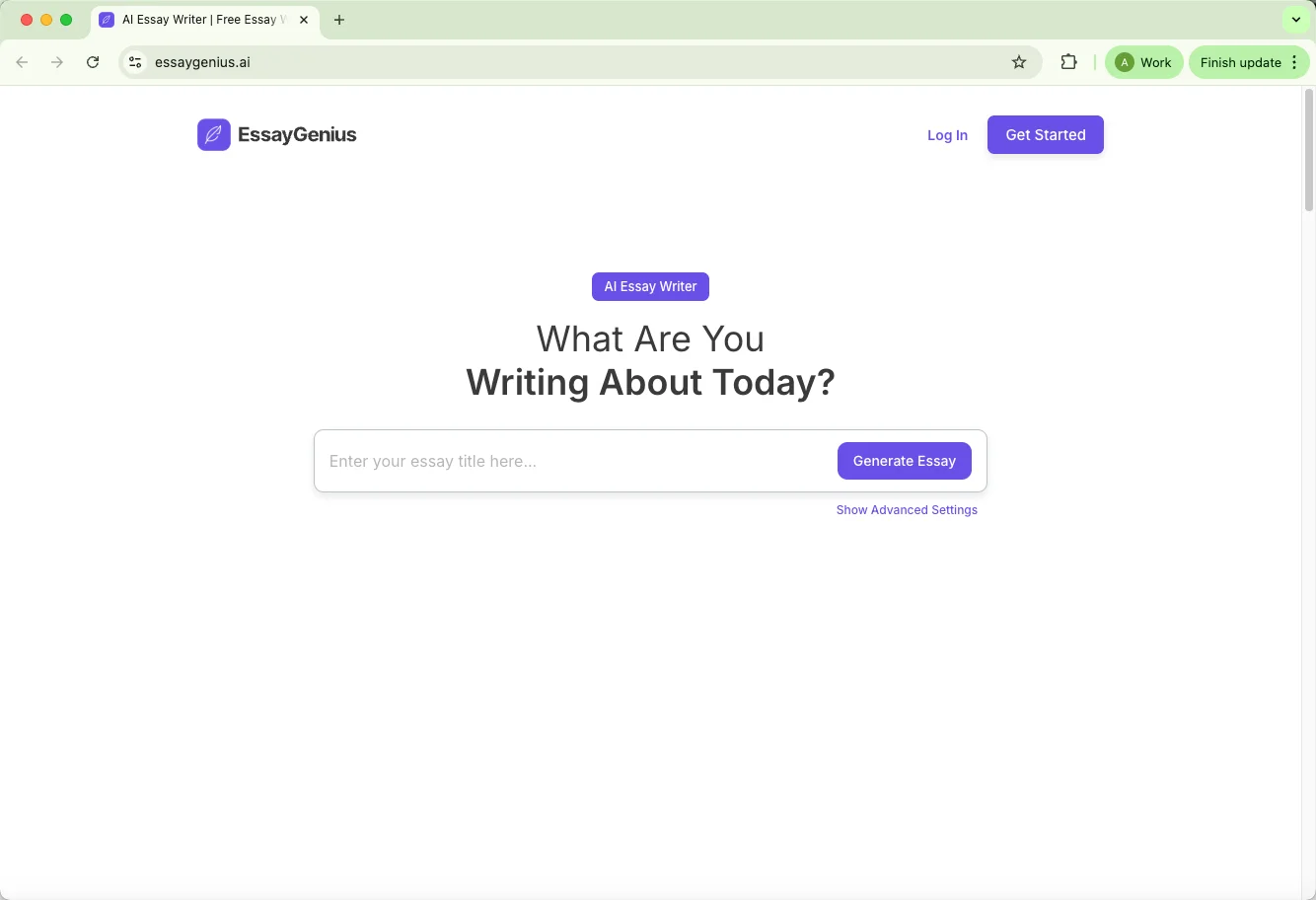
What Is EssayGenius?
EssayGenius is an AI-powered writing assistant designed to help students, writers, and professionals move from a basic idea to a structured essay draft. It uses AI models to generate essay structures, paragraphs, and even full essays based on a user-provided prompt, typically in under a minute. Users can also specify essay length, select a citation style, and upload previous writing to guide the AI’s style.
Main Features
AI Essay and Structure Generation
EssayGenius can produce a complete essay draft from a given topic or prompt. The system generates structured content with sections such as introduction, body, and conclusion.
Editing and Refinement Tools
The platform provides modes like Paraphrase, Expand, Summarize, and Continue, allowing users to adjust, expand, or reword AI-generated text.
Personalization Through Writing Samples
Users can upload their own essays to help the AI align its output with their personal writing style.
Citation and Plagiarism Support
EssayGenius includes a built-in plagiarism checker and a citation generator that supports multiple formats, including APA and MLA.
Multilingual Support
The tool supports essay drafting in more than 28 languages.
User Input Options
Users can customize the generated content by specifying essay type, academic level, length, and other instructions.
How to Use EssayGenius
Using EssayGenius involves a few straightforward steps. The key is to provide clear and detailed instructions to get the best results.
Step 1: Set Up Your Essay Details
Start by entering your essay title and specifying parameters such as essay length, type, academic level, and citation style. The more precise your input, the more tailored the AI’s output will be.
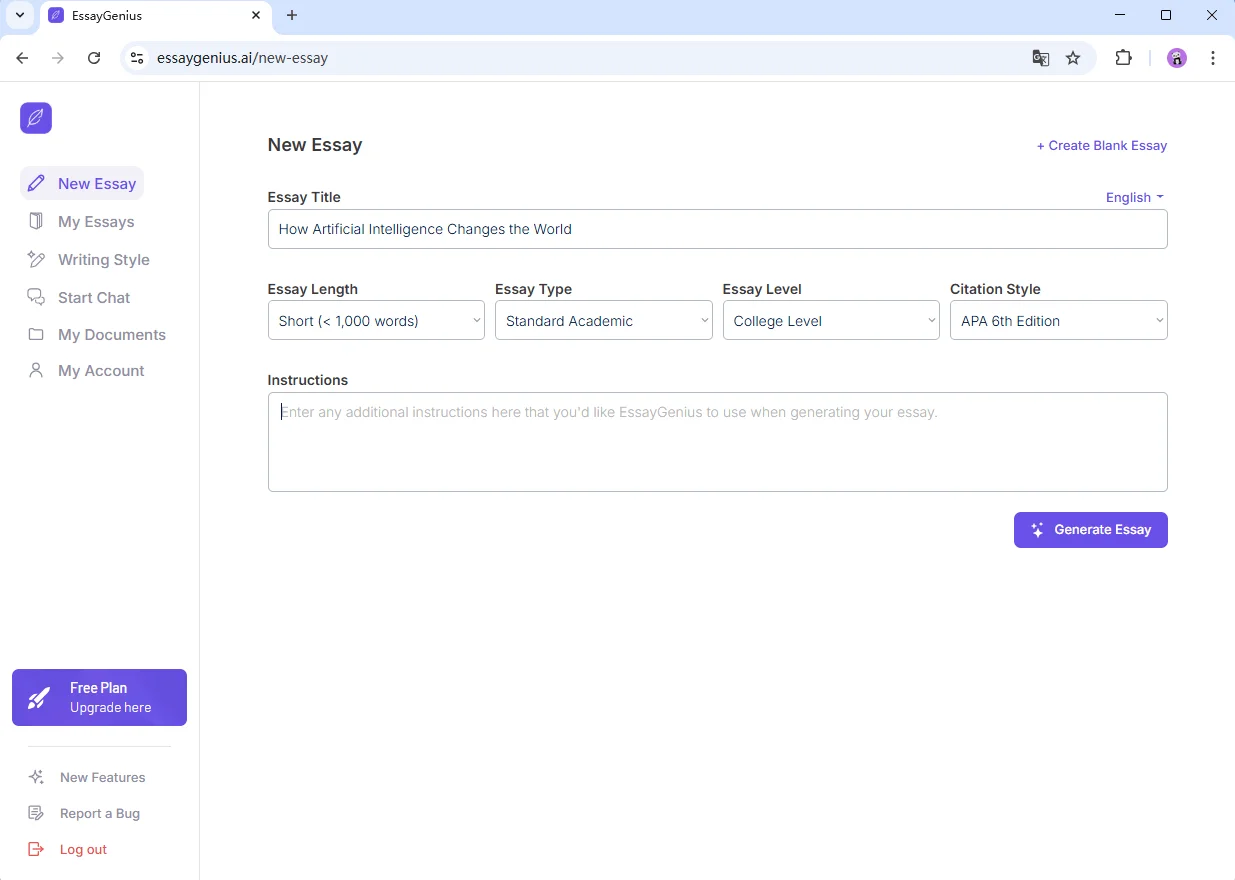
If there are particular sources or materials you need included, you can add them at this stage. This helps the AI generate content that aligns with your requirements.
Instead of a broad topic like “Social Media,” try something more detailed, for example: “A persuasive essay for a college-level course on the effects of social media on teen mental health, using MLA citation style.”
Step 2: Generate the Draft
Once your input is ready, click the Generate button. The system usually takes about 30 to 60 seconds to produce a full essay draft, depending on the essay length.
Step 3: Review and Refine
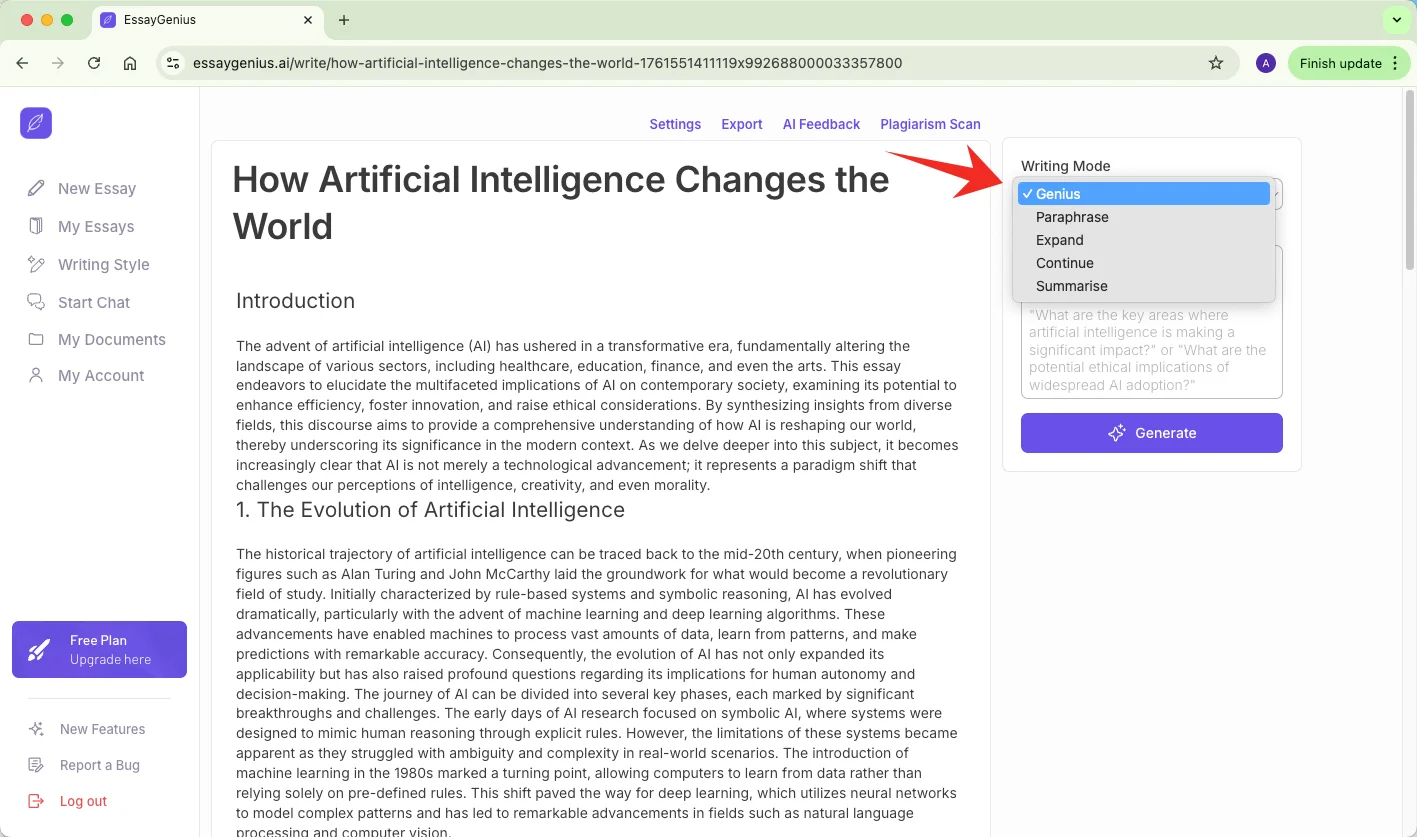
After the draft appears, you can adjust or improve it using the different writing modes available:
Genius: Standard AI draft generation.
Paraphrase: Rewrites selected sections in a different style.
Expand: Adds more depth to existing paragraphs or ideas.
Continue: Extends the essay if additional content is needed.
Summarize: Condenses sections into shorter summaries.
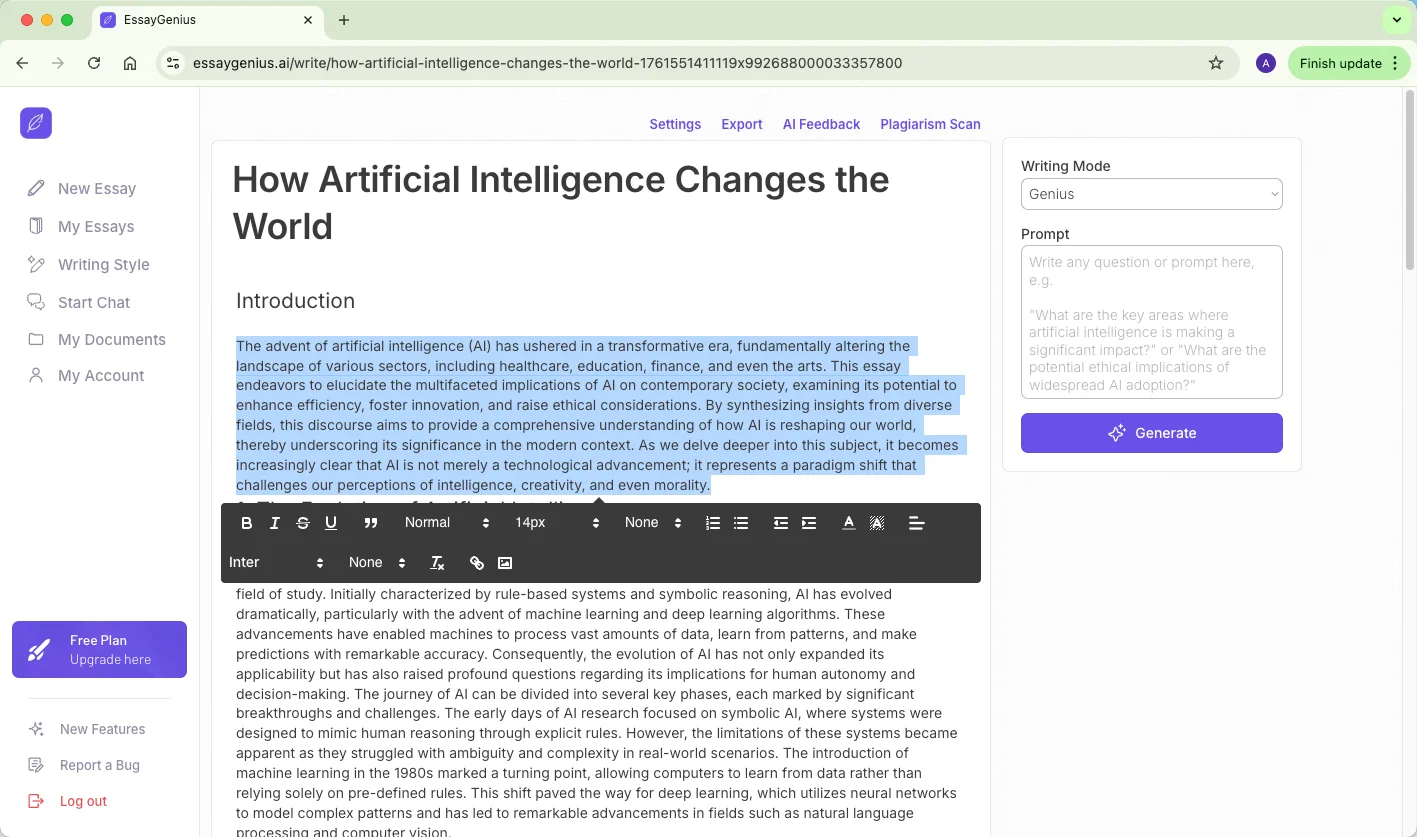
You can also select text directly in the editor to make manual edits, combine sections, or refine phrasing. These tools give flexibility to adapt the draft to your personal writing style or assignment requirements.
Comparing EssayGenius and ChatGPT-5 Outputs
After seeing what EssayGenius can generate, you might be impressed by its speed and structured output. But is it really as comprehensive or detailed as it seems? To answer that, I ran a side-by-side comparison with ChatGPT-5 using the same prompt: “How Artificial Intelligence Changes the World” with APA formatting for a standard academic essay.
EssayGenius result how AI changed the world
Essaygenius result how AI changed the world
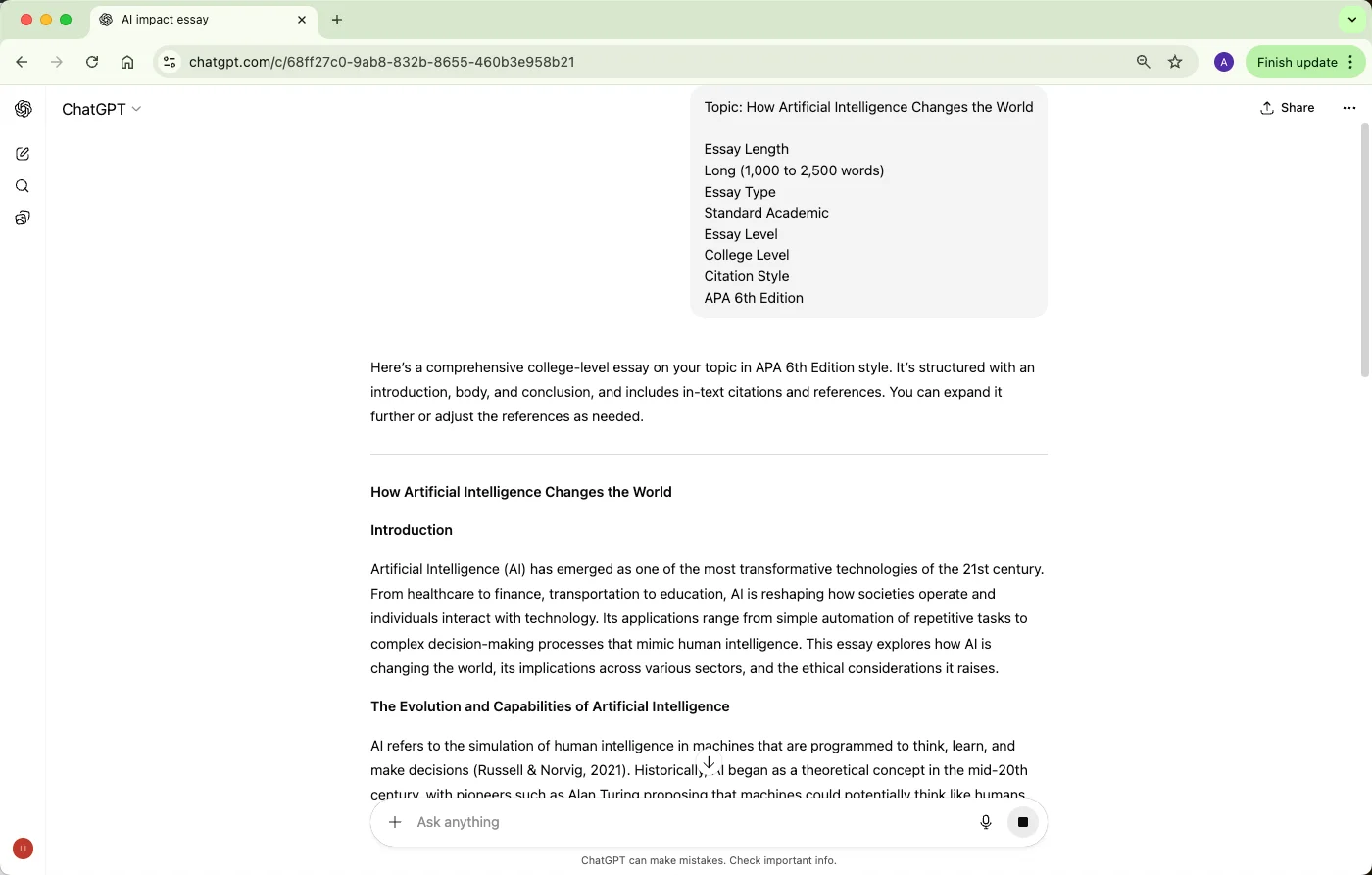
Structure
Both essays follow a standard academic structure: an introduction, multiple body sections, ethical considerations, and a conclusion. EssayGenius organizes the content into seven clearly defined sections, while ChatGPT-5 takes a slightly different approach, including topics like transportation and integrating business with economics.
In my view, these differences are minor. Both tools produce well-structured essays, and any variations can usually be adjusted with prompts. On structure alone, I would consider them roughly equal — the difference is mostly stylistic rather than substantial.
Here’s a clear comparison table showing the outlines from EssayGenius and ChatGPT-5 side by side:
Section | EssayGenius Outline | ChatGPT-5 Outline |
Title | How Artificial Intelligence Changes the World | How Artificial Intelligence Changes the World |
Introduction | ✓ | ✓ |
Section 1 | The Evolution of Artificial Intelligence | The Evolution and Capabilities of Artificial Intelligence |
Section 2 | AI in Healthcare | AI in Healthcare |
Section 3 | AI in Education | AI in Business and Economics |
Section 4 | AI in Finance | AI in Education |
Section 5 | AI in the Arts | AI in Transportation and Urban Development |
Section 6 | Ethical Considerations and Challenges | Ethical and Societal Implications |
Section 7 | The Future of AI | — |
Conclusion | ✓ | ✓ |
Depth of Content
Both essays convey information accurately, but their approach differs. EssayGenius summarizes topics clearly, providing broad coverage with formal explanations organized into distinct chapters. ChatGPT-5, in my test, included more references and specific examples in certain sections, which can give the content slightly more depth. That said, neither essay replaces the need for additional research or critical review.
Writing Style and Readability
EssayGenius maintains a consistent formal tone, and the essay reads smoothly from start to finish. ChatGPT-5’s sentence structures are slightly more varied, which can sometimes feel mechanical. In my experience, both are highly readable and coherent. The differences are minor and mostly come down to style preferences rather than overall quality.
Citations and References
This is the area where the difference is most noticeable. ChatGPT-5 included a reference list with in-text citations, whereas EssayGenius produced no citations despite specifying APA formatting. If proper referencing is important for your assignment, this is a practical consideration.
Overall Impressions
Both tools can produce structured, readable essays, but they do so in slightly different ways. From my point of view, EssayGenius doesn’t clearly outperform ChatGPT-5.
Pricing
Plans
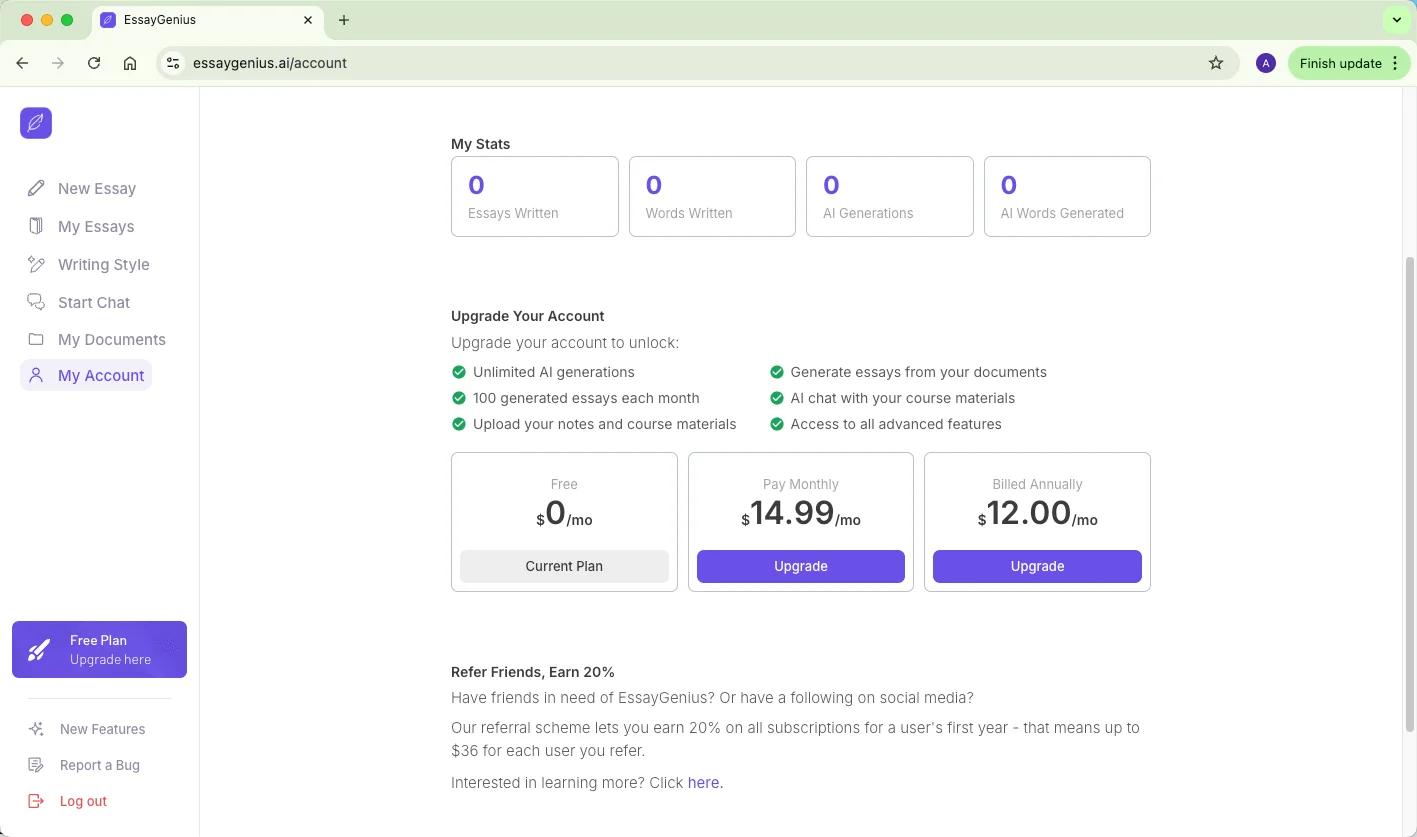
EssayGenius offers a free trial that allows one AI-generated essay after registering, so you can test the tool before committing.
For paid plans, there are two options:
Monthly Plan: $14.99 per month
Annual Plan: $12.00 per month (billed yearly)
Upgrading unlocks additional features, including:
Unlimited AI generations
Up to 100 essays per month
Upload notes and course materials
Generate essays directly from documents
Should You Buy EssayGenius?
In my opinion, the subscription is probably not worth it for most users. The free version already allows you to generate essays and get a sense of the tool’s capabilities.
Paying mainly gives you speed, higher output (more essays per month), and convenient features like document uploads and AI chat, rather than higher-quality content. In my testing, the drafts were decent but not perfect, and the editing features didn’t feel as strong as those of more advanced AI tools. ChatGPT-5, for example, can be a sufficient alternative for most writing tasks.
If your main goal is to save time on drafting, the paid version might be helpful. But if you need in-depth content, references, or detailed examples, you’ll still need to do significant work yourself. In that case, the subscription may not provide enough added value to justify the cost.
Pros and Cons of EssayGenius
Pros
Plagiarism-Free Output: All generated essays are free from plagiarism, which is useful if you want to avoid unintentional copying. ✅
Fast Generation: Drafts are generated in about 30 to 60 seconds, so you can quickly get a structured essay. ✅
Unlimited Essays on Paid Plan: Upgrading allows you to generate as many essays as you need each month. ✅
Basic AI Assistance: The tool can rewrite sentences, complete your thoughts, suggest text, and generate essay structures, which can save time during drafting. ✅
Cons
Limited Free Version: The free plan only allows one AI-generated essay and restricts access to other features. ❌
Prompt Sensitivity: To get useful results, you need to craft detailed and precise prompts; vague instructions reduce quality. ❌
Variable Text Quality: While grammatically correct, generated essays may contain factual mistakes or underwhelming content. ❌
Cumbersome for Some Users: Navigating the interface and using all the features can feel clunky, especially for users new to AI writing tools. ❌
No Customer Support: There’s no way to contact support by email or phone, which can be an issue if technical problems arise. ❌
Advanced Settings Are Limited: Essay length, type, academic level, and citation style can be adjusted, but there’s no flexibility beyond these preset options. ❌
Limited Features Overalll: The tool doesn’t have many advanced writing or research features compared to other AI assistants. ❌
Short Output per Generation: Each generation produces roughly 350 words, so longer essays require multiple iterations. ❌

FAQ
Can I use EssayGenius for free?
Yes, you can. The free version lets you generate your first essay and includes a limited number of AI generations after verifying your email.
Can EssayGenius help with citations and references?
It claims to support APA, MLA, and other styles, but in my test, it didn’t generate correct citations. You’ll need to format references manually.
What modes does EssayGenius have?
EssayGenius offers several modes while writing: Genius, Expand, Paraphrase, Summarise, and Continue. Each mode helps you refine or extend your content in different ways.
Can I export my essays?
Yes. Once your essay is ready, you can either export it as a PDF or copy-paste the content wherever you need.
Does EssayGenius support multiple languages?
Yes. Currently, the tool supports more than 20 languages, so you can generate essays in most major languages.
Rase feature and the proprietary plagiarism checker to help ensure your essays are original.
How long can the essays be?
EssayGenius offers different length options. Paid users can generate essays up to 7,500 words, though each generation typically produces around 350 words at a time.
Can I adapt EssayGenius for my course?
Yes. You can customize several variables such as essay type, academic level, and citation requirements to better match your coursework.
What is EssayGenius AI?
It’s an AI-powered essay writing assistant. It can generate sample essays, rewrite and complete sentences, and create essay structures based on your prompts.
How much does EssayGenius AI cost?
Pricing starts at $12 per month if billed annually or $14.99 per month if billed monthly. Compared to some alternatives, this is on the higher side for AI writing tools.
Is there a mobile version of EssayGenius AI?
There isn’t a dedicated app, but you can access the platform through your mobile browser. It works similarly to the desktop version.
Is EssayGenius really beneficial?
It can help speed up drafting and organizing ideas, but it won’t replace careful editing, fact-checking, or in-depth research. If you’re aiming for high-quality, fully polished essays, you’ll still need to do significant work yourself.
Bottom Line
And that’s a wrap on my review of EssayGenius!
I’ve covered its main features, pricing, pros and cons, and how it performs in practice. From my experience, it can speed up essay drafting, but the content quality, citation issues, and limited features mean it’s not a complete solution.
Hopefully, this gives you a clear picture of what to expect and whether it’s worth trying for your workflow or coursework.