






Claude Watermark Detector: Can You Check if Text Is AI-Written?

An AI detector has flagged a paragraph—but does that mean it found a Claude watermark? Not necessarily. Checking writing patterns and verifying Claude’s watermark are different processes, and the tools available to you depend on whether you’re checking text or a file.
Here’s which check fits your situation, who can access Anthropic’s official detector, and what the results actually tell you.
Claude Text Watermarks vs. File Content Credentials
Text watermark: an invisible statistical pattern in token choices made by supported Claude models. It's part of generated wording, not an added symbol, a hidden Unicode character, or a line of metadata. Anthropic's detector needs access to the corresponding verification mechanism.
File Content Credential: signed C2PA provenance metadata added to supported files, such as certain images. It can indicate Claude involvement in producing or processing that file. It is not the same thing as a text watermark, and it can disappear when metadata is stripped.
How to Detect a Claude Watermark
Option 1: Official text watermark detection
Anthropic’s official text detection API is in private preview for qualifying organizations, including certain regulators, researchers, media, educational groups and enterprises with relevant compliance needs. Eligible organizations can request access through Anthropic’s watermarking guidance.
For ordinary students, teachers, and individual writers, there is no broadly available public paste-text checker from Anthropic described on that page. Websites claiming to be a “Claude watermark detector” should not be assumed to possess Anthropic's private detection key.
Option 2: Check a Claude-generated file for C2PA
Open Anthropic’s free file checker, upload a supported file, and check whether a Claude-issued Content Credential is present. It supports common image, video and audio formats up to 100 MB, runs in your browser, and explicitly does not check text.
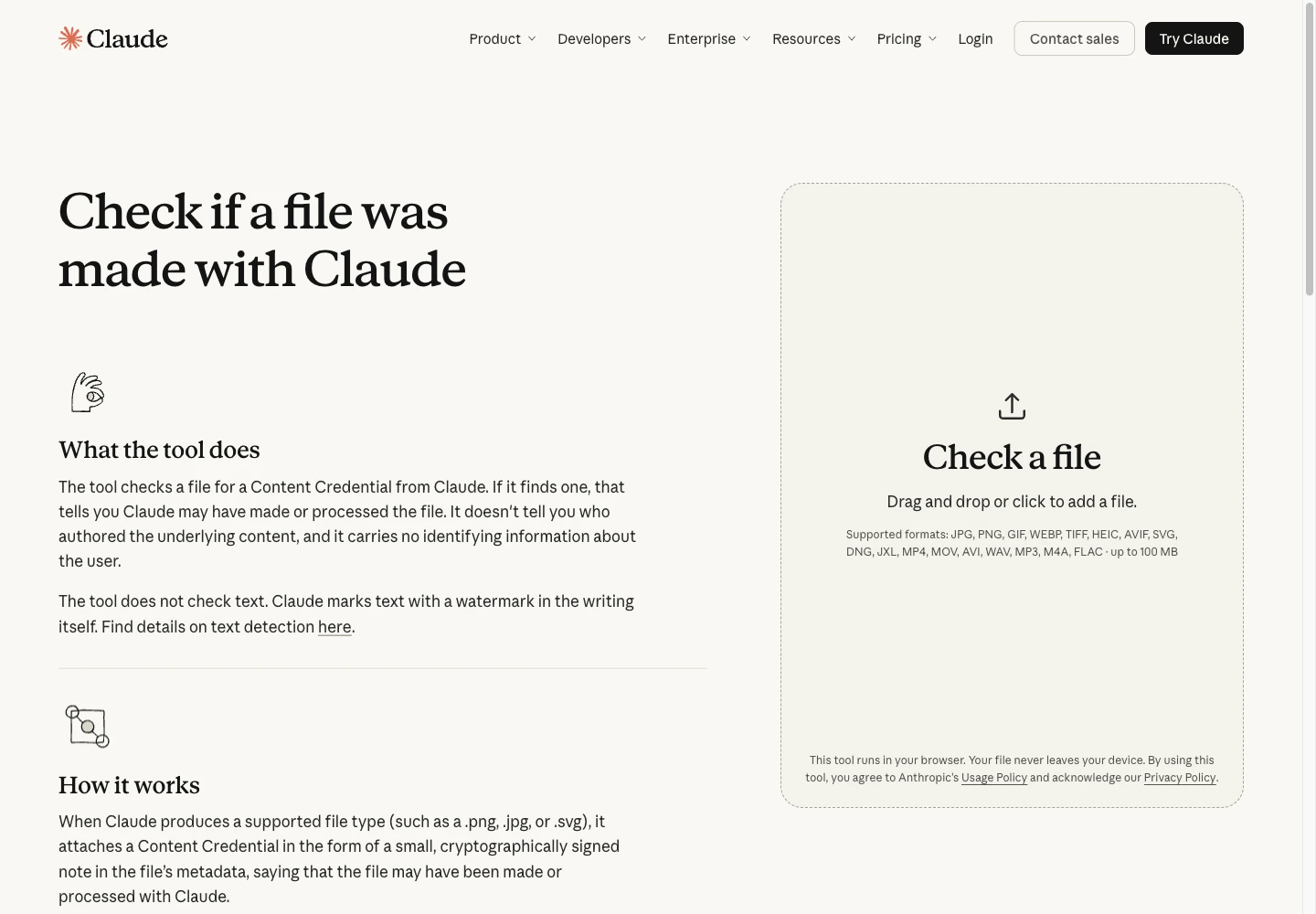
A positive result indicates that a Claude credential was found; it does not show how much of the underlying work a person contributed. A missing credential is inconclusive because metadata can be stripped or the file may have been created in an unsupported workflow.
Option 3: Use a general AI writing detector
Tools such as GPTZero, Turnitin, and other AI text classifiers evaluate writing patterns rather than verifying Anthropic's watermark key. Their output can help prompt closer review, but a percentage labeled “AI” is not a Claude watermark result and does not establish which model wrote the text.
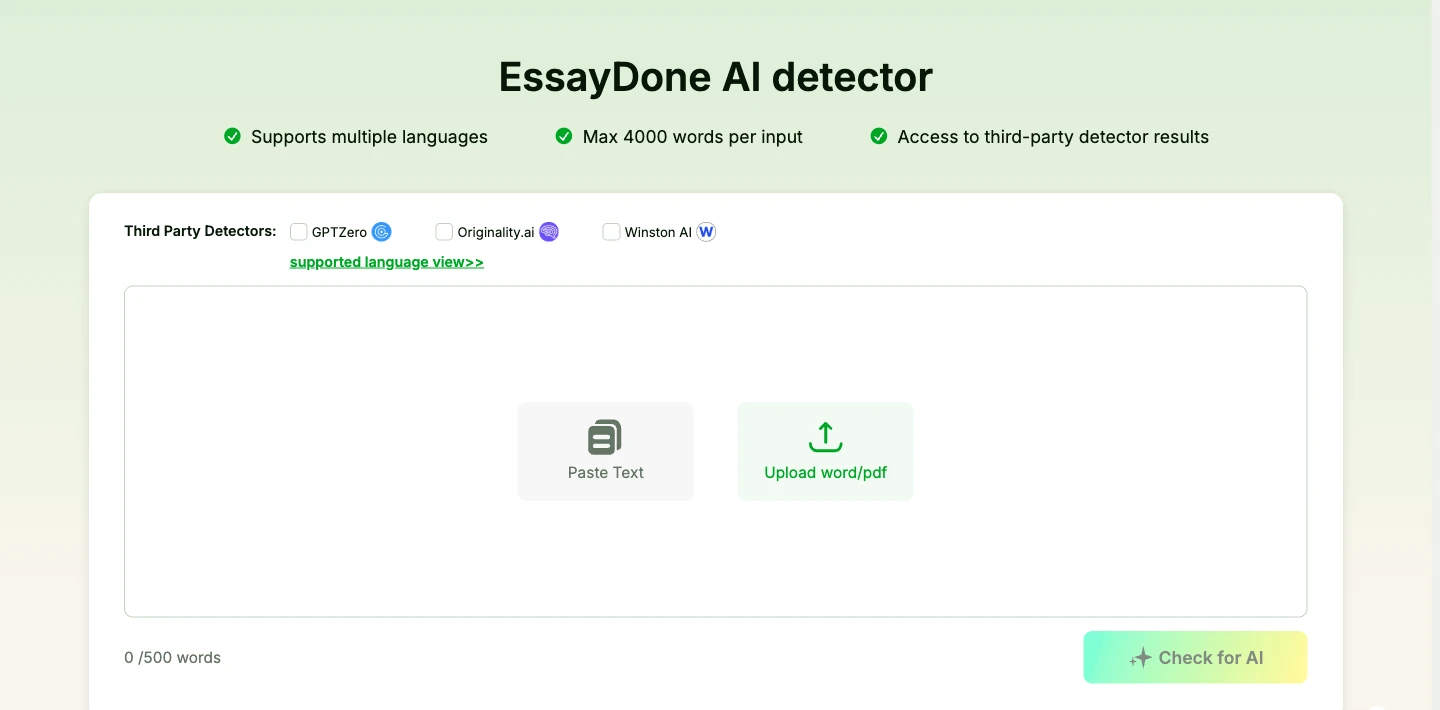
For a preliminary check of writing patterns, you can use EssayDone AI Detector. Its result is not verification of Claude’s watermark or a finding of misconduct.
How Does Claude's Invisible Text Watermark Work?
Language models choose their next token from multiple plausible options. Anthropic's approach adjusts some low-stakes choices using a secret keyed process so the finished writing has a pattern that a compatible detector can evaluate. Anthropic says its method is related to Google DeepMind's SynthID-Text approach. It does not require adding extra characters or increasing output length.
For example, an ordinary sentence might allow several equally natural ways to describe cold weather. A watermark can influence which plausible word is selected. But when there is only one factually correct term or precise code token, there is little freedom for a watermark to act. This is why technical material, direct quotations, and light proofreading may contain a weaker signal than freely generated prose.
Can Claude Watermarks Survive Copying, Editing, or Paraphrasing?
Copying and pasting text can preserve the underlying word-choice pattern because it travels with the text itself. However, substantial rewriting, paraphrasing, translation, or mixing AI and human passages can make that pattern harder to detect. Very short excerpts provide fewer observations and can be inconclusive even when the original long passage was watermarked.
This is about detection reliability, not a method for proving that altered writing is human-authored. Removing or weakening a signal doesn't change how the underlying text was produced.
What Does a Positive or Negative Result Actually Prove?
Positive Claude watermark result: evidence that Claude may have generated or processed some of the passage. It cannot reliably name the human author, determine who owns the text, or quantify exactly how much was AI-written.
Negative Claude watermark result: no supported mark detected under that test. It does not prove human authorship. Older models, unsupported settings, edits, short samples, and mixed text can all reduce detectability.
General AI-detector score: a model's estimate based on patterns in the text, not verification of Anthropic's keyed text watermark. A teacher or editor should not treat a single automated score as conclusive evidence against a writer.
Does Every Claude Model Include a Watermark?
No. Coverage differs by model, deployment surface and some model settings. Check Anthropic’s current model-support table for the latest supported combinations.
Claude Watermark Detector vs. Turnitin or GPTZero
| Check | What it verifies | Access |
|---|---|---|
| Anthropic text API | Keyed pattern in Claude output | Restricted private preview |
| Claude file checker | C2PA credentials in media files | Free public browser checker |
| AI writing classifiers | Writing patterns; not Claude's key | Depends on the provider |
The practical distinction is what each tool measures. Anthropic's official watermark detector tests for its own keyed mark. Turnitin and GPTZero assess text characteristics to estimate possible AI writing. The first is origin-specific but access-restricted; the others are more accessible in their respective environments but do not verify Claude's proprietary watermark.
If your concern is academic integrity, keep drafts, revision history, notes, and sources. These provide context about how the work developed that a detector score alone cannot provide.
Bottom Line
For Claude-generated text, official watermark verification is currently limited to eligible organizations. For a supported image, audio, or video file, try Anthropic's free C2PA checker. For ordinary writing, a general AI detector may offer a preliminary signal, but it cannot substitute for Claude watermark verification—and no single result determines human authorship.
Frequently Asked Questions
Does Claude add hidden characters to writing?
No. Anthropic says the watermark changes statistical token choices rather than inserting hidden characters or a visible signature.
Can Turnitin detect a Claude watermark?
Turnitin's AI writing assessment is not Anthropic's keyed watermark detector. It may assess writing patterns, but that is different from confirming a Claude-specific mark.
Is the official Claude watermark detector free?
The public file credential checker is free. Anthropic's text watermark detection API is in a restricted preview, so it is not currently a generally available free text-checking website.
Choose the check that matches your question: file credentials for supported media, or writing-pattern analysis for a passage. If two classifiers disagree, our GPTZero vs ZeroGPT comparison shows why their reports need to be read separately. Keep the draft and its revision history alongside any result.