



GPTZero vs ZeroGPT: Which Is Better at Detecting Mixed Writing?

Imagine checking the same paragraph with two AI detectors before submitting an essay. GPTZero says the text contains a mix of human and AI writing. ZeroGPT gives it a different score. Then you look at the highlighted sentences and notice something strange: one tool has flagged a sentence taken directly from a human-written paper.
So, which result should you trust?
This is where comparing AI detectors gets interesting. Recognizing a completely AI-generated paragraph is one thing. Telling human writing apart from AI-generated sentences in the same document is much harder. For students, teachers, and editors, getting those individual sentences right can matter more than the overall percentage.
We tested GPTZero and ZeroGPT using three passages on the same historical topic: one written by a human, one generated by AI, and one combining both. The results revealed a clear difference in how the two tools handled mixed writing.
GPTZero vs ZeroGPT: Our Test Results
Both detectors correctly identified the fully human-written and AI-generated samples. The difference appeared in the mixed passage.
| Test sample | GPTZero | ZeroGPT |
|---|---|---|
| Human writing | 100% Human | 0% AI |
| AI writing | 100% AI | 100% AI |
| Mixed writing | All 5 AI sentences found | 5 AI sentences + 1 false flag |
The first two results were straightforward. Both tools recognized the human sample and the AI sample correctly.
The mixed passage was more revealing: GPTZero identified all five AI-written sentences without flagging the human-written section. ZeroGPT found those same five AI sentences but also highlighted one additional human-written sentence.
Where Did ZeroGPT Get It Wrong?
The extra highlight was not a random phrase. It came from the opening of the original human-written academic passage:
“By the Farleys’ account, they owed a total of $119 for the improvement of Long Beach Avenue...”
This sentence was copied directly from the original human-written paper. It was not generated or rewritten by AI.
GPTZero correctly highlighted the five AI-written sentences that followed the human section.
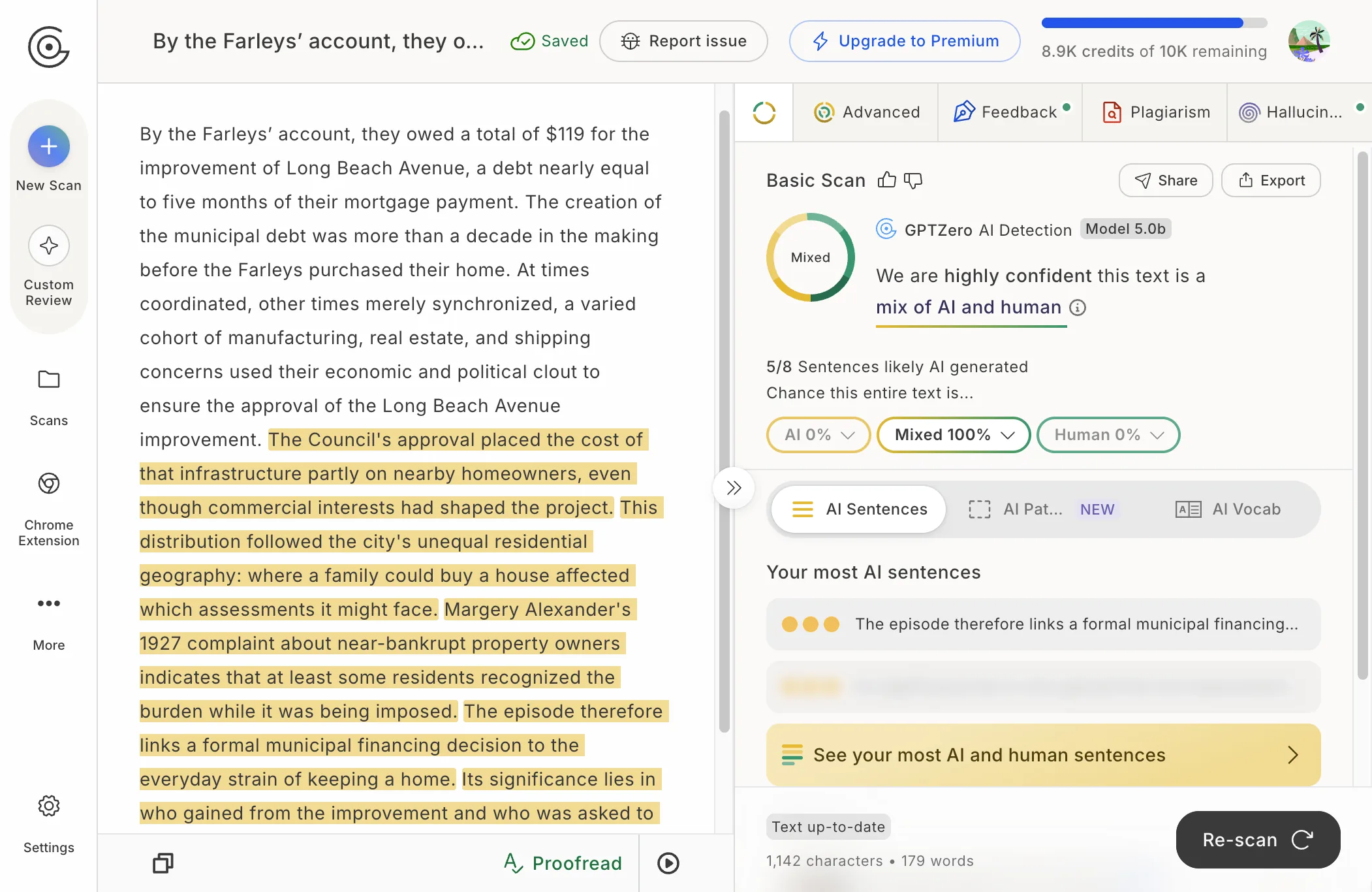
GPTZero: All 5 AI-written sentences correctly highlighted.
ZeroGPT also highlighted the five AI-written sentences, but its report included the original human-written opening sentence.
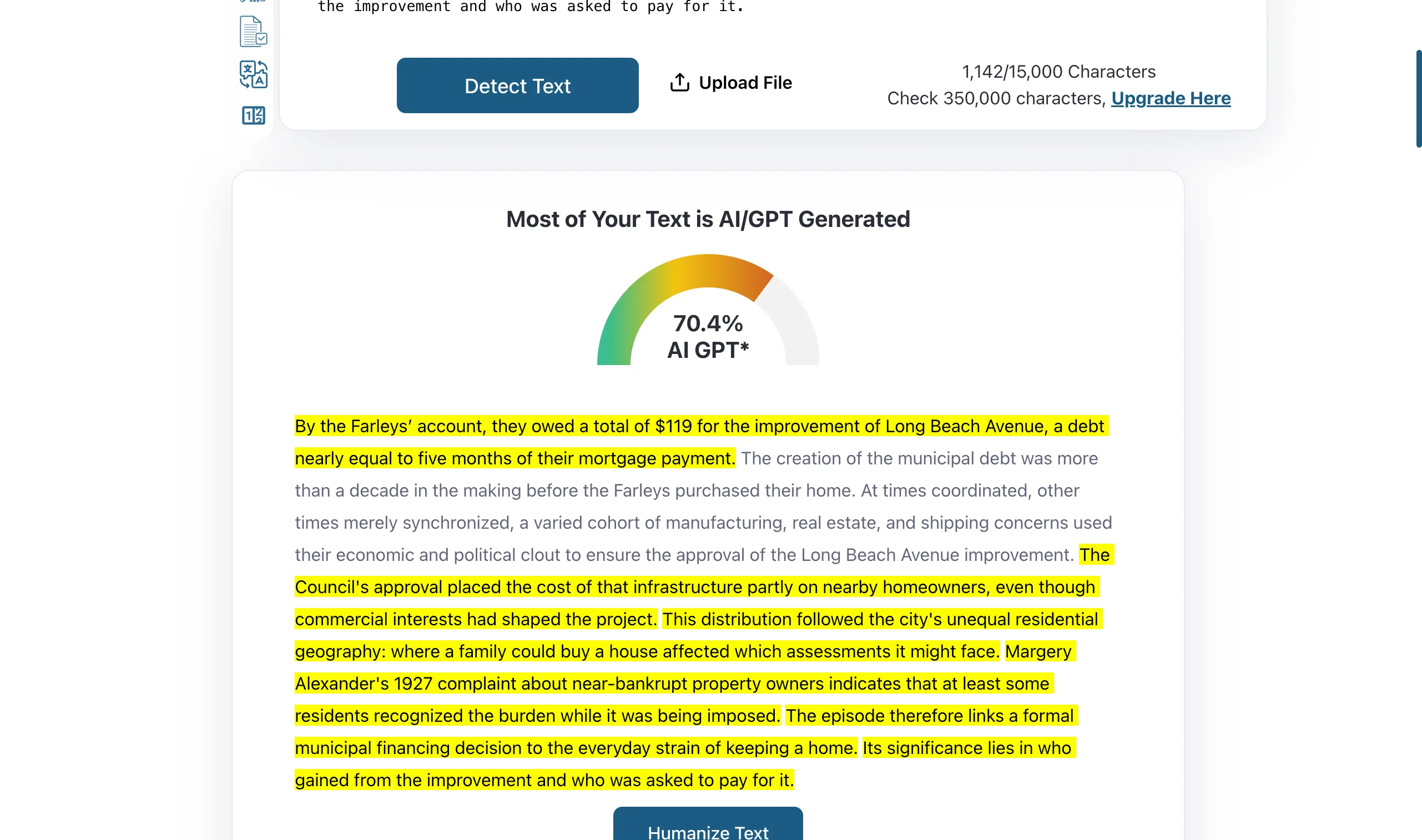
ZeroGPT: 1 human-written sentence incorrectly flagged.
That extra highlight is the most interesting part of this comparison. If you're checking a student's draft or reviewing a document that has been edited with AI, an incorrectly flagged sentence can make the report much less useful.
There was another difference in the overall results. GPTZero classified the passage as 100% Mixed, while ZeroGPT gave it a 70.4% AI score and highlighted 126 of its 179 words.
The two percentages describe different types of results, so they should not be treated as directly equivalent. In this test, the actual highlighted sentences tell us more about the difference between the tools.
How Do Their Free Plans Compare?
Both GPTZero and ZeroGPT allow users to paste text for free, but their limits and report features are different.
| Feature | GPTZero | ZeroGPT |
|---|---|---|
| Free scan limit | 10,000 characters | 15,000 characters |
| Monthly free allowance | 10,000 words | Not listed |
| Sentence highlighting | 1 free Advanced Scan | Available in free results |
| Basic scan | Free | Free |
GPTZero separates its Basic Scan from its Advanced Scan. The Basic Scan provides an overall classification, while the free Advanced Scan gives users an opportunity to inspect sentence-level results.
ZeroGPT offers a larger public input box, accepting up to 15,000 characters in one scan, compared with GPTZero's 10,000-character limit.
In practical terms, GPTZero gives you a larger published monthly word allowance and a free opportunity to try its Advanced Scan. ZeroGPT lets you submit a longer passage in one go.
One distinction worth remembering: a single-scan character limit and a monthly word allowance are two different measurements.
For the full GPTZero plan details, see its official pricing and plan guide.
How We Tested GPTZero and ZeroGPT
We used three passages about the same historical subject:
- A 162-word human-written academic passage.
- A 180-word AI-generated passage on the same topic.
- A 179-word mixed passage.
The mixed sample contained three unchanged sentences from the human-written passage (81 words), followed by five AI-generated sentences (98 words).
The human sample came from Marques Augusta Vestal Jr.'s 2020 UCLA doctoral dissertation, Property Conflict in the Promised Land: A History of Black Home Struggles in Los Angeles, 1920–1950.
We created the AI passage around the same Long Beach Avenue historical topic, using facts and ideas from the original passage. Both detectors received identical text for each test.
Using the same subject helped us compare the results without relying on an unrelated literary passage and a modern AI paragraph with completely different writing styles.
This was one controlled comparison, not a large-scale accuracy benchmark. Its value is in showing exactly how the two detectors handled the same known human and AI sentences.
Should You Choose GPTZero or ZeroGPT?
For mixed human and AI writing, we would choose GPTZero based on this test. It identified all five AI-written sentences without incorrectly highlighting the human-written section.
ZeroGPT is still a useful option for quick free checks, especially if you want to paste a longer passage in one scan. However, its extra highlight in our mixed sample is worth considering if you rely on sentence-level results.
If you want to understand GPTZero's reports in more detail, read our GPTZero review. We also have a separate ZeroGPT review.
You can also try EssayDone AI Detector to compare your text using additional detection tools.
We’ll keep testing both tools with more kinds of writing and share what we find. Stay tuned for the next round!