



Undetectable AI Detector: How Accurate Is It Really?

Undetectable AI Detector is one of the most talked-about tools for checking AI-generated text, but how reliable is it really?
In this article, I put it to the test across different types of writing, explored its features, and compared it with other top AI detectors.
Whether you’re a student, writer, or content creator, this review will give you clear insights to understand its accuracy and practical use.
What is Undetectable AI
Undetectable AI is a company that focuses on helping users navigate the growing challenge of AI-generated text detection. Its tools are designed for people who use AI writing platforms but still need their work to appear authentic and human-written. The brand has gained attention for combining AI detection with rewriting technology that “humanizes” machine-produced content.
What is Undetectable AI Detector
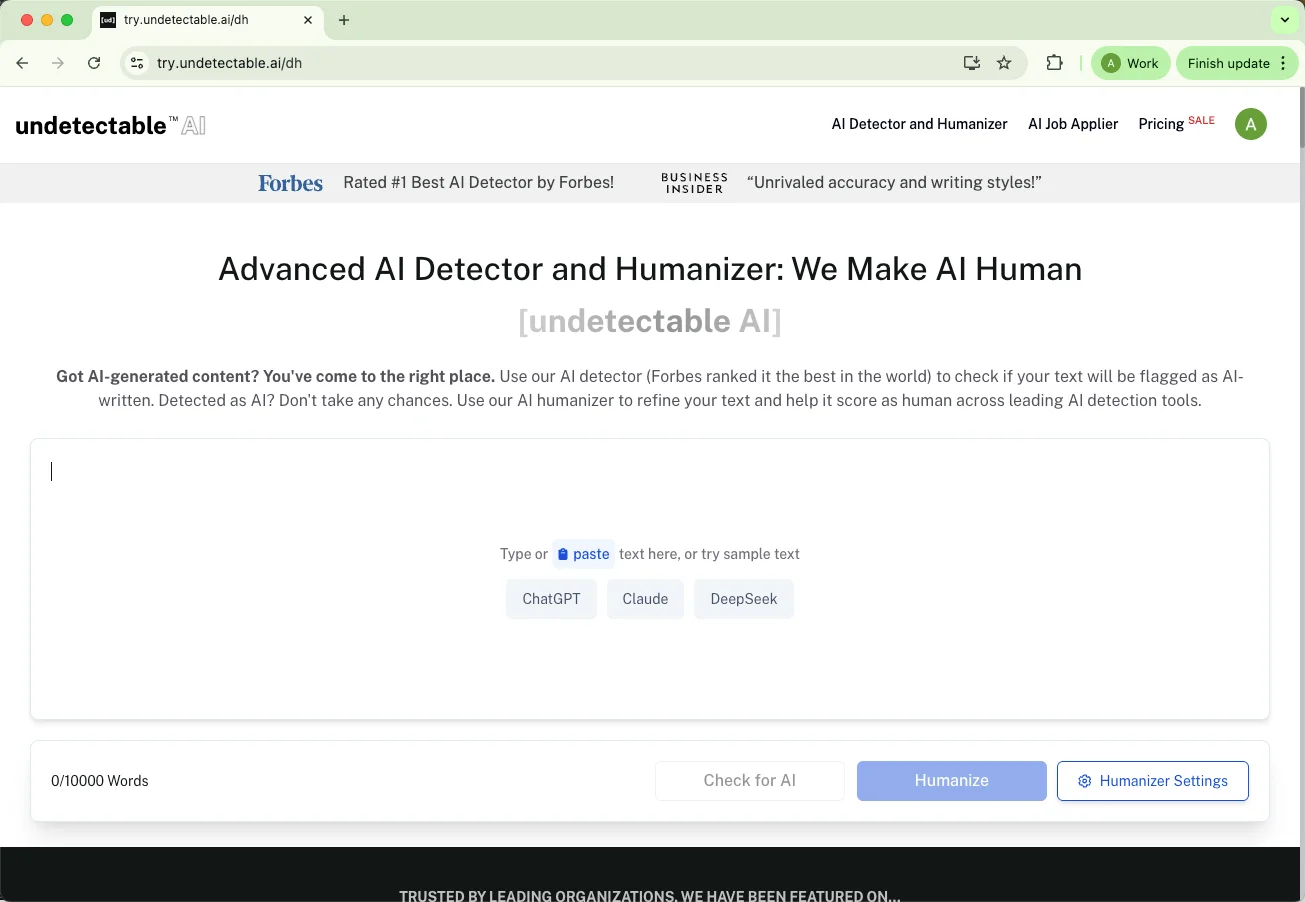
The Undetectable AI Detector is the company’s free tool for checking whether a piece of writing is likely to be flagged as AI-generated. In simple terms, it scans a text and compares it against the detection patterns used by several major AI detectors. According to the company’s official description, this includes systems like CopyLeaks, GPTZero, and Sapling, among others. The goal is to give users a quick overview of how different platforms might interpret their writing.
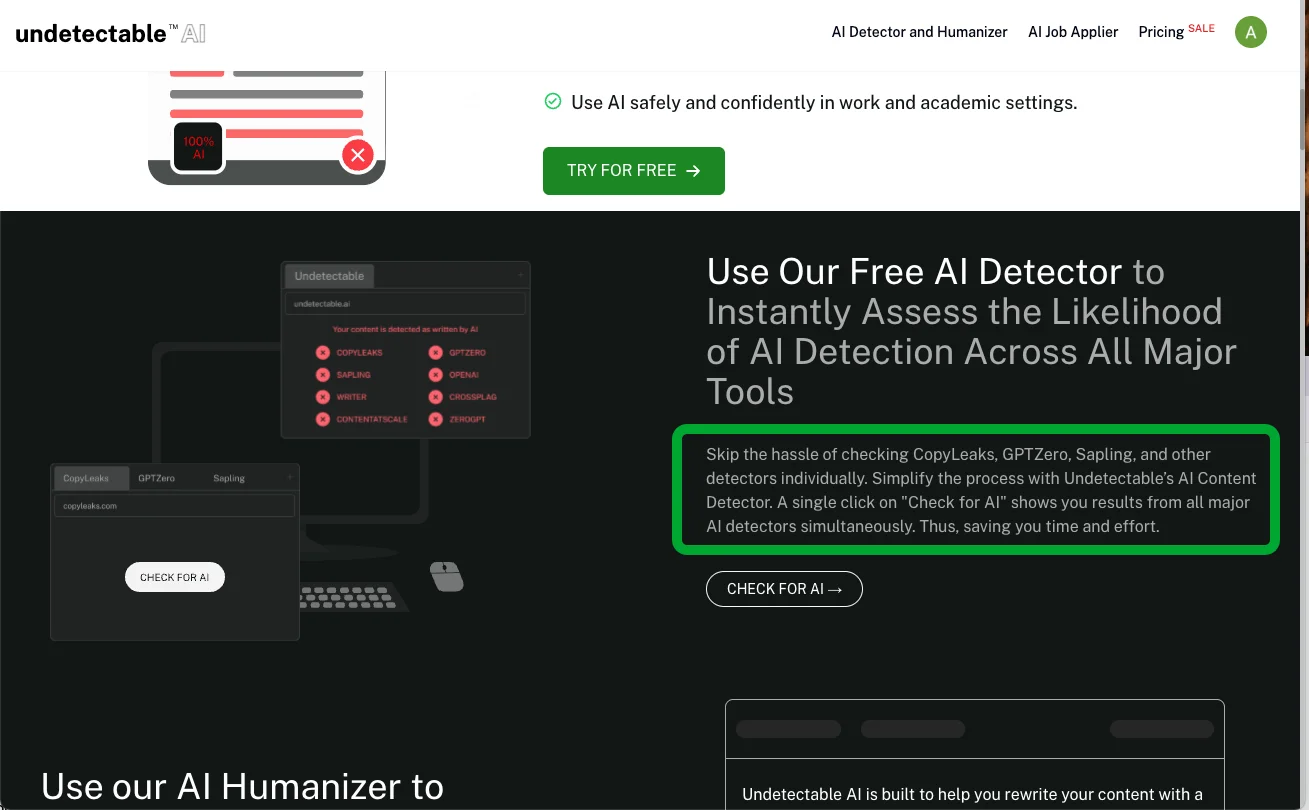
How it works
Users paste or upload text, and the tool analyzes it for AI-generation signals.
It aggregates results from multiple detectors, showing how likely each one is to classify the text as AI-written.
The platform also links to its companion feature — the “humanizer” — which rewrites flagged content to make it sound more natural.
Core features
Multi-detector analysis: checks text against several major AI detection tools at once.
Compatibility with popular AI models, including GPT-3, GPT-4, Claude, and Bard.
Simple one-click interface for quick testing.
Free access to detection results without registration.
While Undetectable AI promotes its tool as one of the most accurate and time-saving detectors available, this review will take a closer look at how it performs in real text situations — especially for students and writers who use AI responsibly and want to understand detection risks.
How Accurate is Undetectable AI Detector
After understanding what Undetectable AI Detector does, the next logical question is how accurate it really is in identifying AI-written content.
According to the company’s official claims, the tool provides instant AI detection results from several major platforms, including CopyLeaks, GPTZero, and Sapling, all in one place. They emphasize convenience and reliability, highlighting that Forbes ranked Undetectable AI as the “#1 Best AI Detector.”’
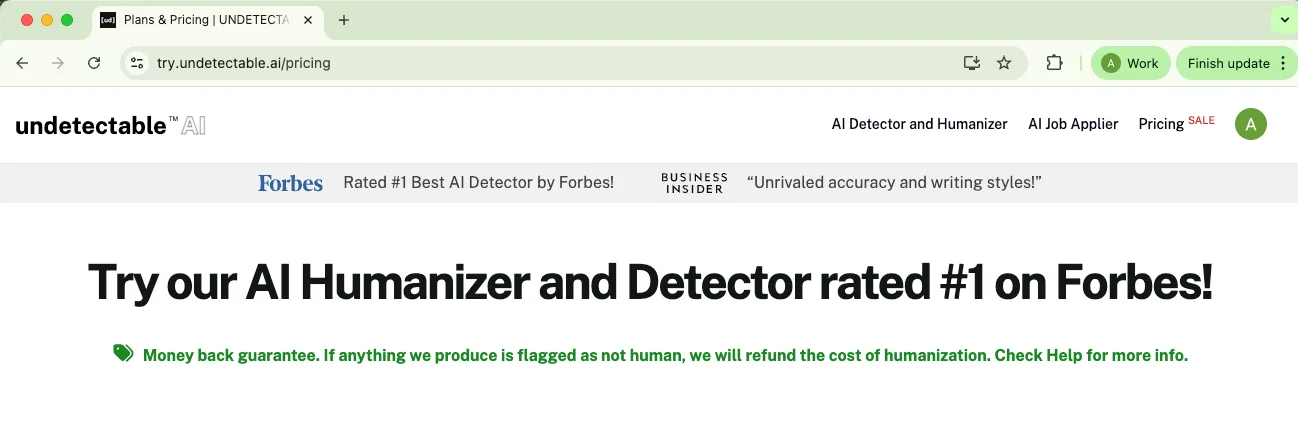
To see how well these claims hold up, we ran a series of tests using different types of writing: pure AI-generated text, a mix of human and AI writing, and content that had been “humanized” using another tool. Each test was analyzed to see whether the detector’s results aligned with what we already knew about the source of the text.
Test 1: Pure AI Text
Setup:
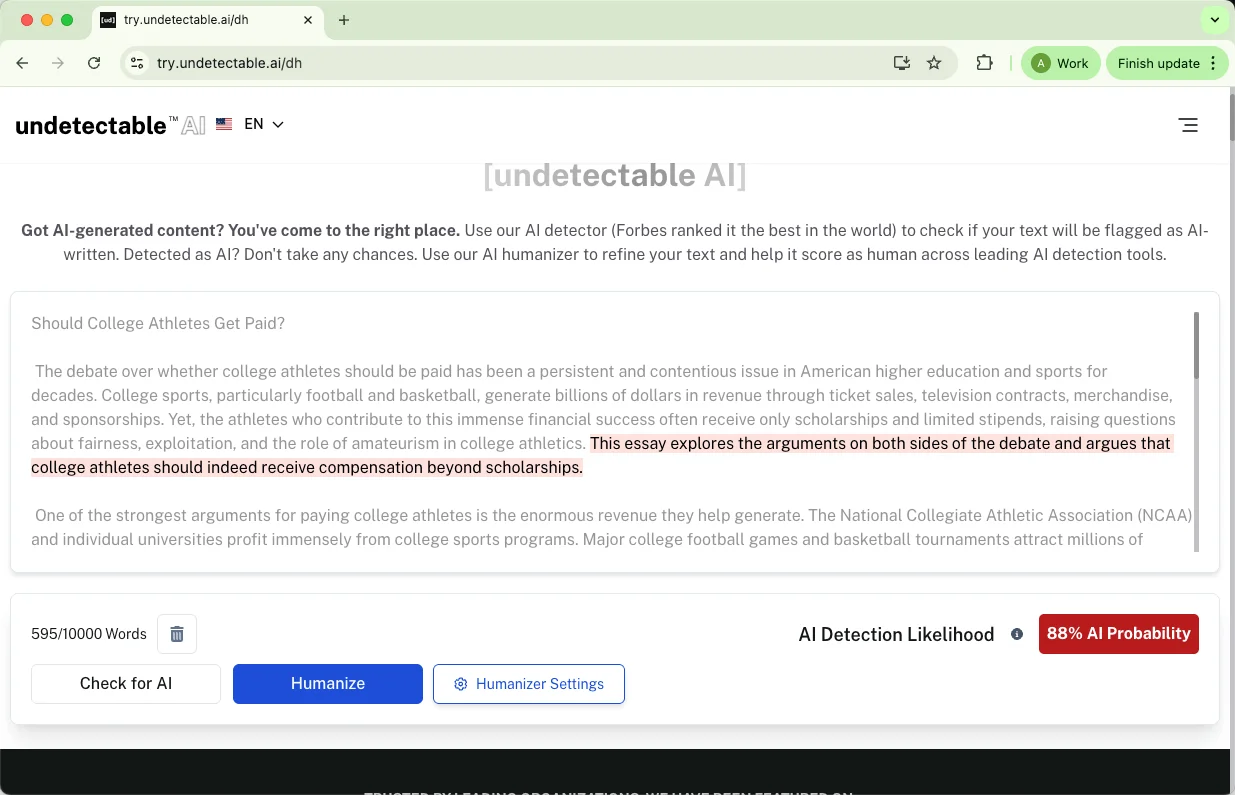
This test used a passage generated entirely by ChatGPT-4, without any human editing. The purpose was to see whether Undetectable AI Detector would correctly identify fully AI-written material.
Results:
88% AI Detection Likelihood
Observations:
The tool marked the text as 88% likely to be AI-generated, indicating it correctly identified most AI writing but not perfectly. While it claims to aggregate results from multiple major platforms such as CopyLeaks, GPTZero, and Sapling, the results interface does not actually display this combined data.
Test 2: Mixed AI + Human Writing
Setup:
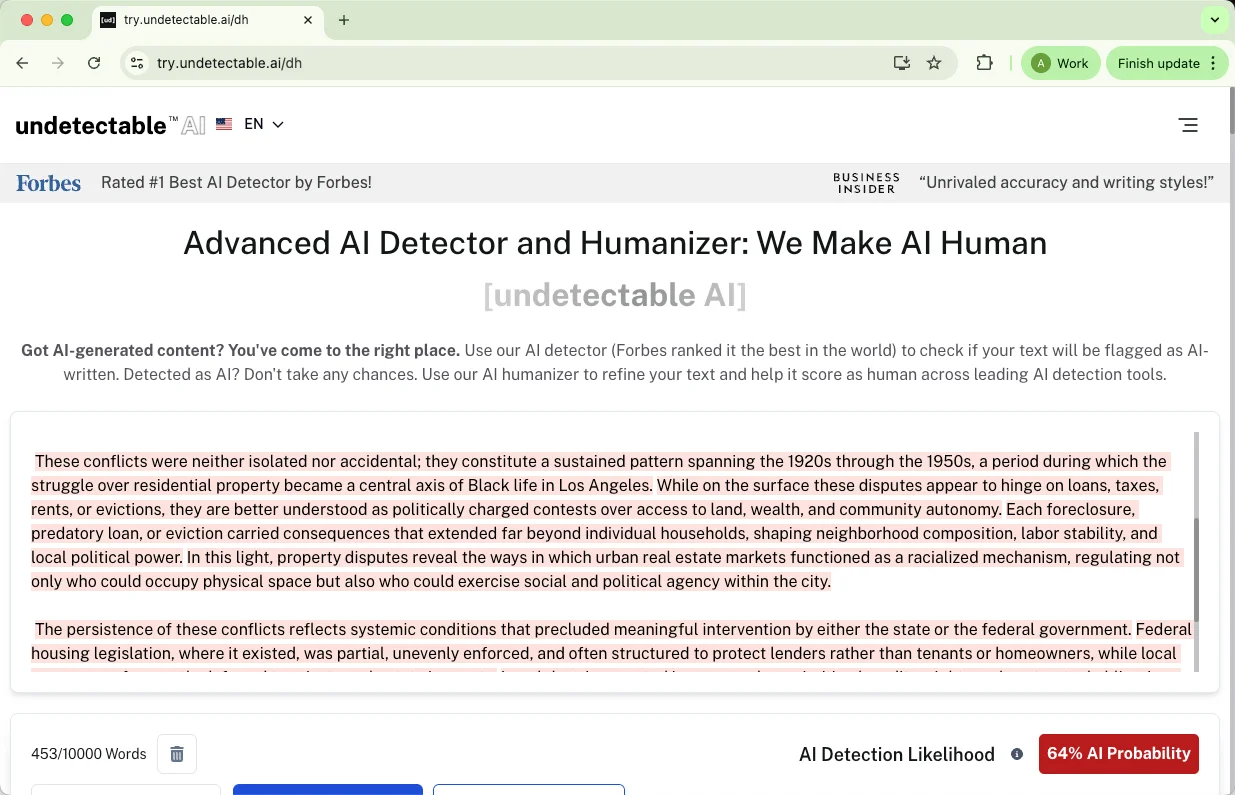
For the second test, we used an academic paragraph originally written by a human before AI writing tools were publicly available. We then asked ChatGPT-4 to continue the same passage. The final piece contained 187 human-written words (41%) out of a total of 454 words.
Results:
64% AI Detection Likelihood
Observations:
The tool labeled this text as 64% AI, which is roughly consistent with the balance of AI and human writing in the sample. This suggests it can pick up on stylistic differences between human and AI writing, but it doesn’t perfectly isolate which parts are which.
Test 3: Humanized AI Text by QuillBot
Setup:
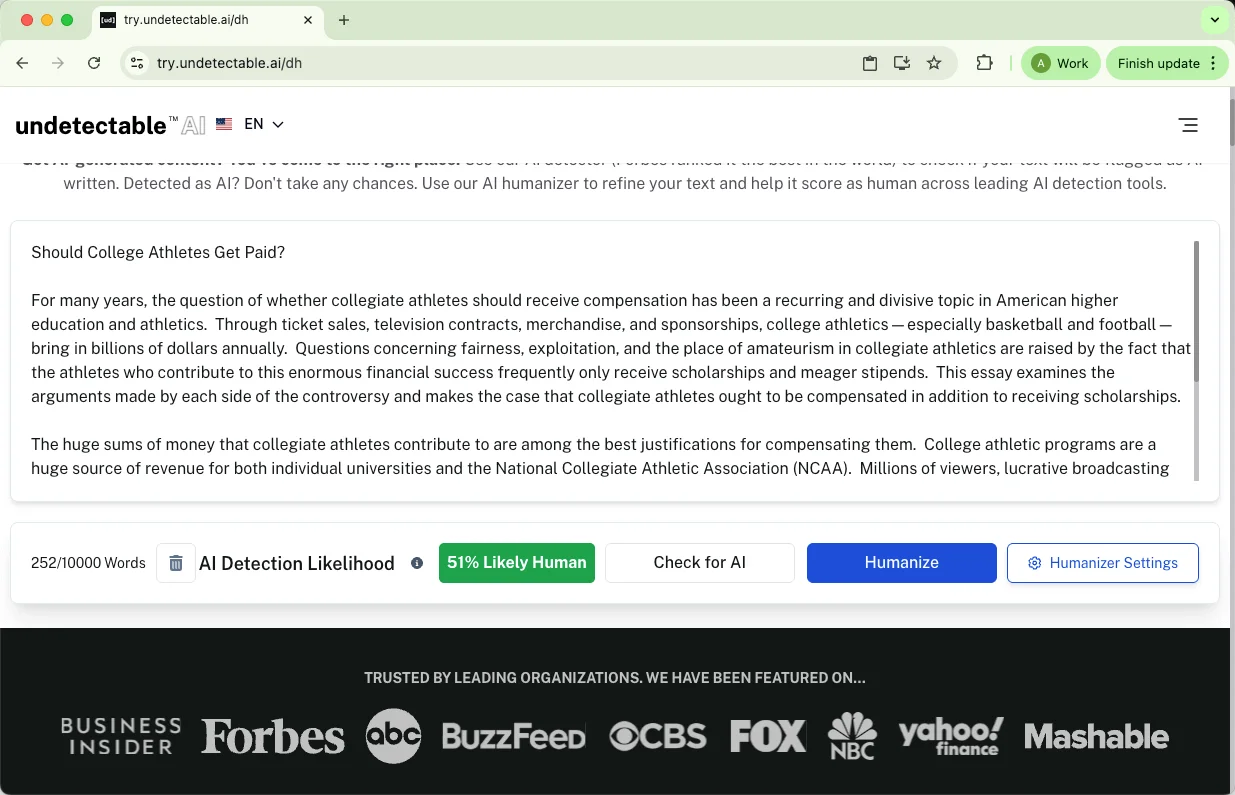
In the third test, we reused the text from Test 1 (100% AI-generated) but processed it through QuillBot’s basic AI Humanizer. The idea was to see how Undetectable AI Detector responds when an AI-written passage has been rewritten to sound more human.
Results:
51% Likely Human
Observations:
After humanization, the detector’s confidence dropped to about half, suggesting uncertainty about whether the text was human or AI. This shows that paraphrasing or rewriting tools can lower detection likelihood, even if the content originally came from AI. It also highlights that Undetectable AI is not foolproof—humanized text can sometimes bypass them.
Undetectable AI Detector: Pros and Cons
After testing and reviewing Undetectable AI Detector, it’s clear that the tool offers several advantages for users who want a quick way to evaluate their text for AI involvement. However, like most detection systems, it also has some limitations that users should be aware of. The following points summarize the main strengths and weaknesses based on hands-on testing, user experience, and feedback from trusted review platforms.
Pros
1. Reasonable Accuracy
Across multiple tests, Undetectable AI Detector produced results that generally aligned with the known origin of the text. It correctly recognized most AI-generated samples and gave balanced scores for mixed writing, showing that its detection algorithm performs reliably for general use.
2. Simple Interface and Ease of Use
The tool’s layout is straightforward. Users can paste or upload text, click a single button, and view detection results within seconds. This minimal design makes it accessible even to first-time users, including students or writers who want fast feedback.
3. Free Access with a Generous Word Limit
Undetectable AI Detector allows users to test up to 10,000 words per scan at no cost. This makes it practical for long essays or articles without needing a subscription or account setup.
4. Integration with “Humanizer” Tool
While separate from the detection function, the connection to Undetectable AI’s rewriting tool adds convenience for users who want to adjust flagged text directly after scanning.
Cons
1. No Sentence-Level Analysis
The detector provides only an overall AI likelihood score without highlighting which specific sentences or sections appear AI-generated. This makes it harder for users to identify and revise problem areas in longer documents.
2. Limited Report Details
There is no in-depth report or breakdown explaining why the detector classified text at a certain percentage. The lack of transparency may make results harder to interpret, especially for academic users who need clearer evidence.
3. Occasional False Positives
Some human-written or lightly edited passages may still receive moderate AI scores. This can happen when the writing style resembles AI-generated text, leading to over-detection in some cases.
4. Speed and Performance Fluctuations
While generally fast, the tool can slow down when analyzing longer documents. Processing times vary depending on word count and server load.
5. Accuracy Not Absolute
Although its overall performance is fair, results should still be treated as estimates. The detector can be influenced by rephrasing or rewriting tools, which may reduce reliability.
Undetectable AI Detector Pricing
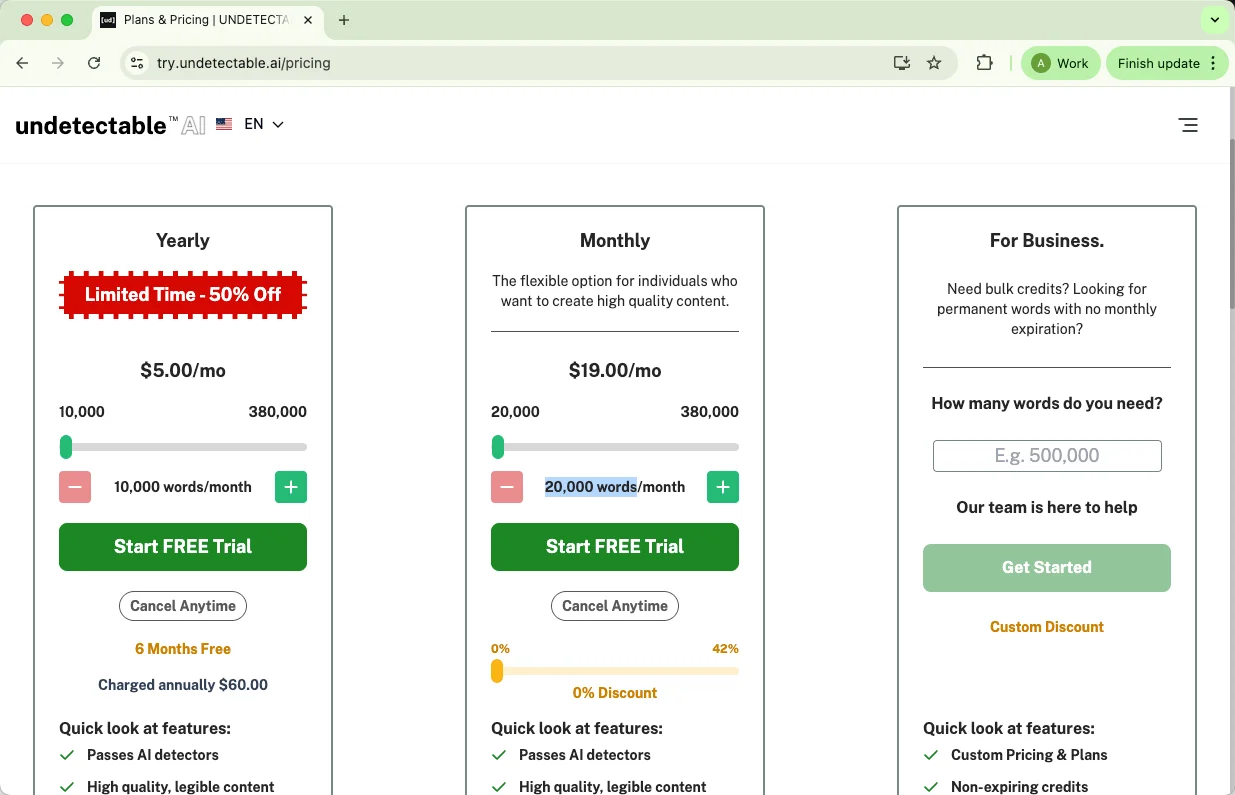
Undetectable AI Detector can be used for free. The free version allows users to test up to 10,000 words in one scan, offering full access to its detection feature without payment.
However, the company also offers paid plans that include additional tools and expanded capabilities. These paid features focus mainly on the brand’s other services—particularly the AI “humanizer” and premium rewriting functions—rather than the detection tool itself.
The paid plans start at $19.00 per month, and users can adjust the number of words they want to process, which changes the price accordingly. Higher word limits and more advanced rewriting options increase the cost.
Can You Bypass Undetectable AI Detector?
Is it actually possible to bypass Undetectable AI Detector? The short answer is — it depends on how the text is written and refined. While no method guarantees a perfect result, there are tools and techniques that can lower AI detection scores and make writing sound more natural. This section explores how that works in practice.
The Challenge: Balancing Detection and Readability
Many users focus on reducing AI detection percentages, but that’s only part of the problem. A text that scores as “human” but reads awkwardly defeats the purpose, especially for students or writers who want clear, natural expression. The real challenge lies in keeping the writing smooth and coherent while minimizing signs of AI generation.
Quality and readability matter because teachers, editors, and review tools often notice unnatural phrasing even when detectors don’t. Therefore, improving sentence flow and tone is as important as lowering detection results.
EssayDone Humanizer
EssayDone Humanizer is a text refinement tool designed to address both of those concerns. It doesn’t just reduce AI detection likelihood — it also improves the overall readability of a piece. The system works by:
Adjusting sentence structure to sound more organic
Refining vocabulary and phrasing for better word variety
Smoothing stylistic patterns so the text feels naturally written
Producing results that balance fluency and human-like rhythm
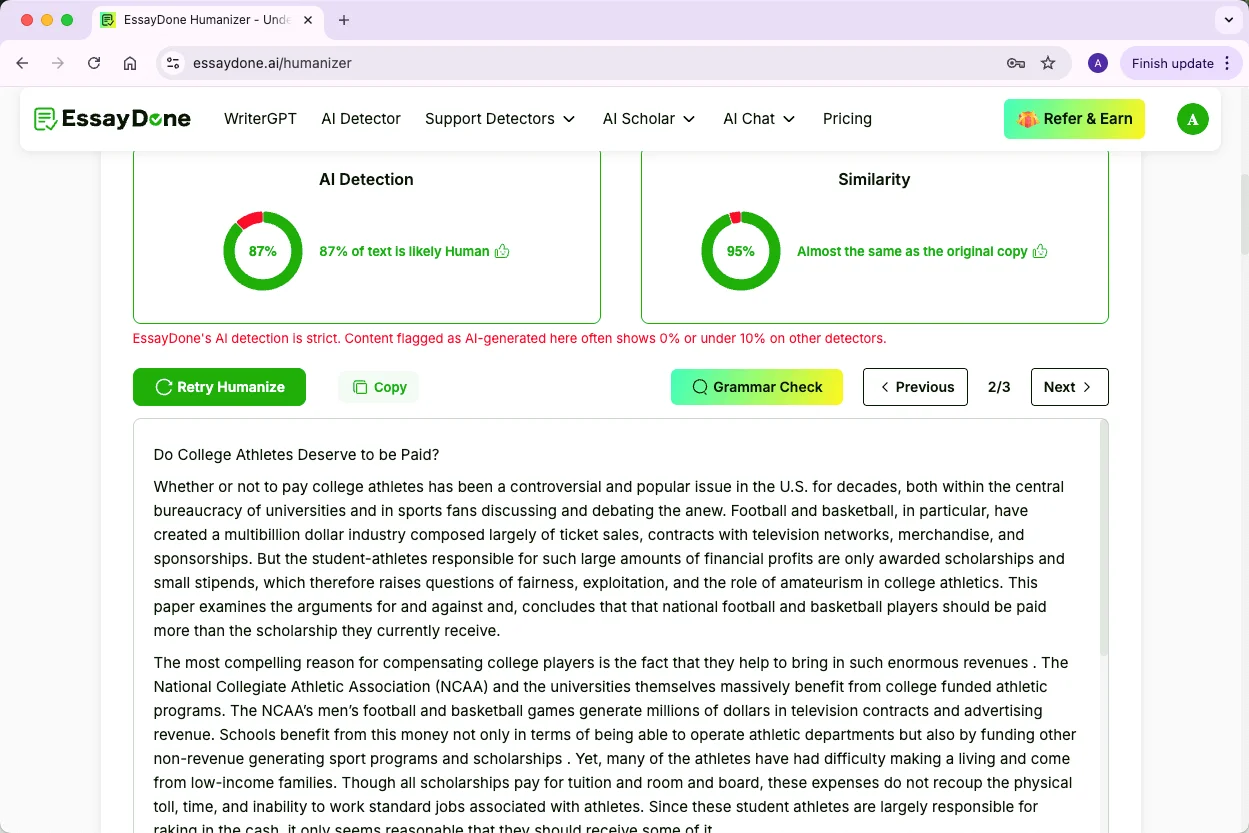
In practice, this means the output remains consistent and readable, while AI detection scores tend to drop noticeably. So if you want to use AI tools responsibly but to maintain a natural tone, a humanizer like EssayDone is a good choice.
5 Alternatives to Undetectable AI Detector
While Undetectable AI Detector is one option, several other AI detection tools offer different features and approaches. Here’s a brief overview of five notable alternatives.
1. Originality.ai
Originality.ai supports multiple languages and offers a wide range of content checks, including AI detection, plagiarism, fact-checking, readability, and grammar analysis. It works with common file formats like PDF and DOCX and includes team collaboration tools and a Chrome extension for convenience.
2. GPTZero Detector
GPTZero is designed to detect AI-generated text while providing writing feedback, plagiarism checks, and citation suggestions. It supports several file formats and offers sentence-level analysis, helping users identify specific sections of AI involvement.
3. Copyleaks
Copyleaks combines AI detection with plagiarism scanning in a single report and supports over 30 languages. It also provides integration tools like Google Docs add-ons and a Chrome extension, although it does not offer sentence-level analysis.
4. ZeroGPT
ZeroGPT focuses on AI detection while offering extra features such as plagiarism checks, AI summarization, and paraphrasing. It supports text input only and provides a basic free plan, with a paid subscription for higher usage limits.
5. QuillBot
QuillBot includes AI detection alongside a suite of writing tools like paraphrasing, summarization, grammar checking, and text humanizing. It supports multiple file formats and offers sentence-level analysis in the premium version, making it versatile for writers who also want to refine content.
FAQ
1. Is Undetectable AI Detector 100% accurate?
No AI detector, including Undetectable AI Detector, can guarantee 100% accuracy. Results provide a probability of AI involvement, which should be interpreted as an estimate rather than a definitive classification.
2. How to bypass Undetectable AI Detector?
Tools like text humanizers or careful editing can lower detection likelihood, but the quality and readability of the writing must also be maintained.
3. Will my professor use an AI detector?
Some instructors and institutions use AI detection tools to check student work, but it varies widely by school, class, and professor. The best approach is to follow your institution’s academic integrity guidelines and use AI responsibly.
4. Can I use AI detectors on my own work before submission?
Yes. Running your work through an AI detector before submission can help identify passages that might be flagged and allow you to revise them for clarity, originality, and human-like phrasing.
5. Are AI detectors legal?
Yes. Using AI detectors is legal, both for academic and professional purposes. They are tools for evaluating content and do not violate copyright or other laws.
6. Is Undetectable AI Detector free?
Yes. The core AI detection service is free and allows up to 10,000 words per scan. Paid plans are available for other features, such as text rewriting and advanced humanization tools.
Conclusion
In this review, we examined Undetectable AI detector’s features, detection performance, ease of use, pricing, and alternatives.
Through independent testing, we explored how it handles pure AI text, mixed content, and humanized passages, while also considering usability and limitations. Additionally, we compared several other AI detection tools to provide context.
We hope this overview helps students and writers better understand how AI detectors function, their strengths and weaknesses, and how to interpret results when using these tools for academic or professional writing.