





SciSpace AI Detector Review: My Honest Take on 3 Tests

If you’re asking whether SciSpace AI Detector can really spot AI-generated text, you’re not alone.
With AI writing showing up in essays, research, and online content, detection tools are everywhere—each claiming to tell humans and machines apart. SciSpace has quickly become one of the popular choices.
But the real question is: how well does it perform? In this review, we’ll test its accuracy, explore pricing, and break down where it delivers—and where it doesn’t. Let’s dive in!
SciSpace Test Results at a Glance
The original pure-AI and QuillBot-rewritten samples both received 100% AI. The mixed sample is the important contrast: its saved screenshot says “Essentially Human,” with a 19% headline score and eight flagged sentences. These are the original observations, not a fresh test of the current model or an accuracy percentage calculated across a large dataset.
| Scenario | Known sample composition | Reported detector output | Interpretation |
|---|---|---|---|
| Pure AI text | AI-generated with no human editing | The detector flagged 100% of the content as AI-generated. | Correctly identified this unedited AI sample; this is one observation, not population accuracy. |
| Mixed human + AI text | 454 words: 187 human-written (about 41%) and 267 AI-generated (about 59%) | The saved report shows a headline score of 19%, the label “Essentially Human,” and 8 out of 17 sentences marked as AI-written: 1 High AI, 5 Moderate AI and 2 Low AI. | The overall label and sentence flags disagree in emphasis. Compare flagged passages with the known original and continuation; do not convert the headline score into a word-by-word authorship count. |
| Humanized AI text | AI text processed through a rewriting tool | SciSpace still flagged 100% of the content as AI-generated. | Shows sensitivity to rewritten patterns, but does not prove authorship. |
How to Read the Results
Start with the saved source files: the first 187 words were human-written, and the 267-word continuation was generated. Then compare the highlighted sentences with that boundary. The mixed screenshot’s “8 out of 17” is a count of sentences in its AI categories, while 187/454 describes words of known origin. Different sentence lengths mean those fractions cannot be substituted for one another.
For a draft self-check, inspect a flagged claim, its source and the surrounding sentence before rewriting anything. For an authorship review, keep the original paragraph, generated continuation and revision history together with the report. A new scan after editing can show that the detector’s response changed, but it cannot reconstruct the writing process on its own.
What Is SciSpace?
SciSpace is an all-in-one AI tool designed to make academic research and writing more efficient. It serves as a smart research assistant, helping students and writers navigate scholarly literature with ease.
What Is the SciSpace AI Detector?
SciSpace AI detector is a feature within the platform that identifies AI-generated content in academic writing. It works by analyzing text at the sentence level. The detector supports both pasted text and uploaded PDFs and offers two specialized modes: one for professional scientific content and another for non-scientific writing.
Extra Tools in SciSpace
AI Writer – generate drafts, summaries, or explanations of research papers.
Citation Generator – quickly build citations in the right academic format.
Paraphraser – reword text while preserving its meaning.
Literature Review – organize and analyze academic sources.
Find Topics – discover potential research ideas.
Extract Data – pull out key information from research papers.
How Accurate Is SciSpace AI Detector?
Three numbers answer different questions. Our saved mixed sample contained 454 words: 187 human-written and 267 AI-generated. SciSpace showed “Essentially Human,” a 19% headline score and eight of 17 sentences flagged. This is one historical test, not an accuracy benchmark.
For its current research-paper workflow, SciSpace reports 96.2% F1 on its academic corpus. Its broader essay benchmark reports 93.2% F1. These are the provider’s evaluations. F1 combines precision and recall; neither value means that the same percentage of an individual paper was correctly attributed, and neither is interchangeable with the 19% interface score.
For a methods or literature section, the useful step is to inspect the highlighted sentences against the actual drafts and sources. Journal or university rules govern permitted AI use; a headline score alone cannot establish who wrote the text.
SciSpace claims its AI detector can reliably identify AI-generated content in scholarly writing, supporting both professional scientific and general texts. But how well does it actually perform in real-world situations?
To find out, we tested the detector across three different scenarios. These tests allow us to evaluate how well the detector performs with pure AI text, mixed AI-human writing, and AI content that has been humanized through paraphrasing.
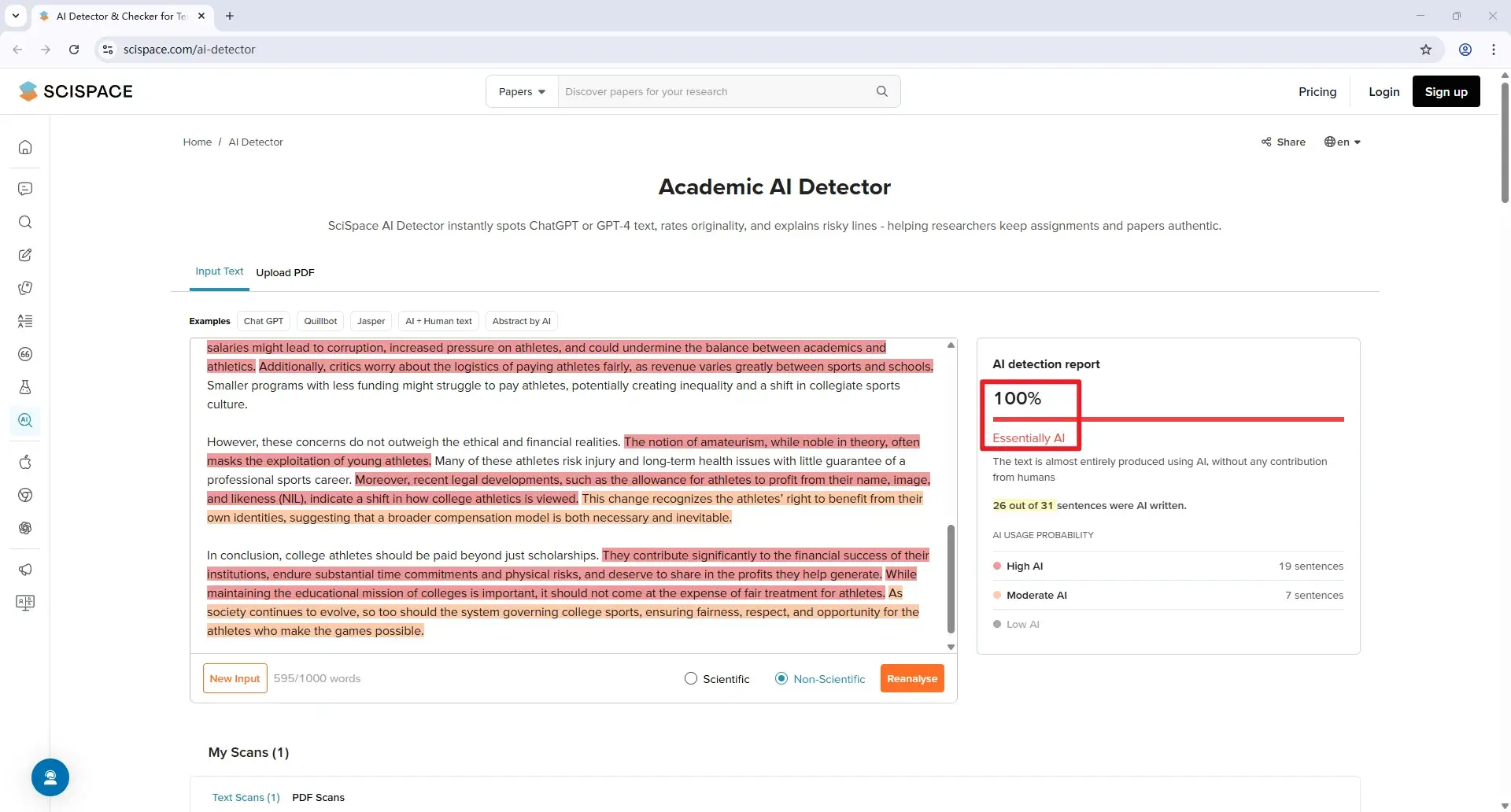
Test 1: Pure AI Text
Setup: We first used a text written entirely by ChatGPT-5.
Results: The detector flagged 100% of the content as AI-generated.
Observations:
SciSpace handled this scenario accurately, identifying text that was completely machine-written.
Test 2: Mixed AI + Human Writing
Setup:
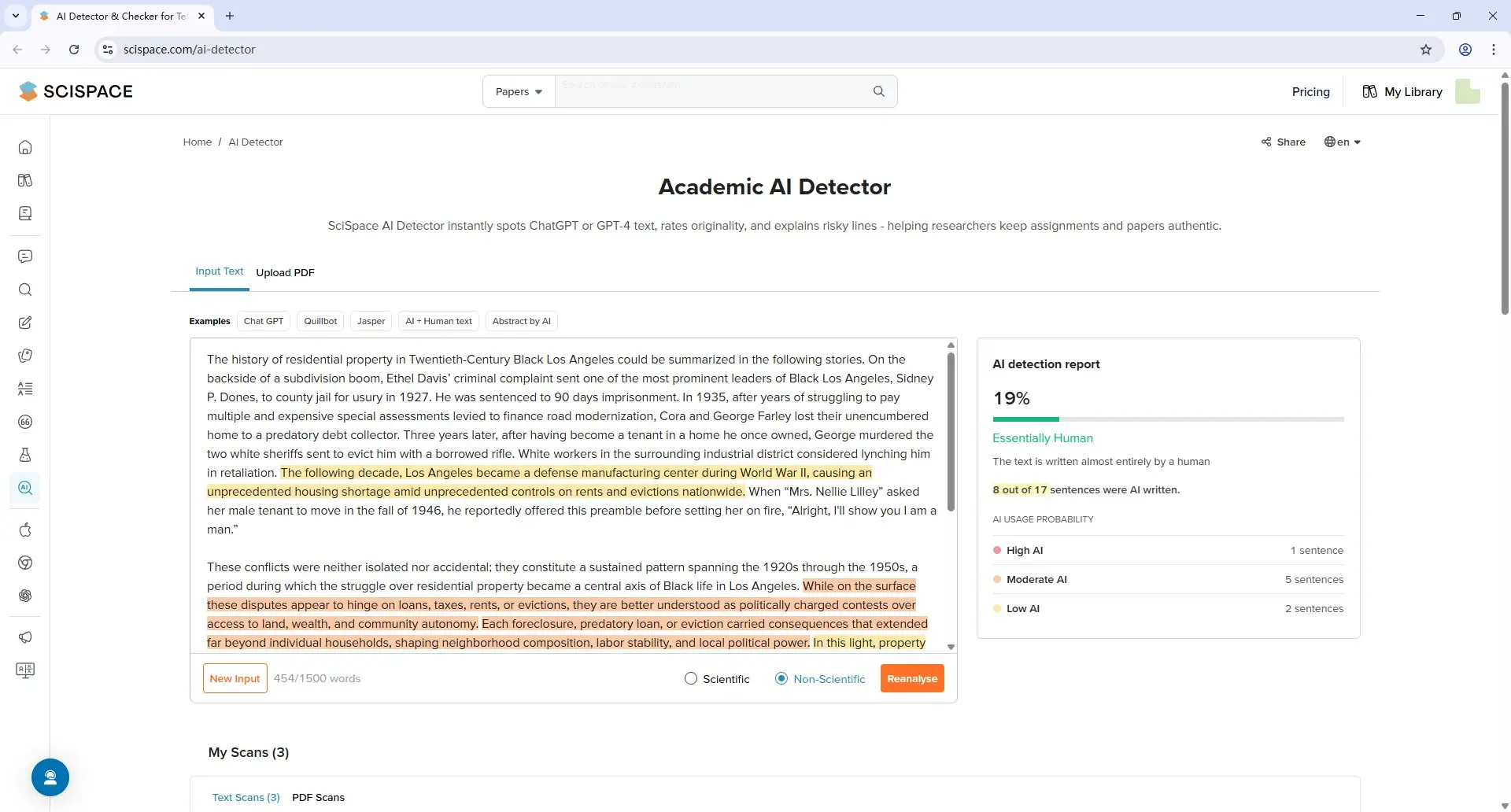
Next, we tested a paper originally written by humans before ChatGPT’s release, then continued using ChatGPT-5. The sample had 187 human-written words out of 454 total (about 41% human, 59%AI).
Results: The saved report shows a headline score of 19%, the label “Essentially Human,” and 8 out of 17 sentences marked as AI-written: 1 High AI, 5 Moderate AI and 2 Low AI.
Observations:
Observations: The report does not show “19% human and 91% AI”; that was a transcription error in the earlier text. Its headline score, overall label and count of flagged sentences are separate readouts. Neither 19% nor 8/17 is a direct count of the sample’s 187 human-written and 267 AI-generated words. The useful finding is that a text containing a known AI continuation received an “Essentially Human” label while some sentences were still flagged. That makes this mixed case unsuitable for a simple human-versus-AI verdict.
Test 3: Humanized AI Text by QuillBot
Setup:
Finally, we took 100% AI-generated content and ran it through QuillBot AI Humanizer in basic mode, which lightly paraphrases text without changing sentence structure or underlying patterns.
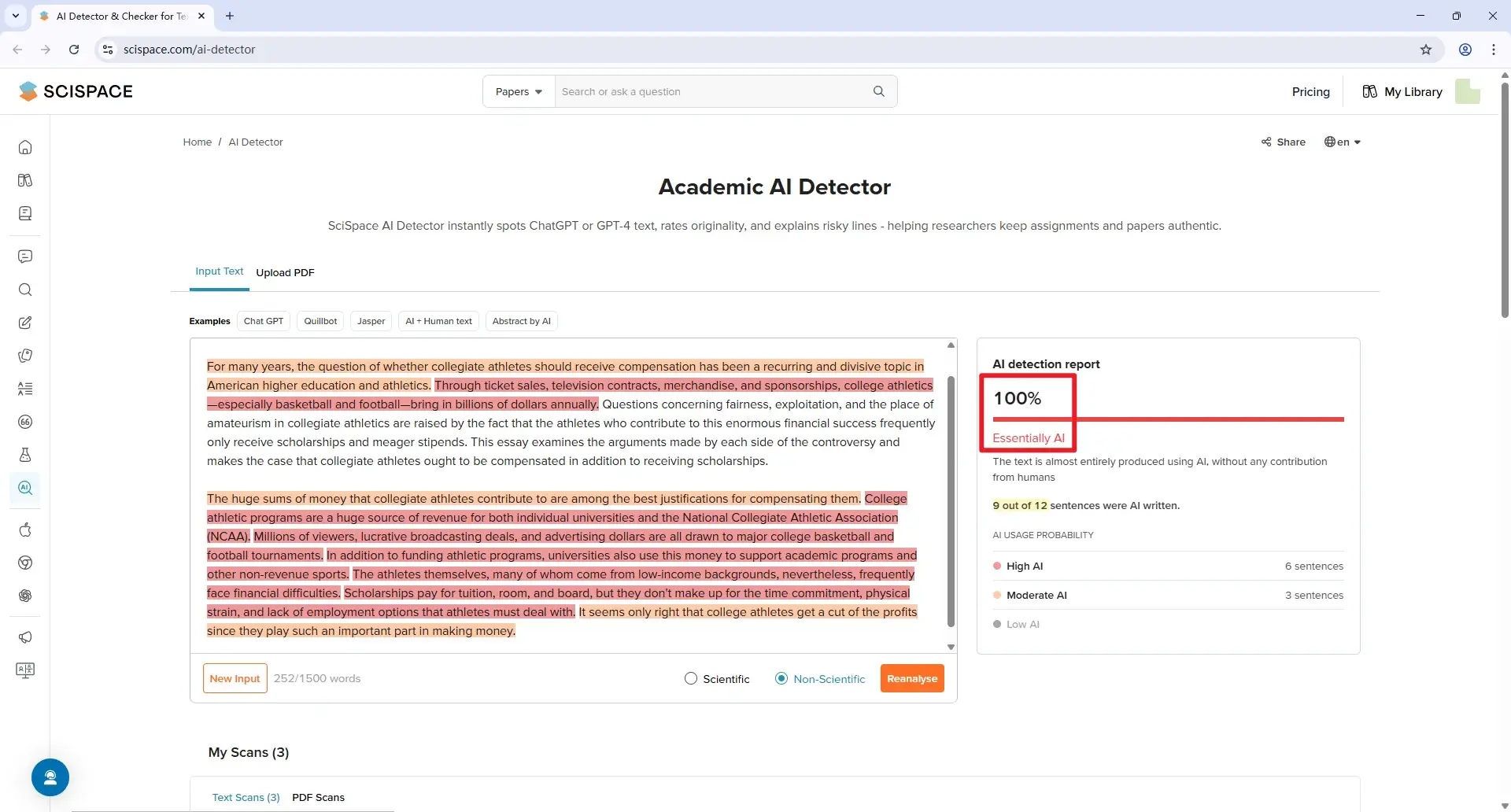
Results: SciSpace still flagged 100% of the content as AI-generated.
Observations:
Light humanization did not fool the detector. This suggests that SciSpace is sensitive to machine-like patterns, such as predictable sentence structure and consistent phrasing, even when words are slightly reworded.
Pros and Cons of SciSpace AI Detector
Pros
Wide AI coverage: It can detect outputs from GPT-4, ChatGPT, Jasper, and similar tools, making it useful for academic contexts.
Flexible input options: Users can either paste text directly or upload PDF files, which makes it convenient for different writing situations.
Specialized modes: Separate settings for scientific and non-scientific writing help tailor the detection process to different types of content.
Cons
Accuracy issues: Results can be inconsistent, especially with mixed human and AI text, which may confuse users.
Limits of the explanation: the sentence labels locate passages worth reviewing, but they do not provide a source-by-source account of who wrote them. Our mixed screenshot shows why a short overall label is insufficient even when detailed flags are present.
Language evidence: all three saved tests use English. They do not establish detection performance for translated, multilingual or non-English submissions.
SciSpace Pricing
Free access
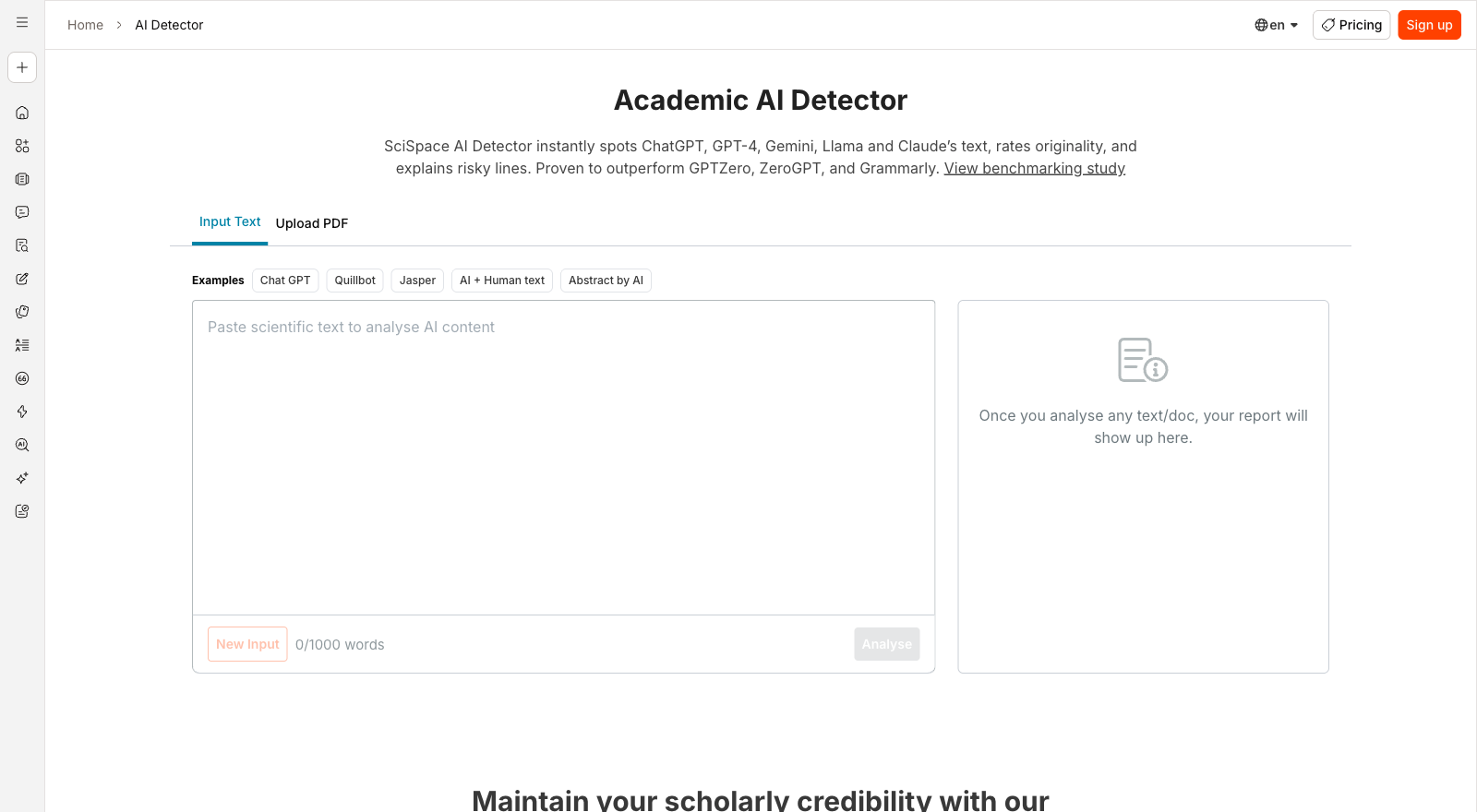
The public text editor currently displays 0/1,000 words before sign-in. The screenshot from our original mixed test shows an account editor with a 1,500-word counter. Those are interface limits for different access states, not a promise of unlimited anonymous scanning. Start at Academic AI Detector, choose Input Text or Upload PDF, and use Analyse. The report contains an overall label and sentence-level categories; our saved screenshot shows how those can point to different aspects of the same text.
Individual subscriptions
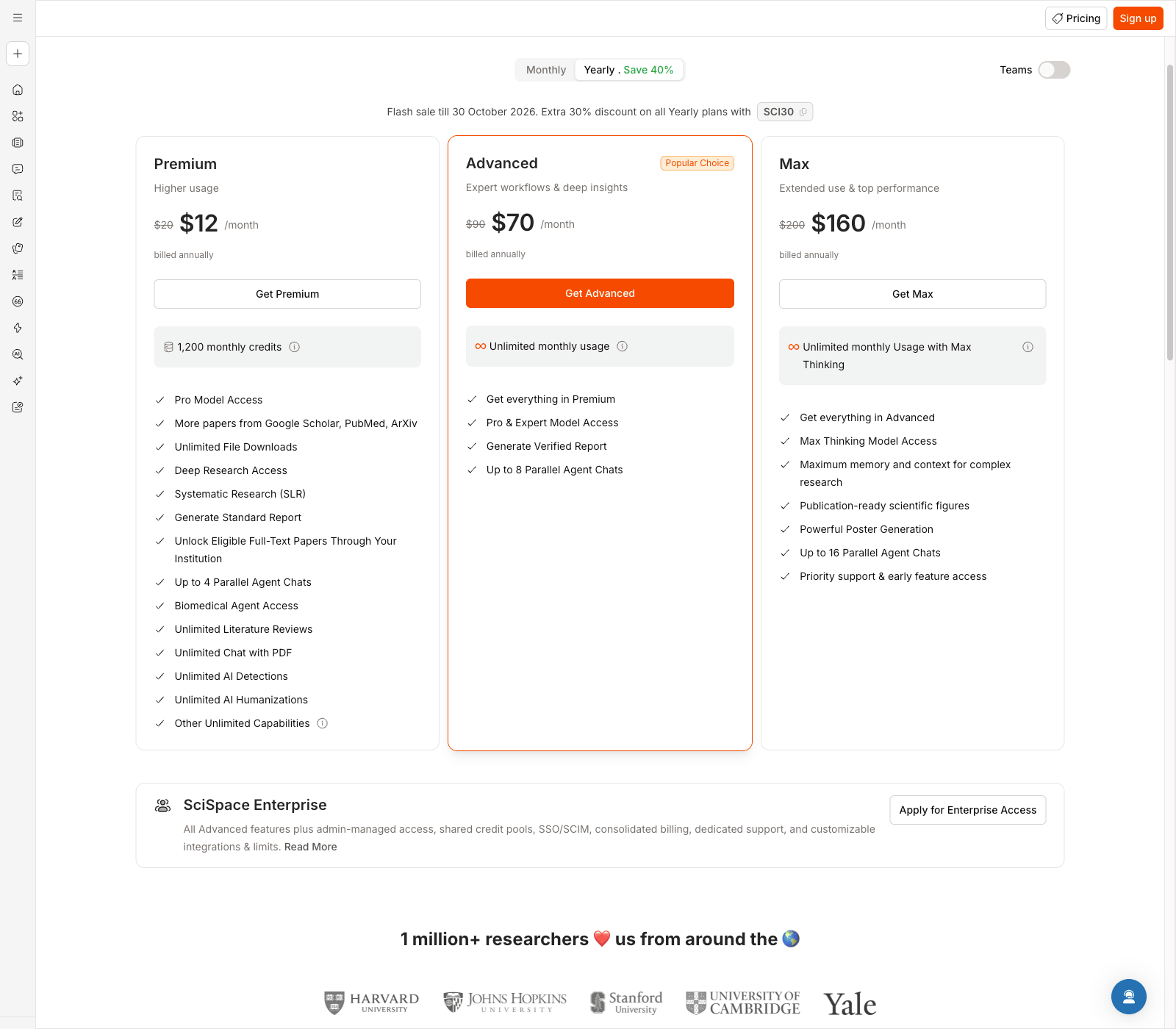
The current Yearly pricing lists Premium at 12 USD/month billed annually, Advanced at 70 USD/month billed annually and Max at 160 USD/month billed annually. These correspond to annual charges of 144, 840 and 1,920 USD. They are annual-billing equivalents, not month-to-month subscriptions.
Premium includes 1,200 monthly agent credits, up to four parallel agent chats and unlimited AI detections among its tools. Advanced adds Pro/Expert model access, verified reports and up to eight parallel agent chats. Max adds Max Thinking, larger context, scientific figures and up to sixteen parallel agent chats. The agent credits and parallel-task limits describe the research platform; they are not an AI detector accuracy score. Upgrading does not by itself prove more accurate authorship decisions.
Organizations
SciSpace Enterprise offers admin-managed access, shared credit pools, SSO/SCIM, consolidated billing and custom integrations or limits through a custom arrangement. It should not be described as a universal 8 USD-per-seat plan.
Can You Bypass SciSpace AI Detector?
The short answer is yes—but not with simple tricks. Simple rewriting or word replacement is not enough. As seen in Test 3, light paraphrasing with tools like QuillBot only changes words superficially, leaving sentence structure and predictable phrasing intact. SciSpace still flagged the text as 100% AI-generated, proving that casual edits are ineffective.
This is where EssayDone Humanizer comes in. It’s a comprehensive AI humanization tool designed to make AI-generated text read naturally and authentically. By altering sentence structure, vocabulary, and overall writing flow, it reduces the mechanical patterns that detectors look for.
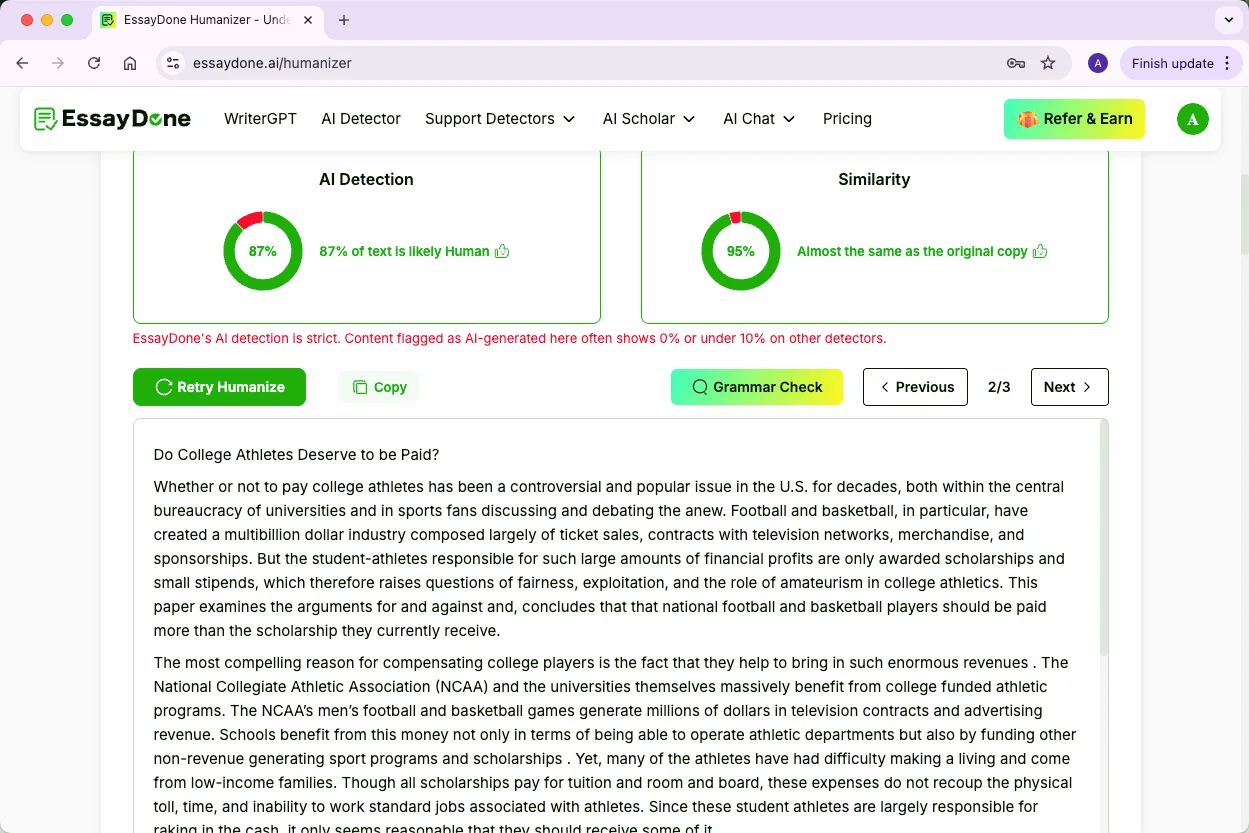
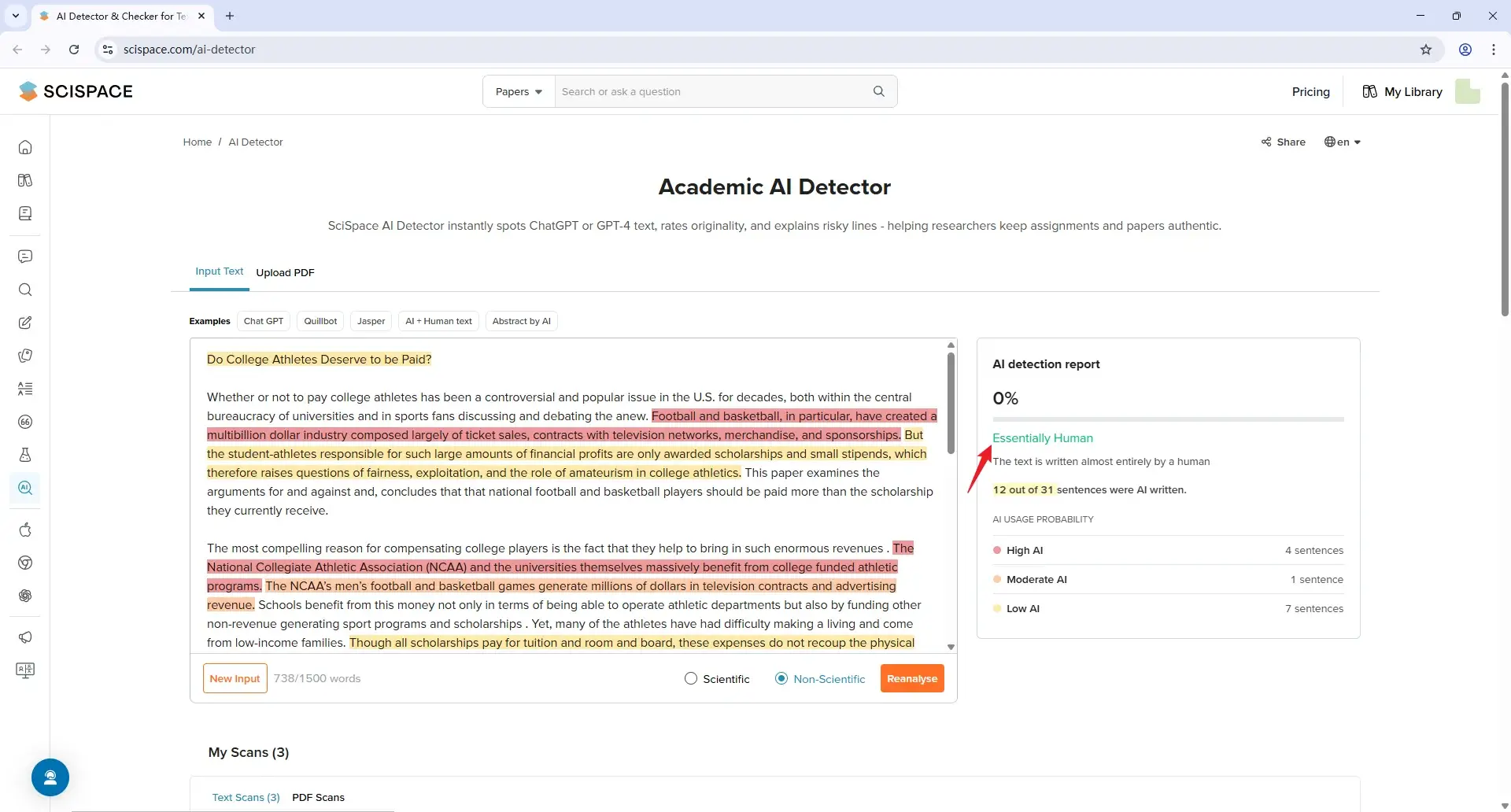
In practice, using EssayDone on the 100% AI text from Test 1 successfully lowered the AI detection score to 0%. This demonstrates that professional humanization, which targets both linguistic style and structural patterns, is far more effective than simple paraphrasing.
Alternatives to SciSpace AI Detector
Tool | Multilingual | Free Plan | Paid Plan | File Formats | Login Required | Sentence-Level Analysis | Extra Features |
Yes | Limited free tools | Pro: $14.95/month or $12.95/month billed annually; 2,000 credits/month (200,000 words with 5.0 or 20,000 with 5.0 Max, AI only) | DOCX, PDF, DOC; bulk and web scans on Pro | Account for saved scans and paid tools | Yes | 5.0: 1 credit/100 words for AI only, or 2 with plagiarism. 5.0 Max: 10 credits/100 words for AI only. Readability, grammar and fact-checking tools are separate from detector scores. | |
GPTZero | Yes | 10,000 words/month; 10,000 characters/scan | Premium: $23.99/month or $12.99/month billed annually; 300,000 words/month | Text and files; Premium batches up to 50 files | Account for the monthly allowance and history | Advanced Scan: one free trial, then paid | Writing feedback, citations and plagiarism checks; Premium scans up to 50,000 characters. |
Copyleaks | Yes: 30+ AI-detection languages | 25,000 characters per public scan | Personal: $16.99/month (100 credits/month) or $167.88/year (1,200 annual credits) | Text and documents; multiple-file uploads | No for the public check; account for saved reports | Sentence insights with an account; AI Logic on subscription | AI + plagiarism report. 100 credits cover up to 25,000 words or 100 images. |
ZeroGPT | Yes | 15,000 characters per scan | Pro: $14.99/month or $8.99/month billed annually; 100,000 characters/scan | Text; paid batch-file checking and PDF reports | Public check available; account for subscription | Highlights and document/paragraph/sentence analysis | Summarizer, paraphraser, grammar, translator; plagiarism has a separate quota. |
QuillBot | Yes | 1,200 words/scan; up to 6 scans/day | Premium: $19.95/month or $8.33/month billed annually; unlimited AI scans | Text and document uploads | Public trial available; account for Premium | Explainer cards; more detail on Premium | Paraphraser, Humanizer, grammar and summarizer; plagiarism: 25,000 words/month on Premium. |
FAQ
Q: Is SciSpace AI detector 100% accurate?
A: No. In our original tests, pure AI and QuillBot-rewritten AI both received 100% AI. The mixed sample received an “Essentially Human” label, a 19% headline score and eight flagged sentences. Those outcomes support using the report as an initial signal, not as a dependable standalone proof of authorship.
Q: How to bypass the SciSpace AI detector?
A: Simple paraphrasing or word replacement is not enough. Professional humanizers, like EssayDone, can adjust sentence structure, vocabulary, and flow to make AI text more natural and reduce detection scores.
Q: Will my professor use an AI detector?
A: Some professors may use AI detectors, especially for research papers or assignments submitted online. Others may rely on traditional plagiarism checks and judgment. Policies vary by school and instructor.
Q: Can I use AI detectors on my own work before submission?
A: Yes, using AI detectors on your own writing can help identify sections that might appear machine-generated and allow you to revise before submitting.
Q: Are AI detectors legal?
A: Yes, AI detectors are legal. They are tools for verifying originality, much like plagiarism checkers, and using them does not violate copyright or academic policies.
Q: Is SciSpace AI detector free?
A: The public text editor allows an initial check and currently displays a 1,000-word limit before sign-in. Our original account screenshot displays 1,500 words. Premium lists unlimited AI detections alongside other research tools, but paid access is not evidence of higher detection accuracy.
Conclusion
Is SciSpace AI Detector reliable? It can provide a useful first signal on an English draft, but our three examples do not support treating it as a standalone authorship test. The mixed sample is the clearest reason: the known AI continuation did not prevent an “Essentially Human” label, even though individual sentences were flagged.
You’ve also seen where it holds up and where it struggles, especially with bypass attempts.
For a quick self-check, use the highlighted passages to find claims or awkward sentences worth revisiting. If you need explainable evidence, compare the report with sources and writing history. For a multi-round writing project, preserve versions so you can distinguish an improvement in writing from a change in the detector’s reaction. The three original screenshots support those different uses; they do not establish a universal success rate.