



Monica AI Detector Put to the Test: How Accurate Is It?

Let’s talk about Monica AI Detector.
With AI writing popping up everywhere—from essays to blog posts—it’s getting harder to tell what’s human-written and what’s AI-generated.
Monica AI checker is one tool that tries to do just that. In this article, we’ll walk through how it works, test how accurate it really is, peek at its pricing, and compare it with a few other options, giving you a clear idea of what to expect in real-world use.
What is Monica AI Detector?
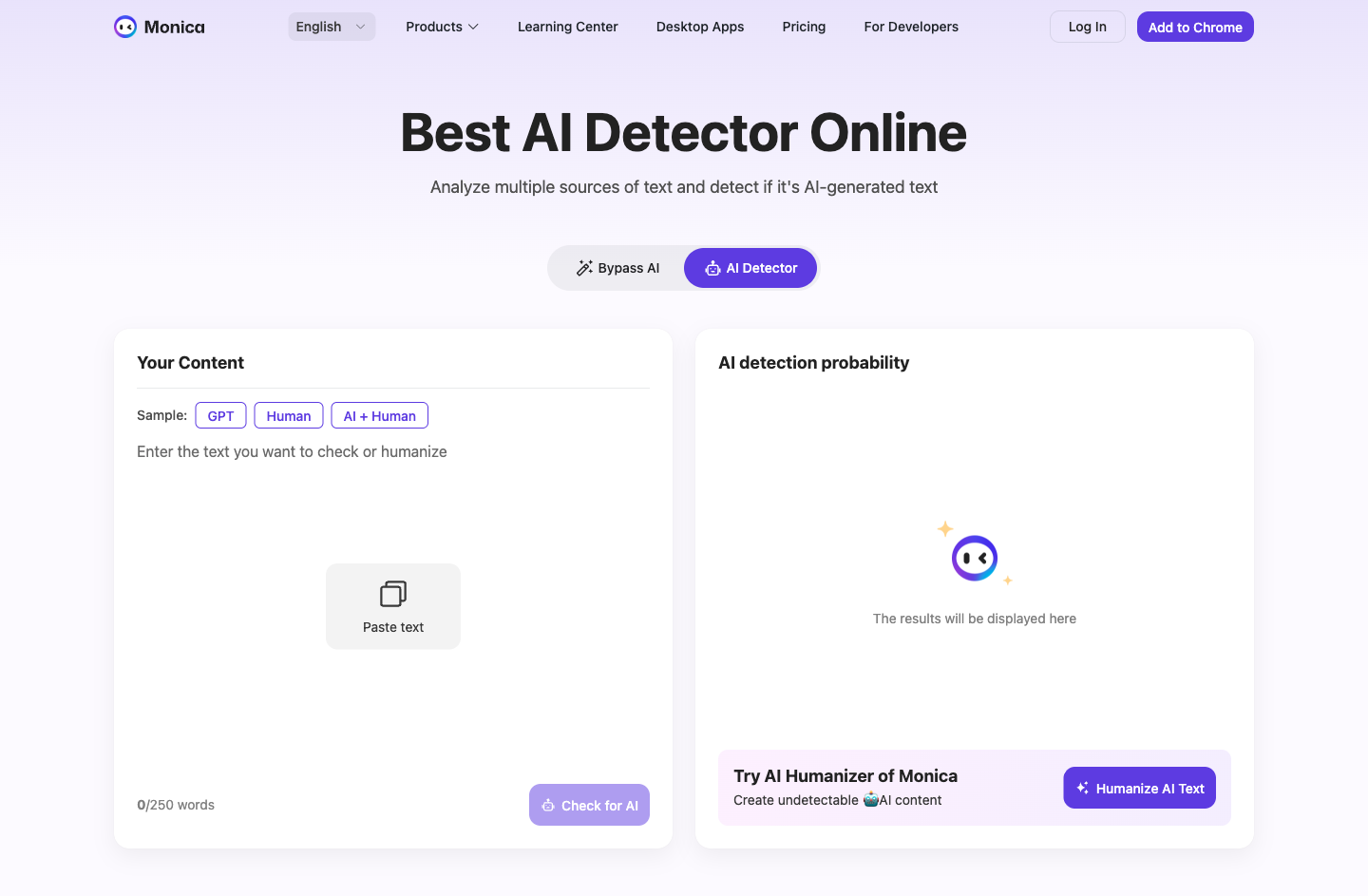
Monica AI Detector is an online tool available through the Monica AI platform. Instead of running its own detection model, it connects to three well-known AI detectors—GPTZero, ZeroGPT, and Copyleaks. This integration lets users see how different engines evaluate the same piece of text in one place.
The detector can spot writing produced by major AI models, including ChatGPT, GPT-4, Claude, Gemini, and LLaMa. Paid users can view the combined results from all three tools at once, which can be useful for comparison.
How it works is pretty straightforward:
Paste or upload your text.
Click the “Detect” button.
Review the analysis showing which parts might be AI-generated.
How Accurate is Monica AI Detector?
Monica AI Detector makes a big claim right on its page—it says it can detect AI-generated writing with up to 98% accuracy. It presents itself as a fast, detailed content checker that can spot machine-written text with just a quick paste-and-click.
Those are strong claims, so I wanted to see how true they felt in real use. To keep things fair, I ran three quick tests: one using purely AI-written text, another mixing human and AI writing, and a third using AI text that had been “humanized” by a rewriting tool. Here’s how it went.
Test 1: Pure AI Text
Setup:
For this one, I generated a short piece entirely with ChatGPT-4. The goal was simple—see if Monica could catch what was obviously AI-written.
Results:
Monica (through its ZeroGPT engine) did flag the piece as AI-generated.
Observations:
That’s the result you’d expect, but it came with a catch. It didn’t give exact percentages or sentence-level analysis. It only showed a general label. To get the full results from GPTZero or Copyleaks, you’d need a paid account. So, while it got the overall call right, there wasn’t much detail to back it up.

Test 2: Mixed AI + Human Writing
Setup:
For the second test, I used an older human-written essay paragraph—something created before ChatGPT existed—and then asked ChatGPT-4 to continue it. The result was a mix: about 41% human writing out of 454 total words.
Results:
According to the ZeroGPT reading inside Monica, the whole passage came back as “100% Human Written.”
Observations:
That was a bit surprising. The AI continuation made up more than half the text, yet Monica didn’t pick up on it at all. It seems that mixed content—where AI adds onto something human—can easily pass under the radar, at least with the visible results in the free plan.

Test 3: Humanized AI Text (QuillBot)
Setup:
For the last round, I took the same 100% AI text from Test 1 and ran it through QuillBot’s Advanced Humanizer Mode to see what would happen once the writing was “smoothed out” to sound more natural.
Results:
This time, Monica labeled the piece as 50% Human Written.
Observations:
The saved screenshot shows a mixed message: ZeroGPT gives a 50 reading, matching the “50% human written” legend, but Monica’s overall banner still says the text seems AI-generated. That is not a clean pass. GPTZero and Copyleaks remain locked in this report, so this test does not show how those two engines classified the rewrite.

What the visible results actually compare
Input used in this review | Visible engine or report | Result shown |
|---|---|---|
ChatGPT-4 text | ZeroGPT inside Monica; GPTZero and Copyleaks locked | ZeroGPT shows 0 beside the red cross; the banner says the text seems AI-generated. |
454-word mixture, including 187 human-written words (about 41%) | ZeroGPT inside Monica; GPTZero and Copyleaks locked | ZeroGPT shows 100 with a green check and a human-written banner. |
Test 1 text rewritten with QuillBot Advanced | ZeroGPT inside Monica; GPTZero and Copyleaks locked | ZeroGPT shows 50 beside the “50% human written” legend, while the overall banner remains red and says AI-generated. |
The mixed-text miss belongs to the visible ZeroGPT result. It is not evidence that GPTZero and Copyleaks gave the same answer: their full reports were behind the paywall in this test. The input’s known human share and a detector’s displayed percentage describe different things; 41% human source material does not make the displayed 100% a measured authorship breakdown.
For a repeat check, save the input, select the engine if the interface offers that choice, and record the engine name beside its visible label. Compare the same passage across reports before changing the text. A paid report is useful here when the question requires the locked GPTZero or Copyleaks details; buying access alone does not show whether those engines agree with the free result.
Monica AI Detector: Pros and Cons
After testing Monica AI Detector and looking through its main features, a few clear strengths and weaknesses stand out. It’s not a bad tool by any means, but like most AI detectors, it comes with trade-offs depending on what you’re using it for.
Pros
Combines multiple detection systems:
Monica brings together GPTZero, ZeroGPT, and Copyleaks, giving users access to several popular engines in one place. That unified setup can save time if you usually compare results across different tools.
Simple and easy to use:
The interface is clean and straightforward—just paste your text, click “Detect,” and wait a few seconds. It doesn’t overload you with settings or extra steps, which makes it approachable even for first-time users.
Multi-language support:
Monica can check content in multiple languages, including English and Spanish. This feature is handy for students, researchers, or writers who work in more than one language.
Web-based access:
Since everything runs through a browser, there’s no need to install any software or extensions. It’s quick to open, use, and close—ideal for quick checks.
Cons
Limited free usage:
The public input is limited to 250 words, so a long essay does not fit in one scan. The original free test also did not expose all three engine reports.
No proprietary detection model:
Monica doesn’t use its own AI detection engine—it relies on other tools. That means its performance depends entirely on how well those third-party detectors work.
Lack of sentence-level analysis:
The results are more of an overall score rather than a detailed, sentence-by-sentence breakdown. This makes it harder to pinpoint which parts of your writing might need editing or rewriting.
Potential for false positives or misses:
Like most AI detectors, Monica can misclassify text—especially with mixed or paraphrased writing. It might mark human writing as AI-generated or overlook AI sections.
Access differed in our test:
The GPTZero and Copyleaks reports were locked in the original test. That limited which engine results we could compare; the new plan names and assistant quotas do not change what those test screenshots recorded.
Monica AI Detector Pricing: Is It Worth Upgrading?
The public Monica AI Detector accepts up to 250 words per scan. Paste a short passage and choose «Check for AI» to view the result. In our original test, the free report showed ZeroGPT’s result while the other engine reports were locked; the comparison above keeps that distinction.
Paid Plans
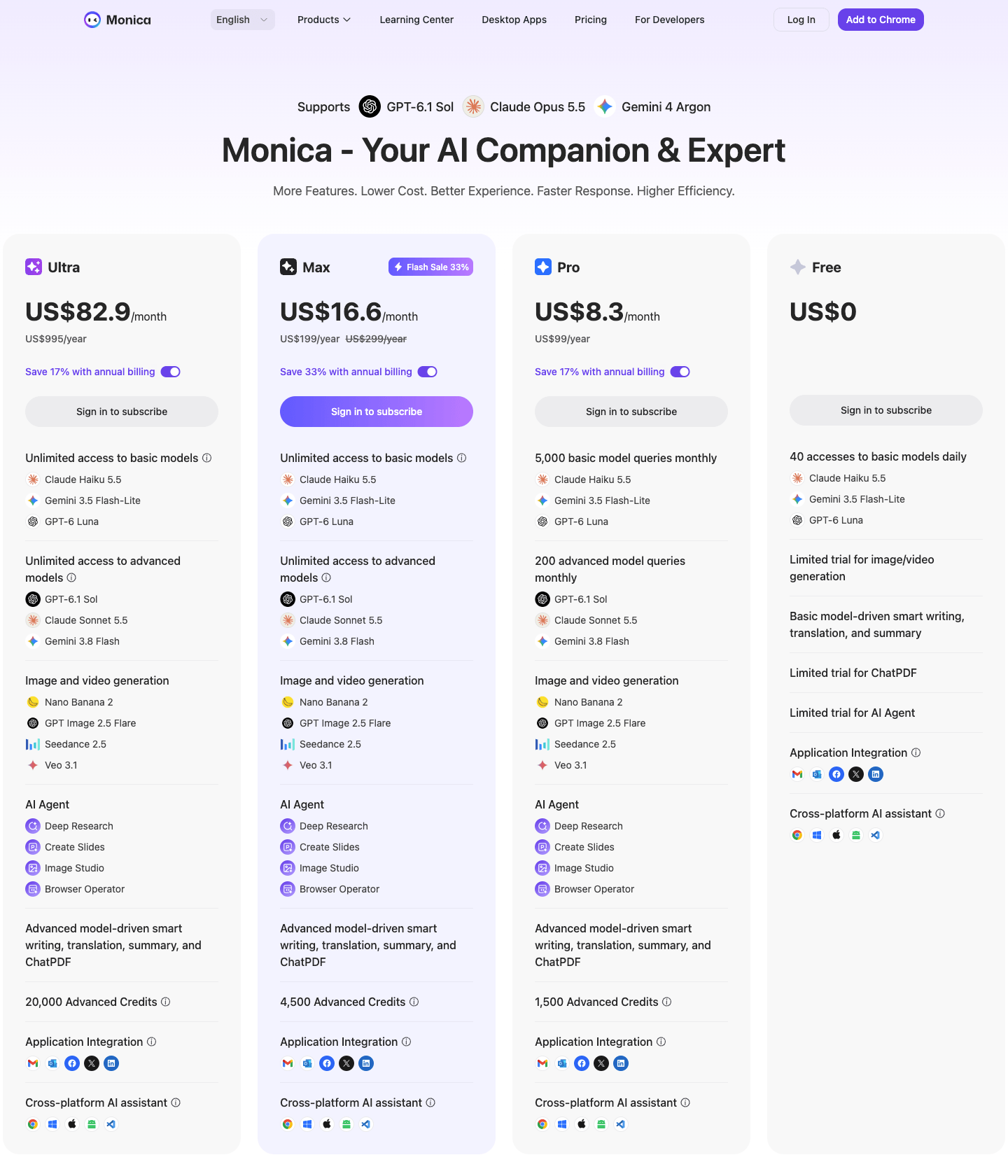
Monica’s current subscriptions are Pro, Max, and Ultra. The annual offers shown are $99/year for Pro (about $8.30/month), $199/year for Max (about $16.60/month, a promotional price), and $995/year for Ultra (about $82.90/month). These are subscriptions to Monica’s wider AI assistant, which includes writing, translation, summaries, ChatPDF, and other tools.
Free vs. Paid: Key Difference
Public detector: Up to 250 words per input. The visible result in our original free test was ZeroGPT’s; it was not a complete three-engine comparison.
Paid plans: Pro includes 5,000 basic-model queries and 200 advanced-model queries per month, plus 1,500 Advanced Credits. Max and Ultra include unlimited basic and advanced model access, with 4,500 and 20,000 Advanced Credits respectively. These are assistant-model quotas, separate from the public detector’s 250-word input field.
Can you bypass the Monica AI detector?
When people talk about “bypassing” an AI detector, they mean trying to change a text so it no longer registers as machine‑generated. Detectors look for statistical and stylistic signals common in AI output — things like predictable phrasing, regular sentence rhythm, or low variety in word choice.
Different engines can classify the same rewrite differently. Here, Test 3 shows ZeroGPT’s 50 reading inside Monica, together with the red AI-generated banner. It does not show unlocked results from GPTZero or Copyleaks.
That said, there are professional editing tools that focus on making writing read more naturally. For example, EssayDone Humanizer positions itself as a rewriting tool that aims to humanize tone and phrasing. It works by varying sentence structures, adjusting word choice, and smoothing rhythm so the text sounds less mechanical.
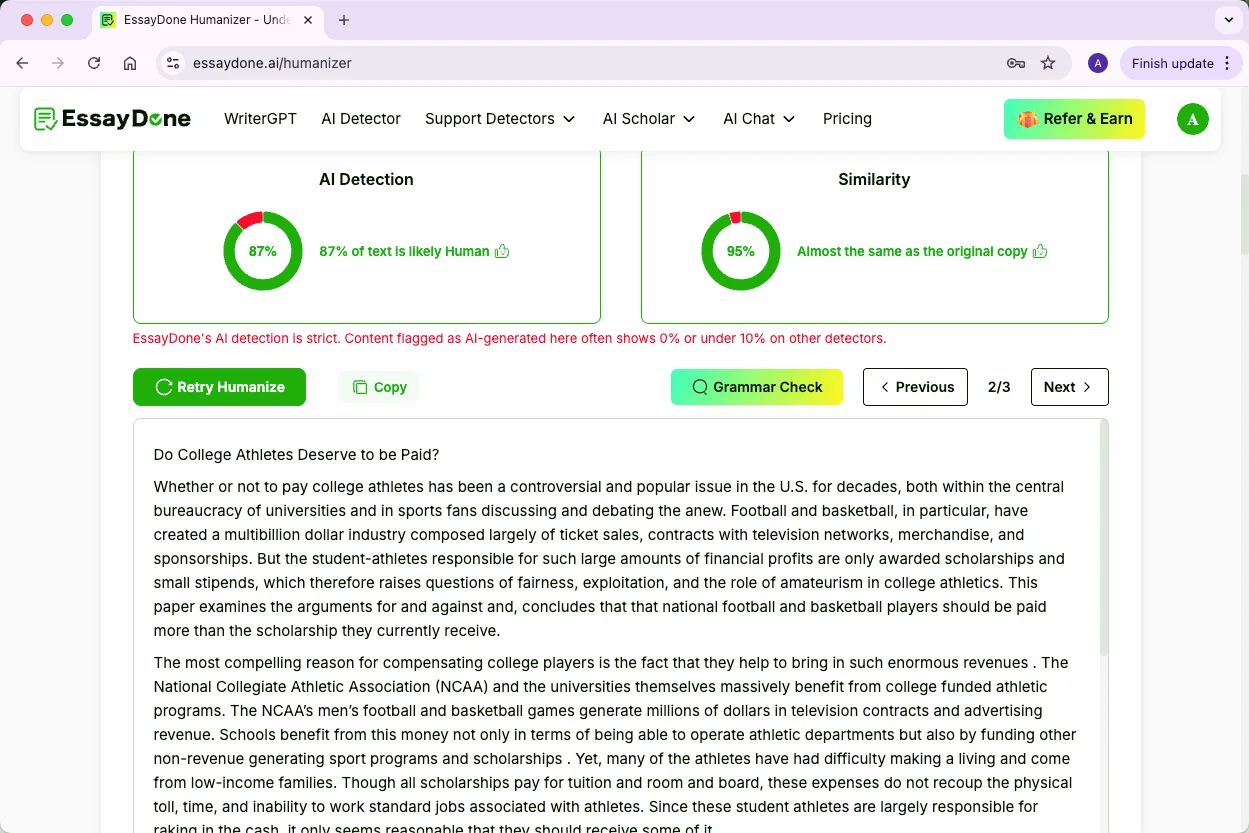
Let’s take another look. Using the 100% AI-generated text from Test 1, the tool brought the AI probability down to 0%. That’s what EssayDone can do.

5 Alternatives to Monica AI Detector
If you’re exploring options beyond Monica AI Detector, several other AI detection tools offer unique features and workflows. Some focus purely on detection, while others bundle plagiarism checks, writing feedback, or text optimization tools. Here’s a quick look at five popular alternatives.
1. Originality.ai
Originality.ai combines AI detection with plagiarism, grammar and readability tools. Pro costs $14.95 per month or $12.95 per month billed annually, with 2,000 monthly credits: enough for 200,000 words of AI-only checking. Checking both AI and plagiarism uses two credits per 100 words.
2. GPTZero AI Detector
GPTZero’s free plan includes 10,000 words per month and 10,000 characters per scan. Premium costs $23.99 monthly or $12.99 per month billed annually for 300,000 words a month, Advanced Scan, downloadable reports and batches of up to 50 files.
3. Copyleaks
Copyleaks allows a public check of up to 25,000 characters without signing in. Personal costs $16.99 monthly for 100 monthly credits, or $167.88 annually for 1,200 annual credits. A hundred credits cover up to 25,000 words or 100 images; AI and plagiarism can appear in one report.
4. ZeroGPT
ZeroGPT’s free detector accepts up to 15,000 characters. Pro costs $14.99 monthly or $8.99 per month billed annually and raises the per-scan limit to 100,000 characters. It also adds batch-file checks and PDF reports; its plagiarism allowance is separate.
5. QuillBot
QuillBot allows six free AI checks per day, up to 1,200 words each. Premium costs $19.95 monthly or $8.33 per month billed annually and removes the detector’s scan and word limits. Its 25,000-word monthly plagiarism quota belongs to a separate tool.
FAQ
Is Monica AI Detector 100% accurate?
No. Accuracy drops with mixed or edited text; scores are indicators, not guarantees.
Will my professor use an AI detector?
Possibly. Policies vary, so check your syllabus or ask directly.
Can I use AI detectors on my own work?
Yes. Use them to spot generic or AI‑like passages, then revise with original analysis.
Are AI detectors legal?
Yes, but follow privacy rules and institutional policies when uploading content.
Is Monica AI Detector free?
The public detector offers checks of up to 250 words. Monica also sells subscriptions to its wider AI assistant; their model-query and Advanced Credit allowances are different from the detector’s input limit.
Conclusion
In this review, we looked at Monica AI Detector’s features, accuracy, pricing, and alternatives, along with practical considerations for using AI detection tools.
Our mixed passage contained 41% known human-written text, yet the visible ZeroGPT result said 100% Human Written. That miss is the clearest limitation in this review. Keep the engine name attached to each result: Monica’s interface does not make the underlying detectors interchangeable.
Hopefully, this article helps you understand the capabilities and limitations of Monica AI Detector and supports your own decisions when checking or revising AI-generated content.