






APA Annotated Bibliography Examples: Format and How to Write One

You have found sources for your paper, but your instructor has asked for an annotated bibliography rather than a simple reference list. What should you add beneath each citation—and how much should you say?
An APA annotated bibliography pairs each APA reference with a short paragraph about that source. Depending on the assignment, the annotation may summarize the work, evaluate its strengths and limitations, and explain how it relates to your project. Below are complete examples using a journal article, a book, and a report.
APA Annotated Bibliography Example: Journal Article
Imagine you are researching study strategies. This entry identifies the article and follows it with an annotation that summarizes the review, evaluates its scope, and explains a possible use in a paper.
Dunlosky, J., Rawson, K. A., Marsh, E. J., Nathan, M. J., & Willingham, D. T. (2013). Improving students’ learning with effective learning techniques: Promising directions from cognitive and educational psychology. Psychological Science in the Public Interest, 14(1), 4–58. https://doi.org/10.1177/1529100612453266
Dunlosky and colleagues review evidence on ten learning techniques, including rereading, practice testing, and distributed practice. They assess each technique for how broadly it can help learners and identify practice testing and distributed practice as especially promising. The review is useful because it compares several strategies rather than treating one study method as universally effective. It was published in 2013, however, so a current paper should also consult later research. For a project on study habits, this source can provide a framework for comparing commonly used techniques and explaining why popularity alone does not establish effectiveness.
What the annotation does: The first two sentences summarize the review; the next two evaluate its comparative scope and age; the final sentence explains its use in the writer’s project. For publication details, see the journal record.
More APA Annotated Bibliography Examples
Book Example
For a paper on how people make judgments, a book may provide a broad conceptual foundation. This example refers to the 2011 US edition; another edition may have different publication details.
Kahneman, D. (2011). Thinking, fast and slow. Farrar, Straus and Giroux.
Kahneman introduces a distinction between fast, intuitive thinking and slower, more deliberate reasoning, drawing on research in psychology and decision-making. The book gives a general audience a way to understand how judgments can be influenced by mental shortcuts. Its accessible scope makes it useful for introducing concepts, but a research paper should also consult the original studies and newer scholarly work for the specific claim being examined. This source could help frame a discussion of decision-making before the paper turns to a narrower body of evidence.
Edition details can vary; this example uses the 2011 edition in the publisher’s listing.
Organization Report Example
World Health Organization. (2022). World mental health report: Transforming mental health for all. https://www.who.int/publications-detail-redirect/9789240049338
The World Health Organization report surveys global mental health needs and argues for stronger community-based care, supportive environments, and greater commitment to mental health. It draws together research, examples of practice, and lived experience, making it a useful starting point for a broad policy discussion. Its international scope is valuable for context, but it does not replace local evidence about a particular community or service. A paper on access to care could use the report to frame the issue, then compare it with current national or local data.
Here, the organization is both author and publisher, so the publisher name is not repeated.
How to Format an APA Annotated Bibliography
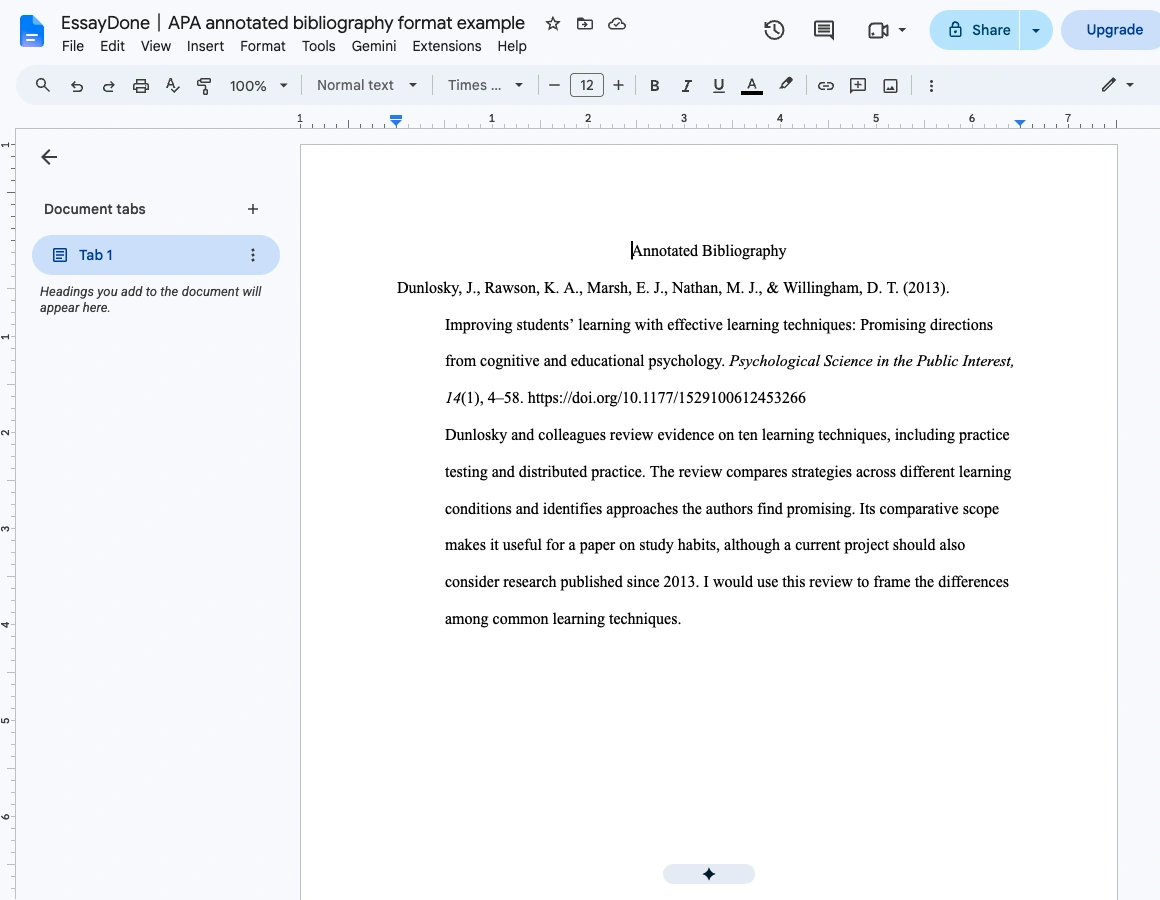
- Give each source a complete APA reference. Use the format for the actual source type: journal article, book, report, or webpage.
- Arrange entries alphabetically by the first author’s surname or organization name, unless your instructor asks for another order.
- Use a 0.5-inch hanging indent for the reference. The first line starts at the left margin; subsequent lines are indented half an inch.
- Place the annotation on the next line. A common layout indents the whole annotation 0.5 inch from the left margin. Double-space the entry and annotation; follow your instructor’s annotation-specific layout if it differs.
- Follow the assignment. Your instructor may specify a title, word range, number of sources, or whether your annotation must include evaluation and reflection.
Set it up in Google Docs
- Select the reference, not the annotation. Choose Format > Align & indent > Indentation options.
- Under Special indent, choose Hanging, set it to 0.5 inch, and select Apply.
- Select the annotation separately and set its left indent according to your assignment; a common choice is 0.5 inch for the whole paragraph.
- Select the entry and use Format > Line & paragraph spacing > Double.
An annotation is not the same as an abstract. An abstract describes a work, usually written by its authors; your annotation responds to the source in relation to your own research assignment. Some assignments request summary only, so do not assume every entry must contain the same kinds of evaluation.
How to Write an Annotation Step by Step
- Read the source. Identify its purpose, central argument or findings, and the evidence or approach used.
- Summarize the most relevant points. Explain what the source contributes to your topic rather than retelling every section.
- Evaluate it when required. Consider the authors’ expertise, evidence, methods, date, scope, and limitations. Explain your judgment with a specific reason.
- Connect it to your project. Say whether the source provides background, evidence, a contrasting view, or a method you can use.
- Check the reference. Compare names, publication year, title, page range, and DOI or URL with the original source.
How the journal example puts the steps together
| Part | What to write | Dunlosky example |
|---|---|---|
| Summary | The source’s main subject or finding | Reviews ten learning techniques and identifies two as promising. |
| Evaluation | A specific strength | Compares several strategies instead of treating one as universally effective. |
| Limitation | A constraint relevant to the project | Published in 2013, so a current paper should also consult later research. |
| Relevance | How it contributes to your own project | Provides a framework for comparing study habits. |
Try this adaptable structure: “[Author] examines [topic] using [evidence or method]. The source finds or argues [main point]. Its strength is [specific strength], although [limitation]. It will help my research by [specific contribution].” This is a writing aid, not a mandatory APA template. If the assignment asks only for summary, omit evaluation and relevance unless requested.
Common Questions
How long should an annotation be? A useful starting range is roughly 100–200 words per source; longer evaluations may require more. University guidance varies—for example, Quinnipiac’s library describes 100–300 words. APA does not set one universal annotation length, so follow the assignment’s specified range.
Should I include in-text citations in the annotation? The entry directly above identifies the source being discussed. If you refer to a different source inside the annotation, cite that other work appropriately and follow your instructor’s instructions.
Can I use an AI tool to write my annotations? Follow your course policy. If you use a tool to organize notes, read and evaluate the source yourself, check all citations, and revise any claim the source does not support.
Start with one source you understand well. Write its complete reference, explain what it says, and then add the evaluation or connection your assignment requires. For a closer look at citing articles in the body of an essay, see how to cite an article in an essay.