



What AI Detector Does Turnitin Use? Models, Accuracy & More

With ChatGPT, Gemini, Claude, and AI paraphrasing tools now common in academic drafting, many students ask what AI detector Turnitin actually uses.
The short answer is that Turnitin uses its own AI writing detection systems inside the Similarity Report, not a generic public checker. The more useful answer is how those systems classify likely AI-generated and AI-paraphrased text.
This guide explains the model history, report categories, accuracy limits, and what students and instructors should take from the result.
1. What AI Detector Does Turnitin Use?
According to Turnitin’s official white paper (the source this article is based on), Turnitin’s AI detection system relies on two key deep-learning models:
AIW (short for AI Writing) is the model that checks whether a piece of writing was generated by an AI.
AIR (short for AI Rewriting) is a newer model that looks specifically for writing that’s been paraphrased or rewritten by AI tools to sound more human.
Both are built using transformer-based architecture — the same kind of tech behind modern AI like ChatGPT.
Turnitin first launched its AI detection tool—AIW-1—in April 2023. That model was updated and replaced by AIW-2 in December 2023. Then, in July 2024, AIR-1 was added to detect more subtle use of AI, like when a student uses an AI tool just to rephrase existing content.
Together, these models help instructors spot text that might be AI-written or AI-modified, giving deeper insights into the originality of student work.
Q: Can individuals use Turnitin’s AI detectors?
Turnitin’s AI detection is part of their originality service, which is only available to institutions like schools and colleges. And all Turnitin's service is paid.
Reports are accessible only to instructors and administrators. So, if you’re a student or individual, you can’t directly use Turnitin or its AI detectors. However, some alternative tools are available online, including community-shared Discord links or other AI detection apps.
2. How Was Turnitin’s AI Detector Developed?
First, There Was AIW-1
Turnitin's first public AI writing detector launched in April 2023 and was often described through the AIW-1 model. Its job was to review academic prose for patterns commonly associated with AI-generated writing, such as unusually even structure, generic phrasing, or predictable sentence flow.
When enough qualifying text crossed the model threshold, the report could show that part of the document was likely AI-written.
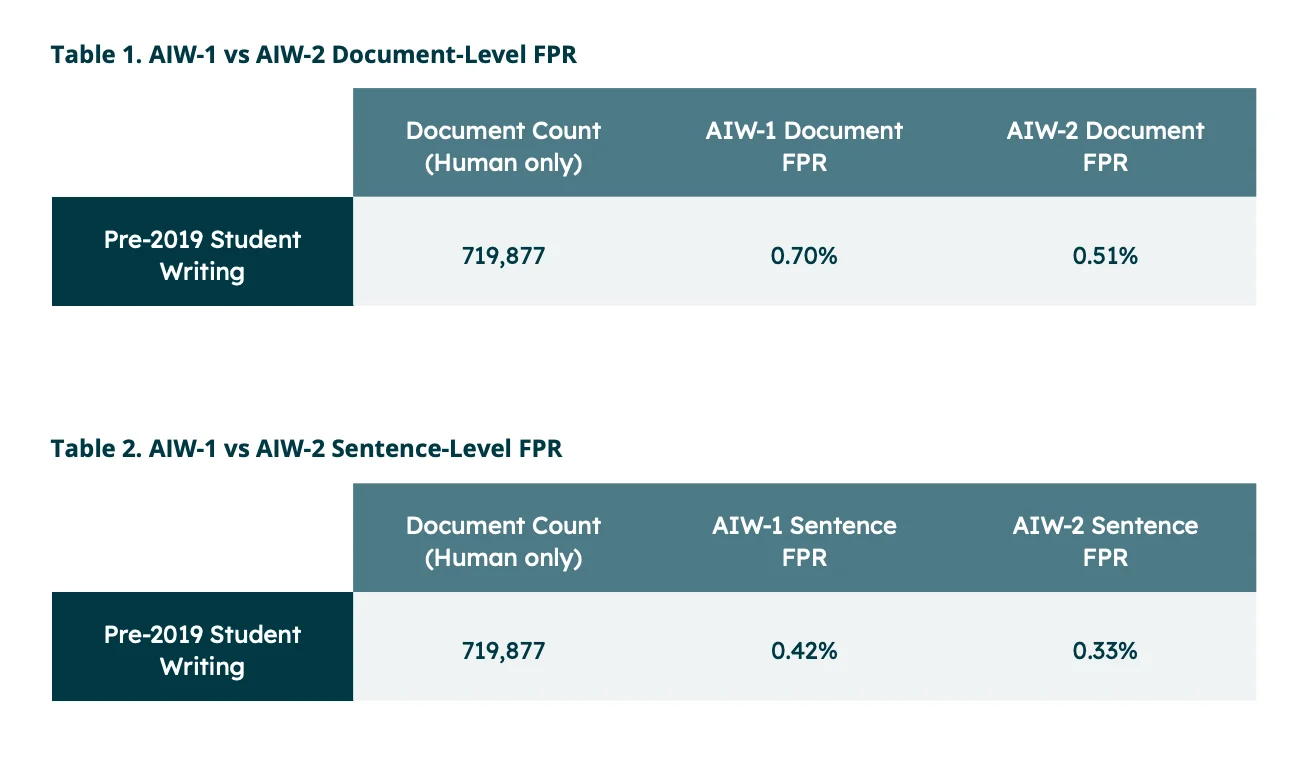
The main design priority was a low false positive rate. Turnitin reported that, for documents above the main reporting threshold, fully human-written papers were incorrectly flagged at a rate below 1%.
That cautious approach helped reduce overreaction to small or borderline AI signals, but it also meant the tool was never meant to be a standalone misconduct decision.
Then Came AIW-2 — A Smarter Upgrade
AI tools then improved quickly, especially tools that rewrite or paraphrase AI-generated text. A surface rewrite can change vocabulary while leaving the same statistical structure underneath, which makes detection harder.
Turnitin later described newer AI writing detection work through AIW-2, trained against a broader mix of examples:
AI-generated academic-style text
Authentic student writing across subjects and writer backgrounds
Text that was AI-generated and then reworded by an AI paraphraser
Mixed documents containing both human and AI-assisted passages
The point of this newer model was not just to catch a single ChatGPT style. It was to recognize broader language patterns across sentence structure, grammar, consistency, and tone.
📊 Turnitin has reported large-scale use of these AI writing reports across student submissions, giving the company substantial operational data to monitor model behavior.
The practical takeaway is that Turnitin's AI detector is model-based and regularly updated. Its result should be read as probability-based evidence, not as a direct view into how the paper was written.
Once general AI writing is detected, the next question is whether the text may have been rewritten by an AI paraphrasing tool. That is where Turnitin's AI-paraphrasing category becomes relevant.
3. The AIR-1 Model: How Does It Detect AI Paraphrasing
AI paraphrasing tools rewrite existing AI-generated text rather than drafting a new argument from scratch. They may change sentence order, word choice, and grammar while preserving the same underlying structure.
That creates a different detection problem: AI-paraphrased text can look less obviously generated while still carrying statistical signals from the original AI draft.
Turnitin's AI-paraphrasing category was built to review those rewritten signals after AI writing has already been detected.
What Is AI Paraphrasing, and Why Is It Tricky?
AI paraphrasing means a generated draft has been rewritten by another tool. The output may sound smoother or more student-like, but it often keeps the same logic, sequence of ideas, and formulaic rhythm.
For detection, that is tricky because the surface wording changes. The model has to look beyond exact phrases and consider whether the rewritten passage still behaves like AI-assisted prose.
How AIR-1 Works
Think of the AI-paraphrasing layer as a second review of passages that already look AI-generated. It does not simply search for synonyms. It reviews how the text is organized, including rhythm, sentence complexity, idea sequencing, and rewritten patterns that may remain after a paraphraser changes the wording.
Here is the basic flow:
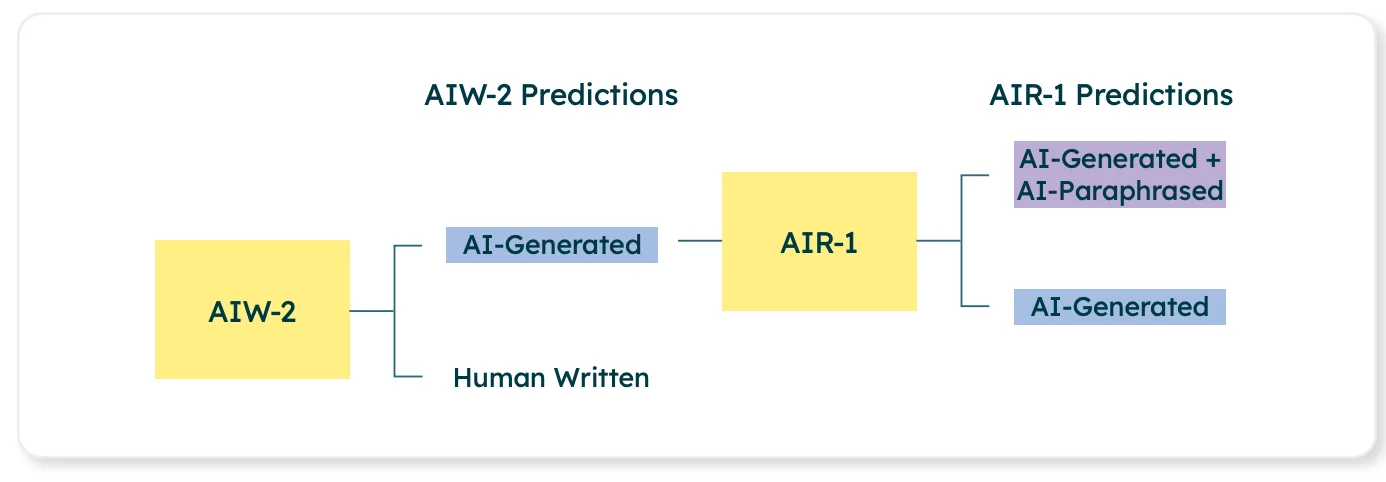
First, the AI writing model reviews the qualifying prose.
If enough text is likely AI-generated, the paraphrasing layer can evaluate those flagged passages.
The second layer looks for signs that the likely AI text was also rewritten by an AI paraphrasing tool.
When the report separates that category, the passage may appear with a distinct highlight such as purple.
How It Shows Up in Reports
When the report labels text as AI-paraphrased, it is usually tied to a passage already identified as likely AI-generated. In the interface, that category can help instructors see whether the text appears directly generated or rewritten after generation.
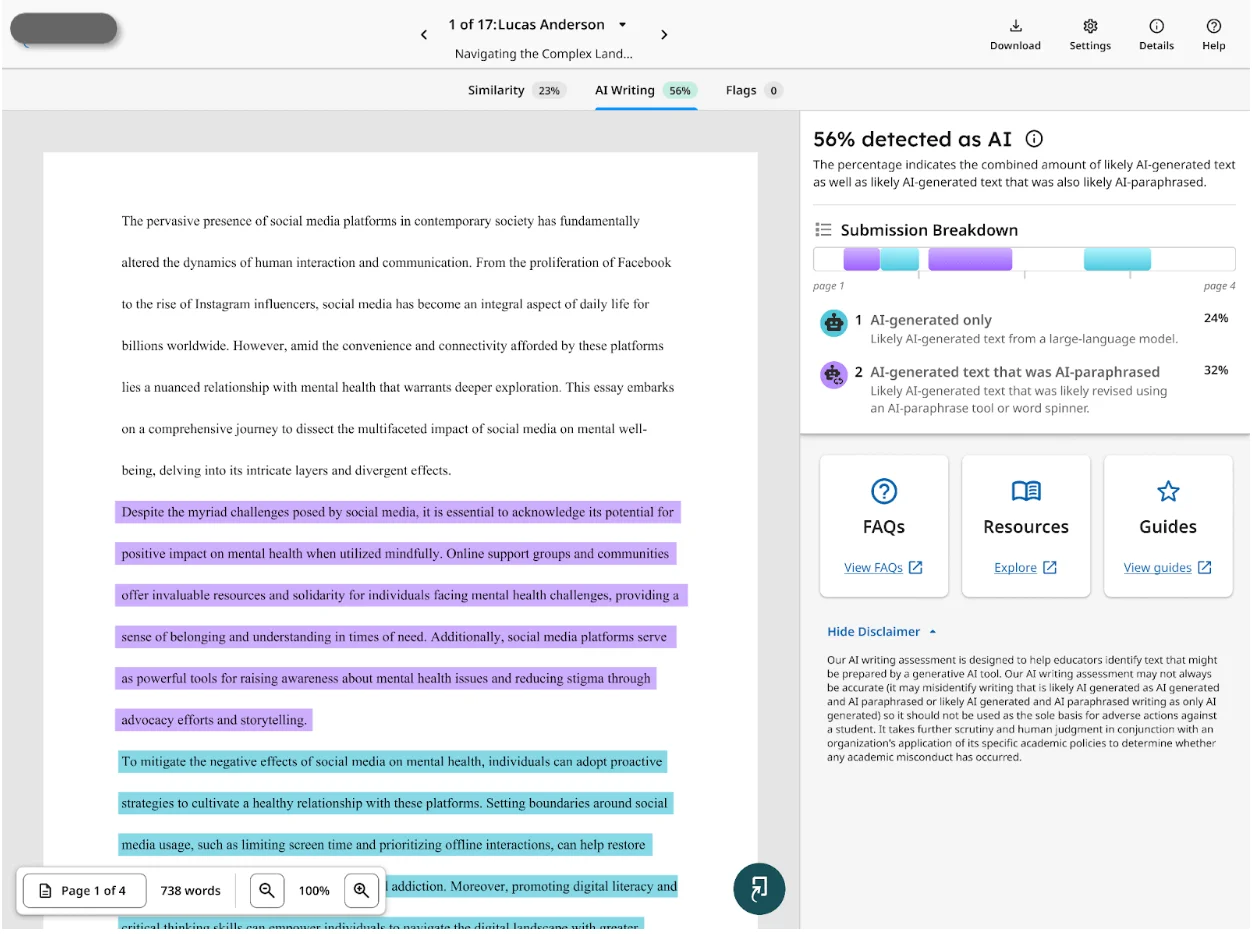
This extra category is useful, but it is still probabilistic. It should guide instructors toward the passages that need review, not replace a conversation about drafts, sources, permitted AI use, and assignment policy.
✳️ The paraphrasing layer does not scan the whole document independently. It reviews text that the AI writing model has already marked as possibly AI-generated, and it does not paraphrase-check text treated as human-written.
Now that we have covered the key report categories, the next question is what kind of data and training supports them.
4. How Were Turnitin AI Detectors Trained and Tested?
Now that we understand what AIW-2 and AIR-1 actually do, it’s fair to ask: how do we know they’re reliable?
Well, according to Turnitin, a lot of care — and a lot of data — went into training and testing these models to make sure they work as expected. Let’s break that down in simple terms.
Training the Models: Where Did the Data Come From?
To teach AIW-2 and AIR-1 how to spot AI-written or paraphrased content, Turnitin used massive datasets — but not just any text.
According to Turnitin:
The AIW-2 model was trained using a mix of AI-generated content and real, human-written academic writing. This included papers from a wide range of subjects, countries, and student demographics.
Turnitin made a special effort to include underrepresented groups, such as second-language learners and students from diverse academic backgrounds. That helps reduce bias and makes the model fairer and more accurate across different writing styles.
Importantly, AIW-2’s training data also included examples of AI-generated text that had been run through paraphrasing tools — which was key to improving its ability to catch “AI+AI-paraphrased” content.
For AIR-1, the focus was even more specific:
It was trained on a wide range of AI-paraphrased text, alongside regular human writing and pure AI content.
This helped AIR-1 learn to spot subtle clues that are unique to reworded AI — clues that traditional AI detectors often miss.
In short, these models were not just trained on examples pulled from the internet. They were carefully designed using realistic academic scenarios to match what educators and students actually deal with.
Testing the Models: How Does Turnitin Measure Accuracy?
When it comes to testing, Turnitin focuses on two core metrics:
Recall – This measures how many actual AI-written texts are correctly identified. A high recall means the model is doing a good job catching what it’s supposed to.
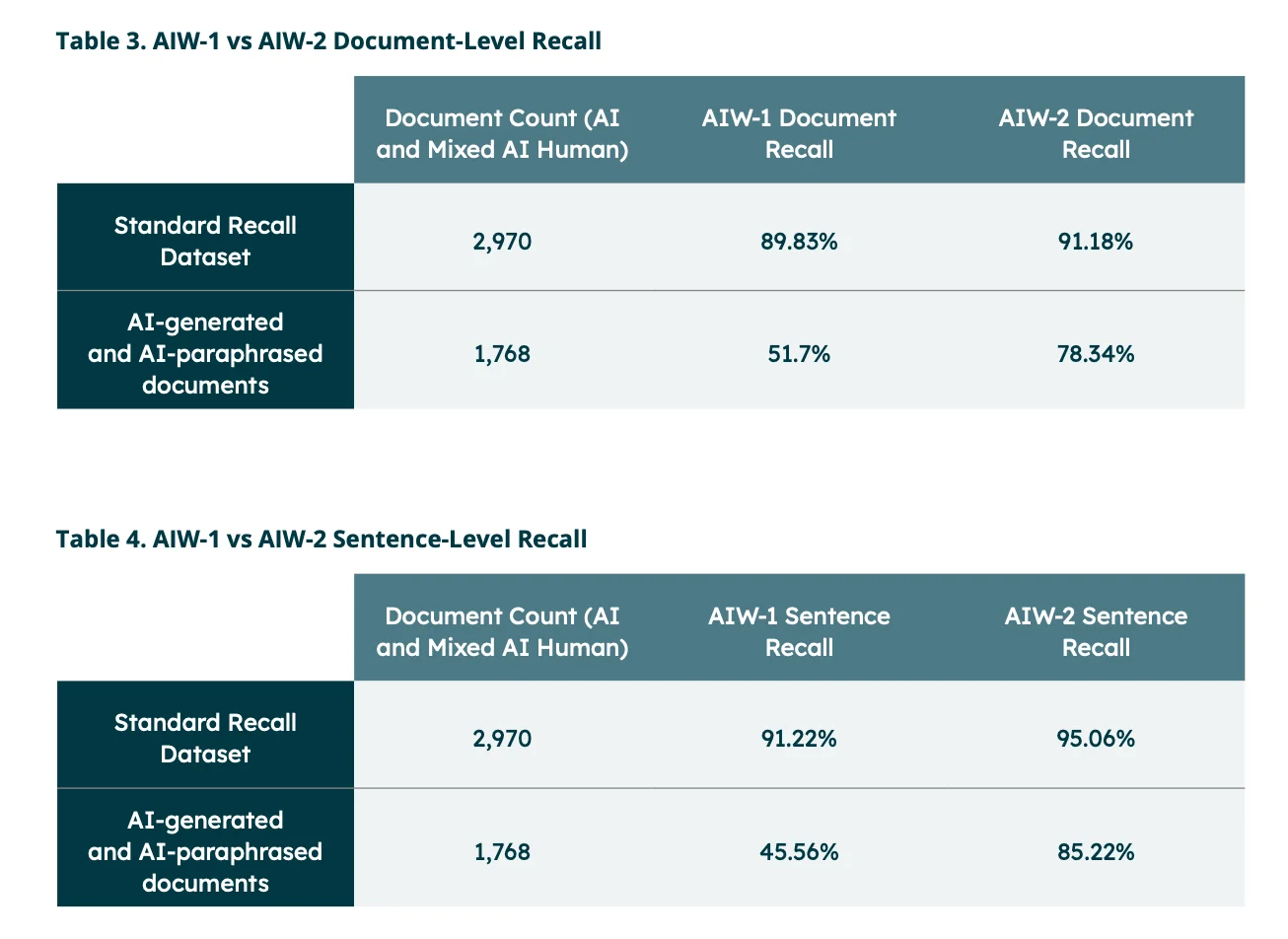
False Positive Rate (FPR) – This shows how often human-written text is wrongly flagged as AI. A low FPR is crucial, especially in academic settings, where a false accusation can have serious consequences.
According to Turnitin, AIW-2 keeps the document-level false positive rate under 1%, as long as it finds at least 20% of a document to be AI-generated. That’s why you’ll often see this 20% threshold mentioned in the AI report — it’s a carefully chosen cut-off point based on testing.
Why “Accuracy” Alone Isn’t Enough
The word “accuracy” can be misleading in AI detection because most submissions are not fully AI-written. A model could look accurate overall while still missing important AI cases or wrongly flagging a small number of students.
That is why measures such as false positive rate and recall matter. False positive rate asks how often human writing is wrongly flagged. Recall asks how much AI writing the system actually finds.
A useful detector has to balance both. If it is too aggressive, it risks unfair accusations. If it is too cautious, it may miss AI-assisted work that violates course policy.
With that balance in mind, the next section explains how Turnitin analyzes a submitted paper at the sentence and document level.
How Turnitin's AI Detector Actually Works
First, the System Breaks the Text into Small Chunks
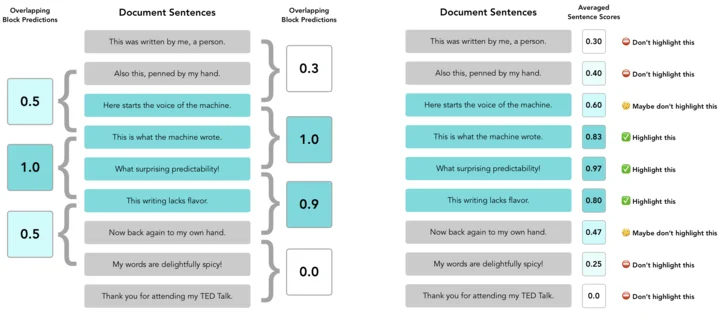
Turnitin uses a method called a segmented window approach. Basically, instead of reading the whole essay in one go, the system breaks it into small, overlapping sections — think five to ten sentences per segment.
Each of these “windows” slides through the document one sentence at a time, so every sentence ends up being analyzed within multiple segments. This gives the model different contexts to evaluate the same sentence more reliably.
Then, It Scores Each Sentence for AI Likelihood
Every segment gets a score between 0 and 1:
A score closer to 0 means the text is likely human-written.
A score closer to 1 suggests it’s more likely AI-generated.
Since each sentence appears in multiple windows, Turnitin calculates a weighted average score for each sentence. This helps smooth out any accidental misreads and gives a more stable judgment.
And as we said before, it also makes AI paraphrase judgments on sentences that have been judged to be AI-generated, which is a separate score.
Next, the System Makes a Document-Level Judgment
So how does it decide if an entire document is AI-generated?
According to Turnitin, a document is flagged only if 20% or more of its sentences are scored above the AI-writing threshold. That 20% rule isn’t random — it's based on testing that showed smaller amounts often lead to false positives. This way, Turnitin aims to be cautious and only flag work when there’s a stronger signal of AI involvement.
In other words, a paper needs to have a significant amount of AI-like content before it’s labeled as such.
Short Papers Don’t Get Checked
Another important limit: Turnitin won’t run the AI detector on documents shorter than 300 words. That’s because short texts don’t give the system enough data to make an accurate prediction. It needs a bit of content to work with — the more words, the better the analysis.
That's all about how Turnitin detect the AI content.
How Turnitin’s AI Detector Stacks Up Against Other Tools
Turnitin differs from many public AI detectors in several practical ways:
Academic setting: The tool is built for instructor review inside educational workflows, so it is evaluated against academic writing rather than casual web text alone.
Report categories: Turnitin may separate likely AI-generated text from likely AI-paraphrased text, giving instructors more detail than a single yes/no score.
Model-based scoring: Instead of relying only on simple signals such as perplexity or burstiness, Turnitin reviews broader language patterns across qualifying prose.
Institutional integration: The report appears inside systems instructors already use, which also means student visibility depends on school settings.
Published limitations: Turnitin documents file requirements, score thresholds, false-positive concerns, and review guidance more clearly than many casual free detectors.
In short: Turnitin is not a casual AI checker. It is an academic review tool, and its strongest use is helping instructors decide what passages deserve closer human review.
Turnitin vs. Other AI Detectors
Wondering if you can just use other AI detectors instead of Turnitin to check your work before submitting? Here’s the thing: Turnitin’s system isn’t easily replaceable by popular tools like GPTZero.
Turnitin trains its AI models on real student papers across a wide range of subjects and languages, so it’s finely tuned for academic writing. Plus, it’s learned from analyzing over 250 million actual submissions—something most other detectors simply don’t have. This real-world data really boosts accuracy.
Turnitin also goes a step further by using two models—one to spot AI-generated writing and another to catch AI-paraphrased sentences. While GPTZero and Quillbot offer some sentence-level highlights, they don’t match the depth and reliability Turnitin provides.
Technically, many detectors rely on simpler stats like perplexity, but Turnitin’s built on advanced transformer models that pick up on subtle language patterns, making its detection smarter.

FAQ
Q: What AI models does Turnitin use?
A: Turnitin uses in-house AI writing detection systems that identify likely AI-generated text and likely AI-paraphrased text. Older documentation often refers to AIW for AI writing and AIR for AI rewriting/paraphrasing.
Q: How can I avoid being flagged by Turnitin’s AI detectors?
The safest approach is not to focus on avoiding flags. Follow the assignment policy, write in your own voice, cite sources carefully, disclose AI help when required, and keep drafts that show your writing process.
Q: Is Turnitin more accurate than free tools like ZeroGPT?
A: Turnitin is usually more relevant for school settings because it is designed for academic writing and instructor review. Free detectors can be useful for a rough second opinion, but many do not publish enough information about training data, thresholds, or false-positive behavior.
Q: Can Turnitin detect writing from newer AI like GPT-4 or Gemini?
A: Turnitin updates its AI writing detection as newer language models and AI-assisted writing patterns appear. It does not need to name a specific tool in the report; it reviews the submitted text for likely AI-writing patterns.
Q: How accurate is Turnitin’s AI detection?
A: Turnitin reports a false-positive rate below 1% for documents above its main AI-reporting threshold, but accuracy is not certainty. Low scores, short text, paraphrased AI, and mixed human-AI drafts still need careful interpretation.
Conclusion
Turnitin uses its own academic AI writing detection systems to review qualifying prose for likely AI-generated and AI-paraphrased patterns. Those models can help instructors identify passages that deserve attention, but they do not replace judgment, context, or institutional policy. Understanding what the detector can and cannot show helps students write transparently and helps educators use the report fairly.