



What Is a Good Turnitin Score? It’s More Than a Number

If you have ever submitted an assignment through Turnitin, you probably looked at the percentage first and wondered whether it was good enough.
An 8% score can feel reassuring. A 38% score can feel alarming. But a Turnitin score is not a pass/fail grade. It is a report signal that only makes sense when you know what is being measured.
So, what is a good Turnitin score? The answer depends on whether you mean similarity, AI writing, or the instructor's policy.
What Is a Good Turnitin Score?
Before we try to answer that question, let’s slow down and look at what Turnitin score is actually showing us.
When you submit a paper to Turnitin, you usually get two reports: the Similarity Report and, more recently, the AI Writing Report. They are measuring very different things.
The Similarity Score helps you determine what percentage of your submitted work matches existing sources, such as academic papers, websites, and prior student submissions, so you can manage in-text citations and the bibliography accordingly.
The AI Writing Report, on the other hand, is Turnitin’s attempt to flag content that may have been generated by artificial intelligence tools like ChatGPT. This is a newer feature.
So before we can say what a "good" score is, we need to understand what these two reports really mean. Let’s break how Turnitin detect the content first—then we’ll come back to that big question.
What Is a Good Turnitin Similarity Score?
First, remember that Turnitin does not judge whether a paper is plagiarized.
It generates a Similarity Report that highlights text matching sources in its database, including student submissions, academic publications, and web content. The report shows overlap; a human reader decides what the overlap means.
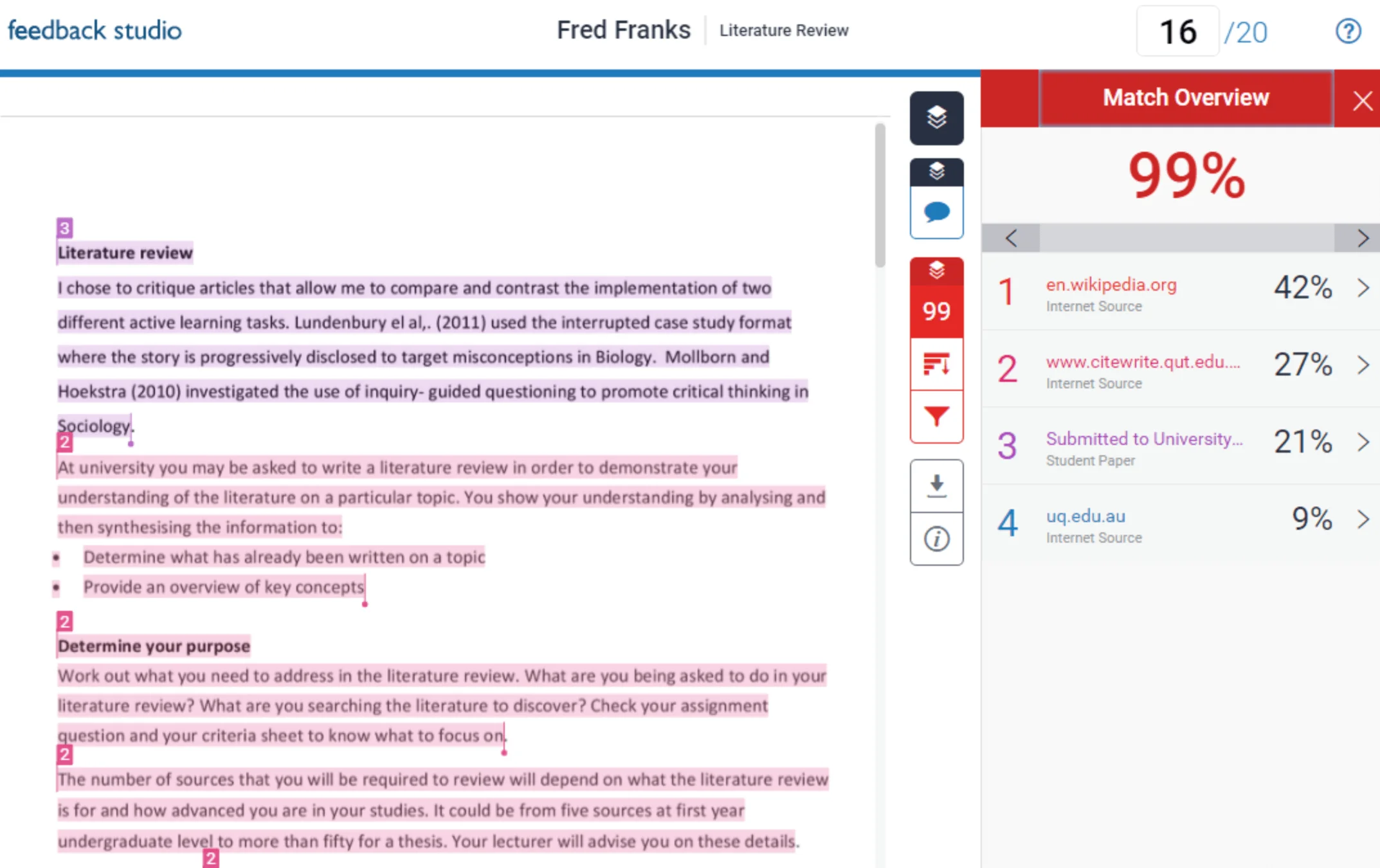
What Is the Similarity Score?
The Similarity Score is the percentage of submitted text that matches material Turnitin can compare against.
The basic idea is:
Similarity % = (Matched words ÷ Total words in the document) × 100
If 200 words in a 1,000-word essay match other sources, the score is 20%.
That number alone is not enough. You still need to open the full report and check whether the matched words are quoted, cited, common, required by the assignment, or copied without attribution.
What Are the Main Factors That Affect the Score?
Several scenarios can increase your similarity score — some of which are completely acceptable, and others that may raise red flags.
Here are the key factors:
Quoted Text or Block Matching: Turnitin will mark any exact quotes, even when cited correctly, as similar. These aren’t bad matches, but they do raise the percentage.
Bulk Word Matching: If you’ve copied large blocks of text or closely paraphrased content, the score will climb.
Checkerboard Matching: Alternating copied and original content in a pattern (e.g. every other sentence) may trigger suspicion in the report.
Qualitative Matching: Turnitin doesn’t just match words — it looks at phrasing and structure too. So if your writing too closely mimics a source’s style, even without exact matches, it may still get flagged.
Document Type and Length: Research-heavy or longer papers are naturally more likely to score higher due to more cited references.
Citations and References: Even correct citations contribute to the percentage, though they’re usually easy to verify and not penalized.
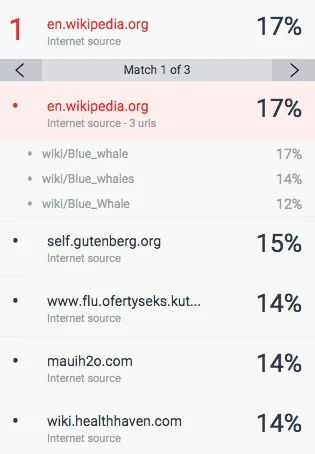
What Do the Colors of the Similarity Score Mean?
Turnitin uses color indicators to make it easy to scan for the level of similarity. The display may vary slightly depending on the platform (classic Feedback Studio or My Files), but the meaning is consistent:
Similarity Score Range | Classic Assignments (Feedback Studio) | "My Files" View |
0% matching text | Blue | Green |
1–24% matching text | Green | Blue |
25–49% matching text | Yellow | Yellow |
50–74% matching text | Orange | Orange |
75–100% matching text | Red | Red |
You can see that orange and red are the most alarming cases, but that doesn’t automatically mean there’s plagiarism. It can result from properly cited material, earlier drafts submitted to Turnitin, common academic phrases, or someone else submitting your work first. For larger works, the percentage is often rounded down, which could obscure high matching text. Consequently, close scrutiny of the full report, and not just the percentage, is essential.
So, What Kind of Similarity Report Score Is Reasonable?
At this point, we can say one thing clearly: there is no universal perfect similarity score. Different institutions, instructors, assignment types, and citation rules produce different expectations.
A score around 15-20% may be reasonable in many research-based assignments, but it is not a universal target. A literature review may score higher because it cites many sources. A personal reflection should usually be much lower.
The key rule is this: the breakdown matters more than the number.
Consider a few examples:
A 35% score may be acceptable if most matches are properly cited quotations, references, or required template text.
A 19% score may be serious if most of it comes from one uncited paragraph copied from a source.
A 0% score may still deserve review if the assignment expected research and the paper has no source support.
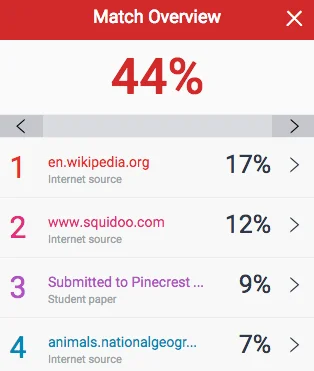
In short, do not chase a low score for its own sake. Aim for a strong paper with clear citations, meaningful analysis, and source use that matches the assignment.
Special Cases:
Large Document Submission:
A large document may show a 0% similarity score if small matches are rounded down, even though the report still contains matched text.Multiple Drafts Submitted:
Submitting drafts to a private repository can cause the final draft to score 100% if it matches earlier versions.Someone Else Submits Your Work First:
If another person uploads your document before you, their submission may become the source that causes your original to appear highly matched.
What is a Good Turnitin AI Writing Score?
After similarity, the other score students ask about is the AI Writing indicator. It is separate from the Similarity Score and estimates whether qualifying prose may have been generated or AI-paraphrased. A paper can have low similarity and still show an AI indicator, or high similarity with no AI percentage.
The AI indicator generally appears in these states:
Blue (with a percentage, either 0 or between 20 and 100): This estimates how much qualifying prose Turnitin's model predicts is likely AI-generated.
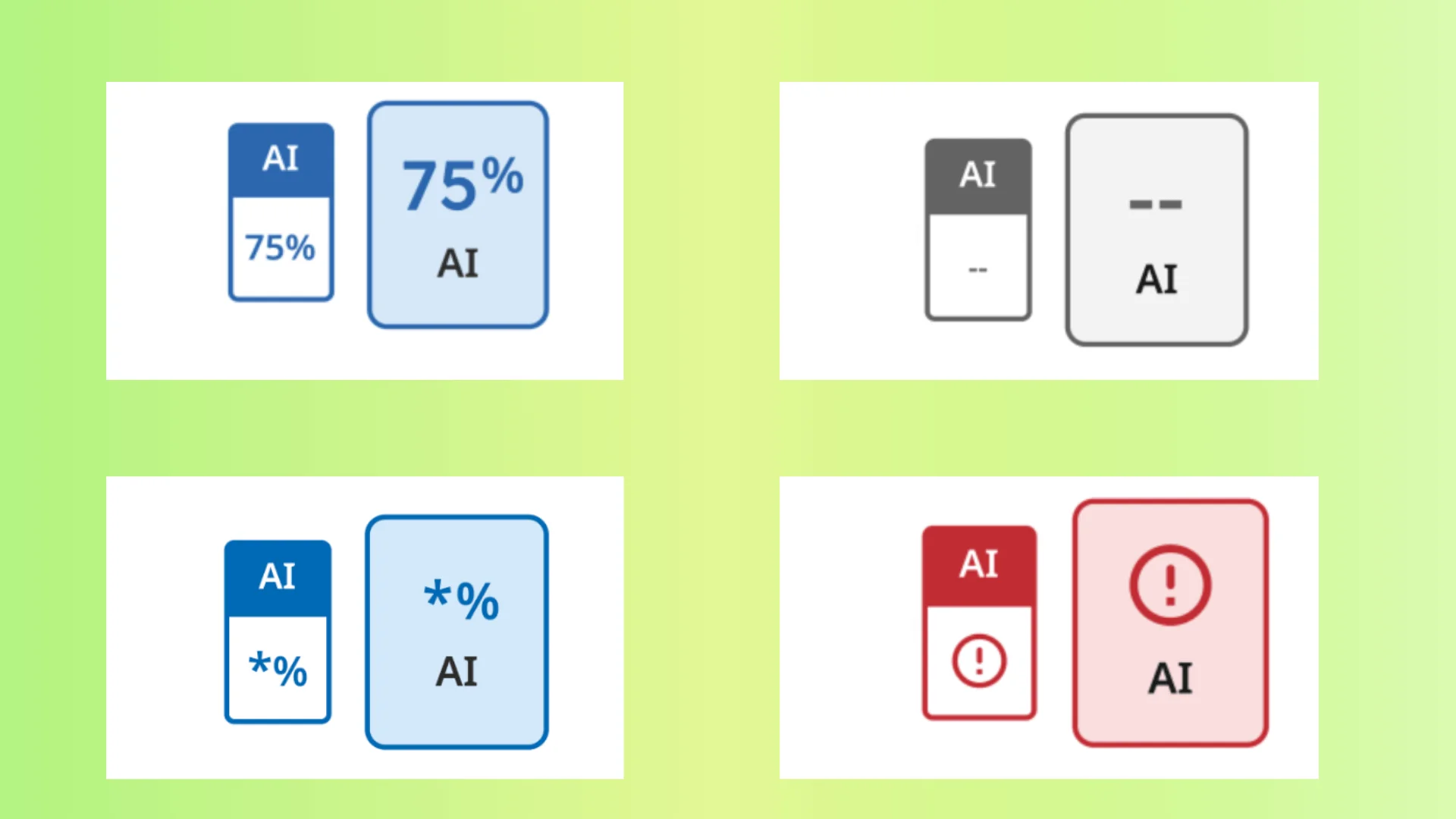
Gray (no percentage displayed, shown as “- -”): The submission could not be processed for AI writing, often because of file requirements, timing, or eligibility.
Error (!) indicator: Processing failed, so the report cannot be interpreted as an AI result.
Scores between 1% and 19% are marked with an asterisk (*%) because this range is less reliable. Turnitin does not show exact percentages or highlights there to reduce overinterpretation.
The AI report may also separate detected content into two categories:
AI-generated only: Text likely created directly by an AI language model. This content may be highlighted in cyan.
AI-paraphrased text: Text likely generated by AI and then rewritten with an AI paraphrasing tool. This content may be highlighted in purple.
So, What Is an Acceptable AI Score?
Like similarity scores, there is no universal good AI score. A 0% AI score means Turnitin did not detect likely AI writing in qualifying prose, but it does not describe your full writing process. A low or asterisked score should be read cautiously, not treated as a charge.
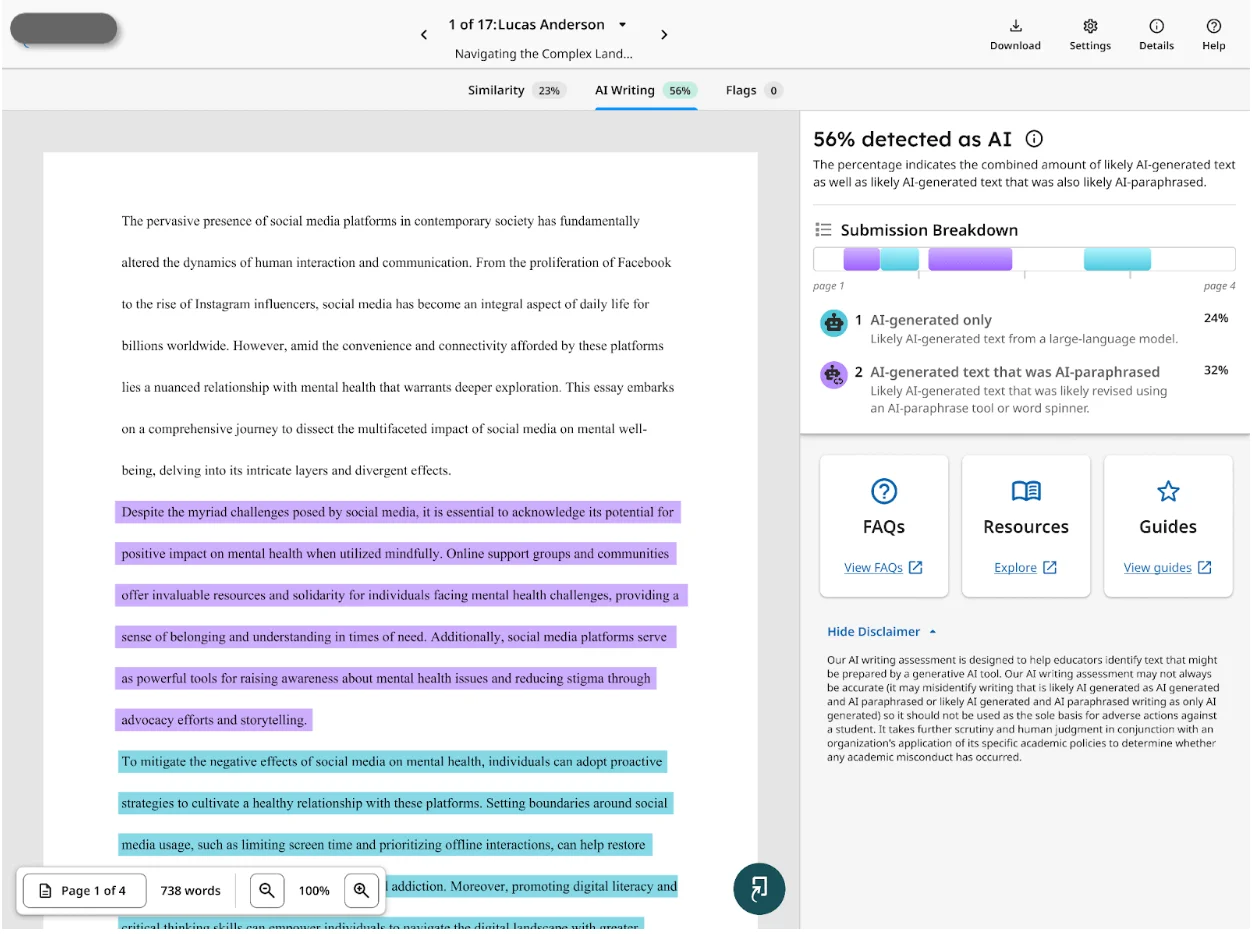
A high AI score above the main reporting threshold usually deserves review. Whether it becomes a problem depends on the assignment policy, disclosure rules, highlighted passages, and evidence of how the draft was produced.
How Do Teachers View a Good Turnitin Score?
When it comes to acceptable Turnitin similarity scores, opinions among educators vary widely. Based on discussions from platforms like Reddit, we can observe a range of perspectives on what constitutes a “good” or acceptable similarity percentage.
Many teachers emphasize that context matters more than the raw percentage. For example, one educator noted that Turnitin can highlight matches that don’t necessarily indicate plagiarism, such as properly cited quotations or common phrases. Another shared that low similarity scores do not guarantee originality, as some students with low percentages have still plagiarized, while others with high percentages might not have.
Several educators discourage setting strict percentage thresholds. Instead, they focus on what exactly Turnitin highlights — whether it’s a few common words or entire sentences and paragraphs copied without attribution. Some have pointed out that:
A low percentage (e.g., 5%) could still include problematic copying if exact sentences are copied without citation.
A higher percentage (e.g., 35-40%) might mostly include quoted material or properly cited sources, which is not plagiarism but could suggest weak original argumentation.
One common theme is that there is no universally “safe” percentage. Instead, instructors recommend reviewing the highlighted text carefully to judge whether plagiarism has occurred. Some suggest rules like “no more than half a sentence should be flagged as too similar,” while others say the focus should be on teaching students not to plagiarize at all, regardless of the similarity score.
In summary, the consensus is that the Turnitin score alone is an imperfect measure. Educators prefer to interpret the report with nuance, looking at the specific matches and how they relate to academic integrity.
FAQ:
Q: How do I get a 0% similarity on Turnitin?
A: You do not usually need 0%. Use your own wording, quote only when necessary, cite every source, and remember that references or required wording can create legitimate matches.
Q: What is an acceptable similarity percentage on Turnitin?
A: It depends on the assignment. Around 15-20% may be reasonable for some research papers, but the matched passages matter more than the percentage.
Q: Is 25% too high on Turnitin?
A: Not automatically. If the 25% comes from cited quotes, references, templates, or common phrases, it may be acceptable. Open the report and inspect the sources.
Q: Is a 40% Turnitin score very bad?
A: It needs close review. A 40% score can be fine for a reference-heavy paper if matches are cited, but it is risky when large blocks are uncited or concentrated in one source.
Q: Is a Turnitin score of 7 ideal?
A: It is low, but not automatically ideal. A 7% score can still include an uncited copied sentence, so even low reports should be checked.
Conclusion
A good Turnitin score is not one fixed number. For similarity, a good score is one where the matched text is cited, explainable, and appropriate for the assignment. For AI writing, a good result is one that aligns with your course policy and your actual drafting process. High scores are not automatically misconduct, and low scores are not automatic proof of quality. Review the highlighted passages, fix weak citations, keep drafts when needed, and write in a voice that reflects your own thinking.