



Is 36% Similarity on Turnitin Bad? Interpret & Improve

You opened your Turnitin report and saw 36% similarity. That number can look alarming, but it does not automatically mean your paper is plagiarized.
The real question is what makes up the 36%: quoted passages, references, common phrases, template text, or uncited source material.
This guide explains how to read a 36% Turnitin similarity score, when it may be acceptable, when it needs revision, and how to talk about the report with your instructor.
Is 36% Similarity on Turnitin Bad?
Start here: a Turnitin similarity score is not a plagiarism verdict. A 36% score usually means the paper deserves a closer look, not that the student automatically copied. The matched passages matter more than the color or percentage.
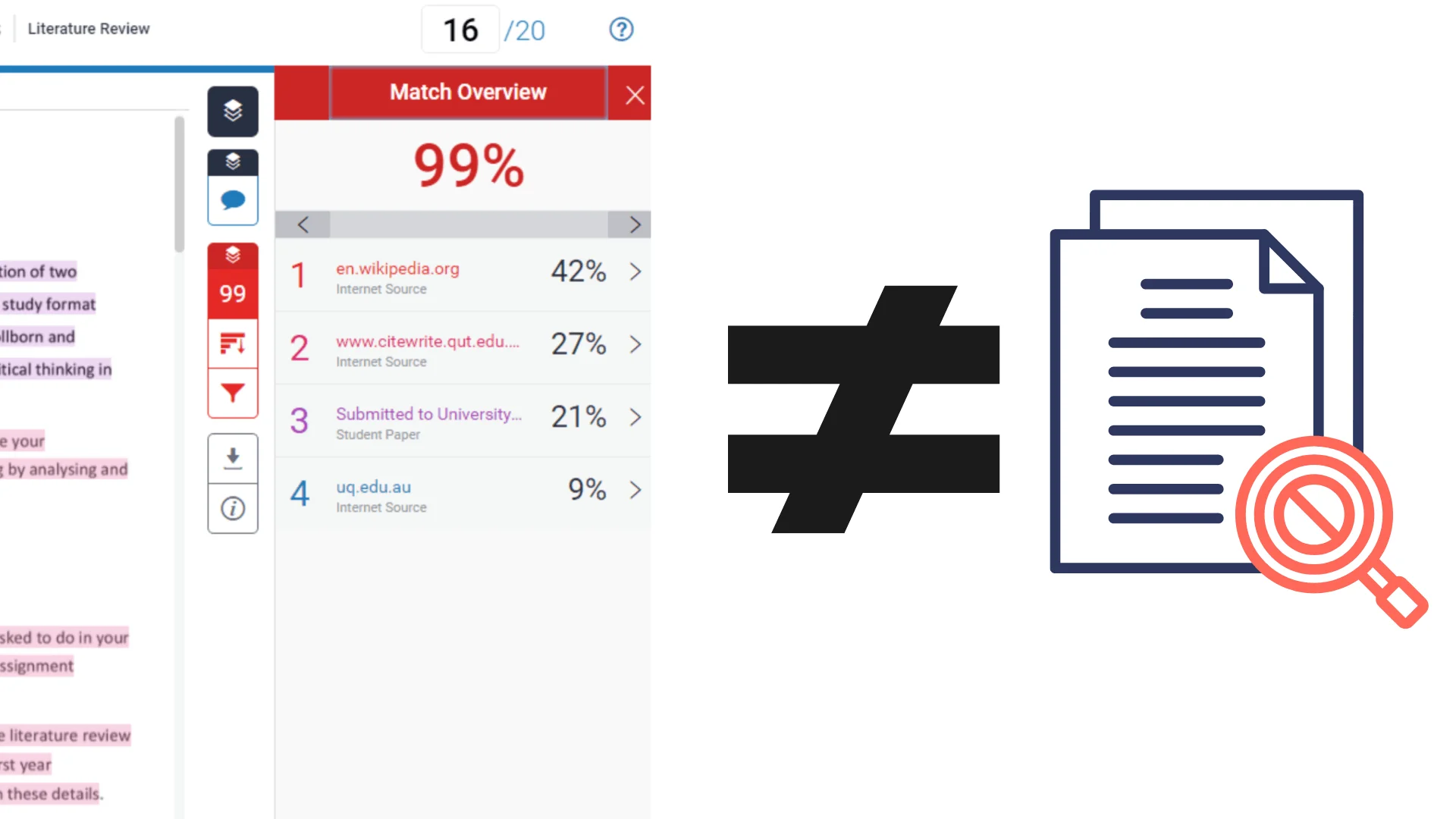
Turnitin Similarity Score ≠ Plagiarism Score
First, remember that Turnitin's similarity score is not the same as its AI score. Similarity measures matching text against Turnitin's source collections. It does not decide whether the match is properly quoted, correctly cited, required by a template, or actually a problem.
Turnitin also does not detect plagiarism automatically. It compares your submission with student papers, web pages, publications, and other indexed sources, then highlights overlap. A human reader still has to decide whether each match is acceptable under the assignment rules.
What Does 36% Really Mean?
A 36% score is a warning to inspect the report, not a final answer. The same percentage can mean very different things in different assignments.
If most matches are properly cited quotations, references, assignment prompts, or common phrases, the score may be reasonable.
If the matches are long source blocks without quotation marks or attribution, you should revise before submission.
If the score comes from a bibliography, template, title page, or required wording, your instructor may ignore those matches.
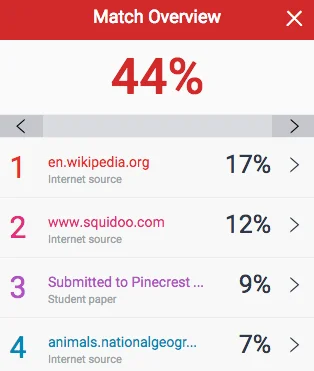
Open the full Similarity Report and ask what is highlighted. Are the matches cited? Are they unavoidable technical terms? Are they concentrated in one source? Those details matter more than the 36% label.
Color-Coding
Turnitin's color codes show how much matching text is in your paper.
If your school uses Feedback Studio:
Blue: No matching text (0%)
Green: 1–24% matching text
Yellow: 25–49% matching text
Orange: 50–74% matching text
Red: 75–100% matching text
If your school uses SimCheck or "My Files" interface:
Green: 0% matching text
Blue: 1–24% matching text
Yellow: 25–49% matching text
Orange:50–74% matching text
Red: 75–100% matching text
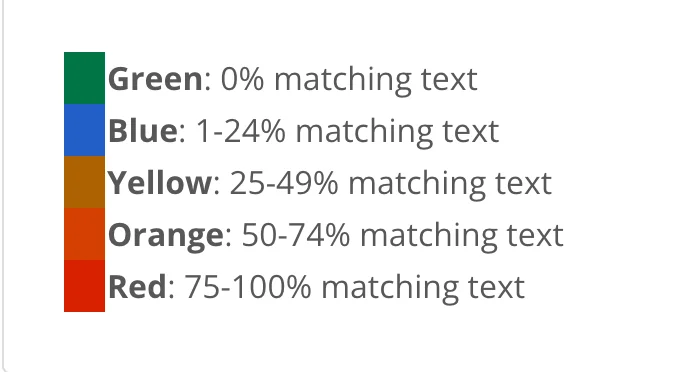
So, yes—36% falls into the yellow range, which may prompt a closer look, but it’s not automatically bad. It just signals that there's a moderate amount of overlap.
Is 30%, 35%, 39% Acceptable?
You’ve probably seen students or teachers ask:
“Is 30% similarity too much?”
“Is 35% bad?”
“Is 39% acceptable?”
……
There’s no fixed rule of a good Turnitin score. It always depends on what kind of content is being flagged and what the assignment requires. For example:
A literature review might naturally have more matches due to citations.
A personal reflection paper should be mostly original.
A group project might repeat shared language from other group members’ work.
Why Did I Get a 0% or 100% Similarity Score?
When you see a 0% or 100% similarity score on Turnitin, it might feel like something went wrong — but it’s not always as simple as “good” or “bad.” There are real, often technical reasons behind these extremes.
🔵 Why You Might See a 0% Score
Getting a 0% doesn’t always mean your work has no similarities at all. In fact, in large papers, Turnitin may find a few matches but round the percentage down to 0%. That’s why it’s still important to check the report, even when you see a perfect-looking score.
🔴 Why You Might See a 100% Score
If you submitted your final draft after already uploading an earlier version to Turnitin — especially to a private repository — the system might detect the new one as an exact duplicate. That can result in a 100% similarity score, even though it’s your own work. To avoid this, it’s best to only submit your final version to the official repository, unless your instructor says otherwise.
Another case? If someone else submits your paper before you do, the system thinks you’re the one copying. For example, imagine you send your essay to a classmate to check for feedback, and they submit it first (either on purpose or by mistake). When you submit later, Turnitin sees a match and flags your work as fully copied — even though it’s yours.
How Turnitin Identifies Collusion Among Students
Collusion is usually flagged when one student’s work matches another student’s—either on the same assignment or from earlier submissions at the same school.
Turnitin can’t automatically tell who copied from whom. But when two students submit similar or identical papers, the similarity score usually spikes—drawing the instructor’s attention.
Here’s a typical example:
Student A gets a copy of Student B’s paper and submits it first.
Student B submits their original paper a few days later.
Turnitin compares B’s work to A’s and flags B’s version as 100% similar, because it matches what A submitted earlier.
At first glance, it looks like B copied A. But of course, that’s not always the full story.
This is where teachers and context matter. When something looks suspicious, instructors might dig deeper by checking:
Submission times
Writing style and tone
Draft history or version control
Any signs of communication or sharing
If Student B can show they wrote the paper first—using dated drafts, notes, or revision history—they likely won’t be penalized. Student A, on the other hand, may be flagged for plagiarism.
How to Lower Your Turnitin Similarity Score and Avoid Plagiarism
The truth is that there is no universal correct percentage for a Turnitin similarity score. A lab report, literature review, legal memo, or reference-heavy paper may naturally show more overlap than a personal reflection. What matters is how the matching text appears.
Before you submit, do this:
📘 Check your syllabus or ask your instructor whether your course has a target range.
📚 Cite every source you use, including quotations, paraphrases, statistics, and borrowed ideas.
🧠 Use your own explanation around every source.
What if my similarity score is too high?
If Turnitin shows a high percentage, first find the biggest matches. A few large matches are usually more important than many tiny common phrases. Then revise the parts that rely too heavily on source wording.
✍️ Paraphrase or summarize more instead of leaning on long quotations.
🧱 Add your own analysis and original thinking after each source point.
✅ Double-check citations because paraphrased ideas still need credit.
What if my similarity score is too low?
A very low score is not automatically better. If the assignment expects research, a 0% report may mean you used too few sources or that the matches were excluded from the report settings.
To fix that:
🔍 Incorporate relevant sources where evidence would strengthen your claims.
💬 Use quotations or paraphrases only where they add value, and cite them.
🧩 Blend source material with your own explanation.
What if large sections come from one source?
A high match from one source deserves close review. Even if the source is cited, too much borrowed wording can make your paper feel like a summary instead of your own argument.
Try this:
✂️ Trim long quotations and keep only the wording you truly need.
🧾 Explain why the source matters and connect it to your claim.
💭 Add your own analysis so the paragraph is not just borrowed evidence.
What if most of my paper is just my own words?
That can be fine for a reflection or creative assignment, but research papers usually need evidence. If your assignment requires sources, then:
📌 Support claims with facts, examples, or expert views.
📖 Use research strategically where it strengthens your point.
🔗 Cite sources properly so the low score does not hide weak evidence.
What if I still need help?
Talk to your teacher or professor. They may see more report detail than you do, and they can explain how your course interprets similarity. Before the conversation:
📄 Bring your paper and any Turnitin report view available to you.
📝 Mark the matches you do not understand.
🧩 Ask which parts should be quoted, paraphrased, cited, or rewritten.
3 Ways to Get a Turnitin Similarity Score Before Submitting
While Turnitin itself doesn’t offer a public pre-check tool, there are a few smart ways to preview your similarity score—before hitting submit for real.
Option 1: Check if Your School Allows Draft Submissions
Some schools or instructors allow multiple submissions before the deadline. If that option exists, you can:
Upload a draft version of your paper
Review the Similarity Report and the highlighted sources
Revise citations, quotes, and paraphrases before submitting the final version
📝 Heads up: after some resubmissions, Turnitin may enforce a 24-hour delay before showing a new report.
Option 2: Ask Your Instructor Directly
If there is no draft submission option, ask early and politely:
“Can I submit a draft to Turnitin to review similarity before the final deadline?”
Many instructors appreciate proactive questions, especially when your goal is to learn citation expectations and revise before the final upload.
Option 3: Use a Trusted Similarity Checker
Some tools offer similarity checks before submission. They can help you notice missing citations, but they are not the same as your school's official Turnitin report. Keep this in mind:
❌ Many do not use Turnitin's full comparison database, so the score may differ
⚠️ Some tools store uploaded papers, which can create privacy or future-matching concerns
✅ If you try one, choose a tool with clear storage and privacy policies
Final Thoughts: Is 36% Turnitin Similarity Bad?
Not automatically.
A 36% Turnitin similarity score can be acceptable when the matches come from properly cited quotations, references, common wording, or required template language. It becomes a problem when the overlap is uncited, concentrated in one source, or copied in long blocks. The number alone does not prove plagiarism; context is key.
Review the report carefully, revise weak matches, and ask your instructor if the assignment has a target range. The goal is not zero similarity. The goal is honest, well-supported writing in your own voice.